
With over 300,000 newly registered domains appearing every 24 hours, the window between a malicious registration and a live phishing campaign has shrunk to minutes. You likely recognize the frustration of high latency in domain discovery and the excessive noise generated by raw feeds that lack technical context. Managing these disparate data sources within existing SIEM or SOAR workflows often feels like a manual uphill battle against a highly automated adversary.
Implementing a dedicated NRD API for security teams transforms this overwhelming stream of data into a clinical, high-fidelity asset. This article explains how to integrate real-time newly registered domain data into your security stack to identify and neutralize brand impersonation threats before they scale. We'll examine the technical requirements for automated look-alike detection and the specific ingestion processes that reduce your mean time to detect (MTTD) for brand-related risks. By moving from reactive searching to proactive reconnaissance, your team can operate with the precision and speed required by the modern threat landscape.
Key Takeaways
- Programmatic access to newly registered domain data is critical for identifying phishing infrastructure during the reconnaissance phase.
- Performance metrics such as data latency and throughput determine the effectiveness of an NRD API for security teams in real-time environments.
- Commercial feeds provide significant advantages over open-source tools by filtering benign registrations and reducing the burden of false positives.
- Automated ingestion into SIEM and SOAR platforms allows for seamless enrichment of domain data with DNS records and IP reputation.
- High-fidelity intelligence feeds enable security operations to move beyond manual monitoring toward automated, clinical brand protection.
The Strategic Role of NRD APIs in Modern Security Operations
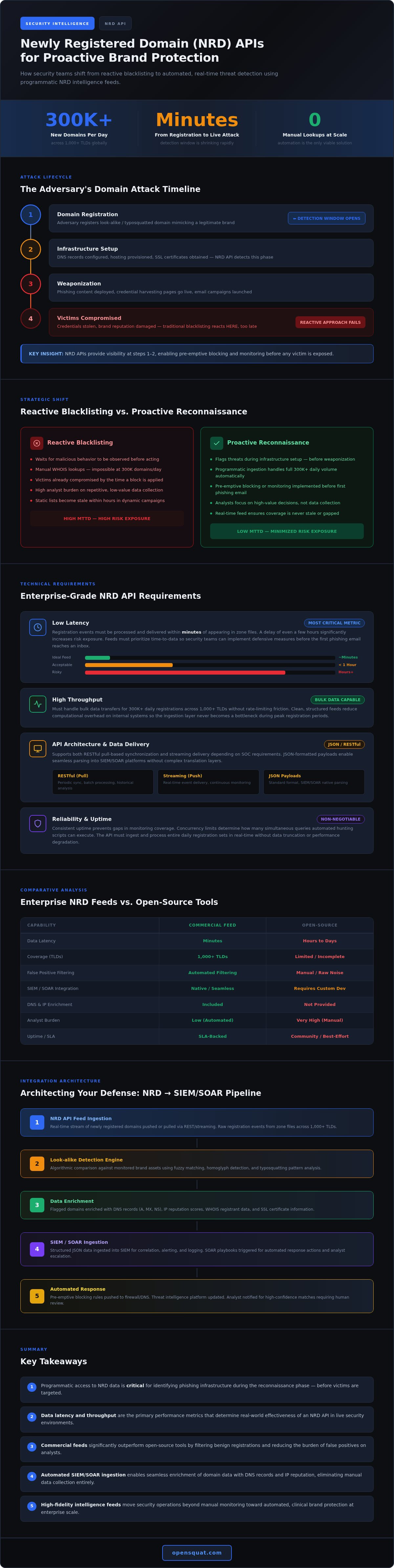
An NRD API for security teams is a programmatic interface designed to deliver structured data on newly registered domains (NRDs) directly into a security stack. Unlike static lists or manual lookups, this API provides a continuous stream of raw intelligence. It serves as the primary input for automated threat hunting. Security operations have historically relied on reactive blacklisting. This method waits for a domain to exhibit malicious behavior before blocking it. By then, the damage is often done. Shifting to proactive reconnaissance allows teams to identify potential threats during the infrastructure setup phase.
From Reconnaissance to Detection
Adversaries follow a predictable lifecycle when preparing an attack. They register domains that mimic legitimate brands, often using techniques like openSquat: Commercial API Access for Proactive Brand Protection, to deceive users. This registration event is the first visible indicator of a pending campaign. There is a critical window of opportunity between the moment a domain is registered and the moment it's weaponized with phishing content. Detecting these domains early reduces the detection gap significantly. By monitoring NRD feeds, security teams can flag suspicious registrations before they're used in live email campaigns or credential harvesting sites. This early visibility is essential for neutralizing brand impersonation threats in real-time.
The Limitations of Manual Domain Monitoring
Scale is the primary adversary of the manual security analyst. Over 300,000 newly registered domains appear daily across more than 1,000 Top-Level Domains (TLDs). Attempting to process this volume through manual WHOIS lookups or individual web searches is mathematically impossible for an enterprise SOC. Manual processes lack the speed required to keep pace with automated registration scripts. An NRD API for security teams eliminates this bottleneck by enabling programmatic ingestion. Instead of analysts searching for threats, the data is pushed directly into SIEM or SOAR platforms. This automation ensures that high-fidelity data is available for algorithmic analysis immediately. It allows human experts to focus on high-value decision-making rather than data collection.
Technical Requirements for Enterprise-Grade NRD APIs
Low latency is the most critical metric for an NRD API for security teams. If an adversary registers a domain at 08:00 UTC, your security stack needs that data before the first phishing email reaches an inbox. A delay of even a few hours significantly increases risk exposure. High-fidelity feeds prioritize time-to-data, ensuring that registration events are processed and delivered within minutes of appearing in zone files. This speed allows for the immediate implementation of defensive measures, such as pre-emptive blocking or targeted monitoring of specific assets.
High throughput is equally essential for enterprise environments. The global registration volume exceeds 300,000 domains daily across more than 1,000 TLDs. An effective API must handle bulk data transfers without rate-limiting friction. It should allow for the ingestion of massive datasets while maintaining data fidelity. A clean, structured feed reduces the computational overhead on your internal systems. It ensures that your ingestion layer doesn't become a bottleneck during peak registration periods.
API Architecture and Data Delivery
The choice between RESTful and streaming delivery depends on your specific SOC requirements. RESTful APIs provide a reliable, pull-based method for periodic synchronization with threat intelligence platforms. This architecture is well-suited for batch processing and historical data analysis. JSON-formatted payloads are the standard for modern security tools. They enable seamless parsing into SIEM and SOAR platforms without complex translation layers. A consistent schema and clear documentation are vital for engineers. They ensure that integration is straightforward and that future API updates don't break existing automated workflows.
Scalability and Performance Metrics
Reliability is non-negotiable when an API is integrated into mission-critical workflows. Uptime must remain consistent to prevent gaps in your monitoring coverage. Concurrency limits also play a vital role in performance. They determine how many simultaneous queries your automated hunting scripts can execute during a deep-dive investigation. High-throughput NRD access for security teams is defined as the capability to programmatically ingest and process entire daily registration sets in real-time without encountering data truncation or performance degradation.
Advanced filtering capabilities allow teams to isolate high-risk patterns programmatically. You can target specific TLDs known for malicious activity or apply keyword-based filters to detect brand impersonation. This clinical approach to data ingestion helps reduce the noise floor and minimizes false positives. For organizations moving beyond basic detection, commercial API access provides the technical rigor and scalability required for professional brand protection. These features transform raw registration data into an actionable instrument for proactive defense.
Enterprise NRD Feeds vs. Open-Source Tools: A Comparative Analysis
Community-maintained tools serve as an excellent entry point for security research. However, enterprise operations require a level of reliability that open-source lists cannot provide. The primary differentiator is latency. While community lists often update on a 24-hour cycle, an NRD API for security teams delivers data as soon as it is processed from registry zone files. This real-time access is the difference between blocking a domain during setup and responding after a breach. Commercial feeds also address the "noise" factor. They utilize algorithmic filtering to remove benign registrations, such as known safe CDNs or parked domains, ensuring your team focuses only on high-risk assets.
When to Upgrade from Community Tools
Local processing of bulk domain data presents significant infrastructure challenges. Monitoring over 300,000 daily registrations requires substantial compute resources and storage. As your monitoring scope expands to over 1,000 TLDs, the risk of data gaps in non-commercial feeds increases. Community tools lack SLAs. If a feed fails or a schema changes without notice, your automated workflows stop functioning immediately. A cost-benefit analysis often reveals that the internal expense of maintaining a custom ingestion and normalization engine exceeds the price of a professional API subscription. Professional feeds provide the stability required for mission-critical security architectures.
The openSquat Enterprise Advantage
Transitioning from the openSquat open-source tool to commercial API access represents a move toward clinical precision. While the open-source engine is trusted by over 900 security researchers on GitHub, the enterprise service provides the high-throughput capabilities needed for global brand surveillance. You gain access to historical context that isn't available in standard daily lists. This allows for deeper investigation into domain ownership patterns and infrastructure reuse. The addition of an enterprise-grade brand monitoring dashboard also bridges the gap between technical analysts and non-technical stakeholders. It provides a visual, high-signal overview of the threat landscape, allowing for clear reporting on proactive defense metrics without the need for manual data manipulation.
Architecting Your Defense: Integrating NRD Data into SOAR and SIEM
The ingestion layer serves as the clinical gateway between external domain intelligence and your internal data lake. Integrating an NRD API for security teams into a SOAR platform requires a structured approach to ensure data remains actionable and structured. Automation scripts should be configured to pull data at regular intervals, ensuring the local repository stays synchronized with the global registration stream. This programmatic ingestion eliminates the manual effort of data collection, allowing the system to move directly to the enrichment and analysis phases.
Enrichment workflows add necessary context to raw domain data. Once a new registration is ingested, your playbooks should automatically query DNS records and check IP reputation against established threat feeds. Combining NRD data with these external variables allows for the creation of high-confidence alerts. Alerting logic must be tuned with specific thresholds to minimize noise. For example, a trigger might only fire if a domain matches a specific keyword pattern and lacks a valid MX record, indicating it's likely being reserved for a future phishing campaign. High-confidence alerts then flow into case management systems, where they initiate pre-defined response actions.
Automation Patterns for Threat Hunters
Security engineers often use Python or Go to build custom surveillance scripts that interact with the API. These scripts apply distance algorithms, such as Levenshtein distance, to identify typosquatting attempts programmatically. By calculating the edit distance between your core brand and newly registered strings, you can flag suspicious domains with mathematical precision. Additionally, your automation should handle Punycode conversion. This allows the system to detect homograph attacks where Internationalized Domain Names (IDNs) are used to mimic ASCII characters. These automated checks ensure that look-alike domains are identified long before they're used in live attacks.
SIEM Integration Strategies
Normalizing NRD data is essential for effective ingestion into platforms like Splunk, Sentinel, or Elastic. You must map API fields to your SIEM's internal schema to enable efficient searching and correlation. A powerful strategy involves correlating new registrations with your internal DNS query logs. If an internal host attempts to resolve a domain that was registered within the last 24 hours, the SIEM should escalate the event immediately. Visualizing these risks through integrated dashboards provides a high-signal overview of brand-related threats. For teams seeking to build these advanced integrations, commercial API access provides the high-throughput, structured data required for enterprise-grade automation.
OpenSquat: Commercial API Access for Proactive Brand Protection
openSquat delivers high-fidelity NRD feeds designed for clinical security precision. While the open-source version provides a robust detection engine, the commercial service is engineered for the rigorous demands of enterprise security operations. It functions as a specialized instrument for experts who require reliable, structured data without the maintenance overhead of community tools. The commercial NRD API for security teams provides the high-throughput capabilities necessary to process global registration data in real-time. This ensures that your defensive perimeter is informed by the most current infrastructure changes across the domain landscape.
Integration is designed to be seamless. The API fits directly into existing brand monitoring and SOC workflows, acting as a silent, vigilant safeguard in the background. It provides the technical rigor needed to move from general awareness to targeted reconnaissance. By positioning openSquat as a technical partner, security teams gain access to a tool built on the principles of transparency and data-driven results. It avoids the hyperbole of black-box platforms in favor of providing raw, actionable intelligence that respects the proficiency of the user.
Enterprise Threat Intelligence Feeds
Security teams can access curated lists of newly registered domains that include specific malicious intent markers. These markers identify infrastructure commonly associated with typosquatting, homograph attacks, and brand impersonation. This isn't a generic data dump. It's a high-signal feed that prioritizes quality over raw volume. You can leverage the centralized brand monitoring dashboard for proactive analysis, allowing for a visual overview of emerging risks. This dashboard enables analysts to track registration trends and infrastructure reuse patterns efficiently. openSquat maintains technical honesty by delivering verifiable data, ensuring that every alert is backed by clinical evidence rather than opaque scoring systems.
Getting Started with the openSquat API
Modular pricing plans are designed to support scalable security deployments, from focused research teams to global enterprise SOCs. These plans allow you to align your data ingestion costs with your actual monitoring requirements. Every tier provides the same commitment to data fidelity and low latency. Comprehensive documentation is available to ensure rapid API integration, allowing your engineers to build automated surveillance scripts in hours rather than weeks. The system is built for stability, ensuring that your mission-critical workflows remain uninterrupted as you scale your brand protection efforts. To secure your infrastructure and begin proactive monitoring, Explore openSquat commercial API access and integrate high-fidelity domain intelligence into your security stack today.
Advancing Toward Clinical Threat Reconnaissance
Effective brand protection requires moving beyond reactive blocking. By integrating high-fidelity domain data directly into your security stack, you eliminate the latency that adversaries exploit during infrastructure setup. Real-time ingestion and automated analysis transform raw registration events into actionable intelligence, allowing your SOC to operate with mathematical precision. This transition from manual searching to programmatic reconnaissance is the key to reducing your mean time to detect (MTTD) for impersonation threats.
Implementing a dedicated NRD API for security teams ensures that your monitoring scope covers over 1,000 TLDs without the noise of benign registrations. This technical rigor is essential for maintaining a proactive defensive posture in a landscape where registration volumes exceed 300,000 domains daily. Specialized security experts worldwide trust these modular, high-throughput feeds for precise integration and reliable results. Relying on a clinical instrument rather than generic data sources allows your team to focus on high-value decision-making.
Secure your organization by leveraging a tool designed for professionals. Access the openSquat Commercial API for Enterprise Security to deploy low-latency domain intelligence across your existing workflows. Your team's readiness is the most effective safeguard against emerging threats.
Frequently Asked Questions
What is an NRD API and how does it help security teams?
An NRD API for security teams is a programmatic interface providing structured data on newly registered domains. It enables the automated discovery of infrastructure intended for phishing or brand impersonation. By ingesting this data early, teams can identify threats during the initial reconnaissance phase. This proactive approach significantly reduces the detection gap compared to reactive blacklisting methods. It serves as a clinical instrument for experts who require high-fidelity intelligence feeds for automated hunting.
How frequently is the newly registered domain data updated?
The system monitors over 300,000 domains daily across more than 1,000 TLDs. Updates are continuous as the platform processes new registry zone files. For enterprise users, this ensures that registration events are available for analysis shortly after they appear. Maintaining this low-latency delivery is critical for neutralizing threats before they reach the weaponization stage. It allows teams to block malicious infrastructure before it is used in a live campaign.
Can I integrate the openSquat API into my existing SIEM or SOAR platform?
Yes, the API is designed for seamless integration into platforms like Splunk, Microsoft Sentinel, and Elastic. It delivers payloads in structured JSON format, which simplifies the normalization process. Security engineers can use Python or Go to build automated ingestion layers. This allows NRD data to be correlated with internal logs or used to trigger automated enrichment playbooks within a SOAR environment. It supports high-throughput demands for global enterprise operations.
What is the difference between the open-source openSquat tool and the commercial API?
The open-source tool provides a detection engine trusted by over 900 researchers on GitHub. However, the commercial API offers high-throughput access and enterprise-grade reliability. While the community version is suitable for local research, the commercial service provides up to 30 days of historical data and higher query quotas. It also includes an enterprise-grade brand monitoring dashboard for visual analysis, which is not available in the standalone open-source engine.
Does the NRD API provide WHOIS data for new registrations?
The primary function of the API is to deliver registration events and domain strings in JSON or CSV formats. While it focuses on the identification of newly registered domains, enrichment workflows often combine this feed with external WHOIS lookups. Security teams typically use the API to flag suspicious domains first, then programmatically query WHOIS or DNS records. This modular approach ensures that your ingestion layer remains fast and focused on discovery.
How does an NRD API help in detecting typosquatting and homograph attacks?
An NRD API for security teams identifies domains that mimic legitimate brands using algorithms like Levenshtein distance. It detects variations created by character substitution or addition. For homograph attacks, the API processes Internationalized Domain Names (IDNs) and converts them to Punycode. This allows the system to flag domains that appear identical to a brand but use non-ASCII characters to deceive users. It provides the mathematical precision required for automated detection.
What volume of domain data can the enterprise API handle daily?
The platform monitors over 300,000 newly registered domains every day across more than 1,000 TLDs. The enterprise API is architected for high-throughput environments, allowing security teams to ingest these massive datasets without rate-limiting friction. Depending on the specific business plan, users can access up to 10,000 queries per month or custom quotas in the Enterprise tier. This ensures the ingestion layer remains responsive during peak registration periods and large-scale threat hunting.
Is there a limit to the number of keywords I can monitor via the API?
Limits depend on the selected commercial plan rather than a fixed keyword count. The Business plan allows for 10,000 API queries per month, while the Enterprise plan offers custom quotas tailored to large-scale operations. Monitoring capacity is defined by your query volume, providing the flexibility to monitor an unlimited number of brand assets. This modular approach allows security teams to scale their surveillance efforts based on the specific threat landscape they need to protect.
