
In June 2026, security researchers identified over 2.0 million newly registered domains with likely malicious intent. This volume represents a significant portion of the 300,000 domains registered daily, making newly registered domain feeds a critical but often overwhelming resource for enterprise defenders. You likely recognize that raw domain lists frequently generate high false-positive rates, which can stall your incident response rather than accelerate it. Managing this data requires more than just collection; it demands a clinical approach to ingestion and filtering.
This guide demonstrates how to evaluate and operationalize these feeds to proactively detect phishing and brand impersonation infrastructure. You'll learn to distinguish between low-signal noise and high-fidelity intelligence that's ready for SIEM or SOAR ingestion. We'll outline the technical requirements for reducing time-to-detection and explain how to automate brand monitoring workflows. By moving from manual review to programmatic analysis, your team can secure the perimeter against look-alike domains before the first phishing email is even sent. We will cover everything from initial data ingestion to the final stages of automated alert enrichment.
Key Takeaways
- Identify the technical requirements for integrating newly registered domain feeds into your security stack to minimize time-to-detection.
- Transition from daily batch processing to real-time API ingestion to stay ahead of rapidly weaponized phishing infrastructure.
- Apply specific filtering criteria to separate high-signal malicious registrations from the noise of legitimate business launches.
- Build automated workflows that map monitored brand assets to live registration data for proactive impersonation detection.
- Scale your defense by moving beyond open-source tools to specialized brand monitoring dashboards and enterprise-grade intelligence.
What Are Newly Registered Domain (NRD) Feeds?
Newly registered domain feeds are clinical data streams that capture every new entry added to the global registry. These feeds function as a primary early warning system for enterprise security teams. In the 2026 threat landscape, threat actors rely on fresh infrastructure to bypass legacy reputation filters. By the time a domain appears on community blacklists, the malicious campaign is often already complete. The first 24 to 48 hours of a domain's existence are the most critical for security operations. This window represents the gap between registration and weaponization, where proactive detection is most effective.
There's a significant distinction between raw zone files and curated intelligence. Raw zone files are essentially bulk lists of all changes within a specific Top-Level Domain (TLD). They lack context and require heavy processing. High-signal feeds, however, provide the structured data necessary for immediate analysis, allowing teams to isolate suspicious patterns from the roughly 300,000 domains registered daily.
The Anatomy of a Domain Registration Feed
A standard feed entry includes the domain name, registrar information, and precise registration timestamps. Understanding the Domain Name System (DNS) hierarchy is essential for interpreting this data, especially as TLD diversity increases. While many security teams focus on .com or .net, malicious actors frequently utilize diverse ccTLDs (country-code TLDs) and new gTLDs to evade detection. Discovery mechanisms for these feeds typically rely on DNS telemetry or WHOIS database updates. Telemetry-based discovery is often faster, capturing domains as soon as they're queried, whereas database scraping provides deeper metadata for attribution.
Why Security Teams Monitor New Registrations
Monitoring new registrations allows for the proactive detection of typosquatting and look-alike domains. Analysts can set alerts for variations of their brand name, catching impersonation infrastructure before it's used in a live phishing attack. This is particularly vital for identifying "burner" domains. These are short-lived assets created for a single burst of activity, such as a malware distribution campaign or a targeted credential harvest.
Choosing high-quality newly registered domain feeds allows analysts to build a defensive perimeter that doesn't wait for an attack to land. Instead of reacting to an incident, teams can block or monitor traffic to suspicious domains based on their age and registration characteristics. This methodical approach transforms raw data into a functional safeguard, providing the high-fidelity signal required for modern SIEM and SOAR workflows.
Technical Mechanics of High-Fidelity NRD Data
High-fidelity data requires ingestion structures that support immediate, programmatic automation. JSON and CSV remain the industry standards for newly registered domain feeds because they facilitate seamless integration into existing security stacks. JSON offers the nested structure needed for complex metadata, while CSV provides a lightweight format for bulk processing and historical auditing. Handling the volume of 300,000 new registrations daily requires a pipeline capable of parsing and indexing data at scale without introducing latency. System architects must ensure that the ingestion layer can handle high-burst registration periods without dropping packets or delaying the delivery of critical alerts.
API vs. Bulk Download: Choosing the Right Delivery Method
Bulk downloads are effective for historical baseline creation and periodic threat hunting. They allow analysts to review large datasets to identify long-term registration trends or registrar shifts. However, relying solely on daily batches creates a significant defensive lag that attackers exploit. For real-time alerting, Commercial API Access is necessary to bridge the gap between registration and detection. APIs allow for programmatic queries that trigger security orchestrations immediately upon domain discovery. This matches the best security practice of minimizing dwell time through proactive monitoring. Enterprise-grade ingestion must account for rate limiting and ensure consistent throughput to avoid data gaps during peak registration periods, such as when major TLD zone files are updated.
Data Enrichment and Metadata
Raw lists of domain names are insufficient for modern risk assessment. High-fidelity feeds enrich the domain string with IP geolocation, nameserver reputation, and registrar data. Analyzing registrar patterns helps calculate risk scores; certain registrars are statistically more likely to host malicious infrastructure. Integrating WHOIS data, where available, allows analysts to identify registrant clusters and shared contact patterns. This historical context distinguishes a truly new registration from an expired domain that has been re-registered. Attackers frequently use re-registered domains to inherit existing domain reputation and bypass filters. By comparing current registration data against historical records, security teams can identify these "aged" domains that are being repurposed for malicious campaigns. This methodical enrichment transforms a simple list into actionable intelligence ready for SIEM or SOAR ingestion.
Evaluating Feed Quality: Signal vs. Noise
Volume is often mistaken for value in threat intelligence. While some providers emphasize the total number of records in their databases, raw size is a poor metric for defensive efficacy. Roughly 90% of daily registrations are irrelevant to specific brand protection or threat hunting workflows. These include parked domains, legitimate small business launches, and internal corporate infrastructure. High-signal newly registered domain feeds prioritize data relevance through clinical filtering. This process removes the noise of parked domains and focuses on assets that display malicious indicators, such as DGA (Domain Generation Algorithm) strings or typosquatted variations of high-value targets.
Reliable enterprise feeds must maintain strict data integrity. Inconsistent uptime or missing zone files create visibility gaps that attackers exploit. An effective feed requires a guaranteed Service Level Agreement (SLA) to ensure that the stream of intelligence remains uninterrupted. This reliability is the foundation of a proactive defense strategy. Without it, your automated detection pipelines are only as strong as the most recent successful data sync.
Key Metrics for Feed Evaluation
Evaluating a feed requires objective performance data. Detection lag is the most critical metric; it measures the time between a domain's registration and its appearance in the feed. A lag of several hours can be the difference between blocking a phishing site and responding to a data breach. The false positive rate is equally important. If the data flags a high percentage of benign domains, it creates alert fatigue. Finally, TLD breadth determines the feed's scope. A high-quality provider monitors hundreds of gTLDs and ccTLDs, ensuring that niche extensions used for "burner" infrastructure don't go unnoticed. Diversity in TLD coverage is essential for global brand protection.
The Cost of Processing Low-Quality Data
Ingesting unfiltered telemetry carries significant operational costs. SOC teams face a resource drain when investigating non-threats generated by low-fidelity data. Every false positive requires analyst time for triage and verification. Beyond human capital, there are tangible storage and compute costs associated with maintaining large, irrelevant datasets. Pre-filtered feeds, such as those provided by openSquat, reduce these overheads by delivering high-signal data. This methodical approach ensures that your security stack processes only the most actionable intelligence, maximizing the efficiency of your SIEM and SOAR platforms. High-signal data doesn't just improve detection; it optimizes the entire security lifecycle by focusing resources on confirmed risks.
Operationalizing NRD Feeds in Security Workflows
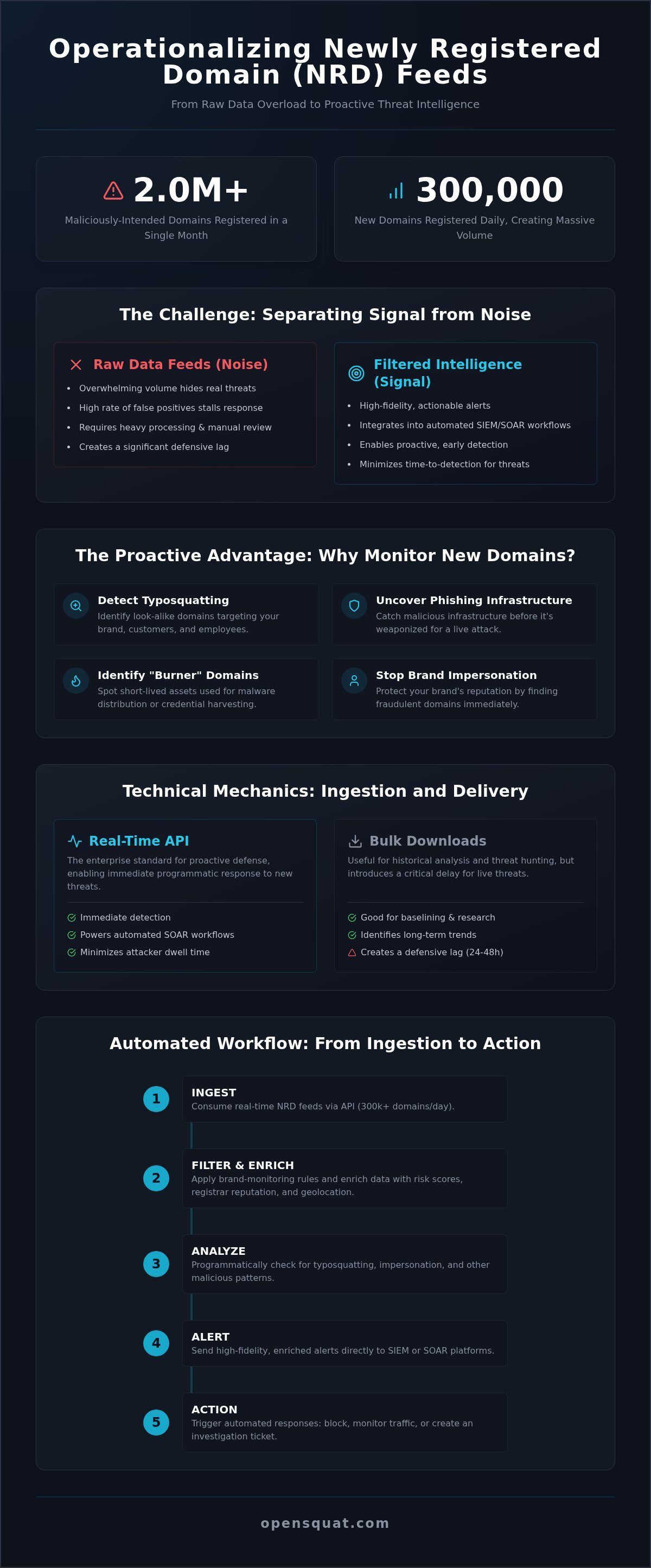
Operationalizing newly registered domain feeds requires a methodical transition from raw data ingestion to automated response. Manual monitoring is no longer a viable strategy for enterprise teams managing the 300,000+ domains registered daily. To build a functional safeguard, security architects must implement a four-step pipeline that prioritizes clinical efficiency and technical precision.
Step one involves establishing a comprehensive baseline of monitored keywords and brand assets. This includes primary trademarks, executive names, and internal service identifiers. Once the baseline is set, step two focuses on configuring automated ingestion. Utilizing Commercial API access ensures that this data flows directly into your security stack without manual intervention. In step three, analysts apply detection logic to identify look-alike and typosquatted domains. This often involves algorithmic checks for homoglyphs or Levenshtein distance variations. Finally, step four orchestrates response actions through SOAR playbooks. These playbooks can trigger immediate investigative tasks or defensive adjustments based on the risk score of the discovered domain.
SIEM and SOAR Integration Strategies
Integration with SIEM platforms allows for the creation of automated "watchlists." These lists monitor new registrations for matches against corporate keywords in real time. When a match occurs, the system enriches the incoming alert with metadata such as registrar reputation and registration timestamps. This enrichment facilitates faster triage by providing analysts with immediate context. For high-confidence malicious detections, SOAR playbooks can trigger automated DNS blocking at the enterprise gateway. This proactive stance effectively neutralizes phishing infrastructure before it can be weaponized against employees or customers. You can begin this process by integrating high-fidelity data via Commercial API access to ensure your pipelines receive the most relevant intelligence.
Brand Monitoring Dashboards
Centralizing domain discovery into a unified interface improves visibility across the entire threat landscape. A dedicated Brand Monitoring Dashboard allows security leaders to visualize registration trends and emerging threat clusters. Instead of reviewing disparate lists, teams can see a graphical representation of impersonation risks over time. This centralized view is essential for generating executive reports that quantify brand risk. These reports provide data-driven evidence of the scale and performance of your defensive measures. By moving from manual lookups to a programmatic dashboard, your team gains a knowledgeable and efficient technical partner that operates continuously in the background. This methodical approach ensures that no suspicious registration goes unanalyzed, maintaining a vigilant perimeter against evolving phishing campaigns.
Beyond Open Source: Enterprise Threat Intelligence with openSquat
The openSquat Open Source Tool serves as a foundational resource for the global security community, providing a transparent methodology for identifying suspicious domains. However, enterprise requirements for 2026 demand a more robust infrastructure that moves beyond community-driven scripts. Transitioning to commercial newly registered domain feeds provides the reliability and throughput necessary for global operations. This shift moves your defensive posture from individual, manual lookups to programmatic, large-scale intelligence ingestion. It's a move toward a knowledgeable and efficient technical partner that scales with your organization's needs.
Precision is our core value proposition. Many providers rely on marketing hyperbole to sell massive, unfiltered datasets that often lead to alert fatigue. We prioritize clinical data precision instead. This means delivering high-signal intelligence that identifies malicious registrations while minimizing the noise of benign activity. It's about providing a trusted instrument that functions with engineering rigor, ensuring that every alert your team receives is grounded in data-driven results.
Enterprise-Grade Features and Capabilities
The commercial offering includes high-fidelity feeds optimized for deep threat research and proactive defense. These feeds are designed for seamless integration into existing security ecosystems, supporting both JSON and CSV formats for immediate ingestion via Commercial API Access. Analysts gain access to advanced detection mechanisms that identify suspicious registration patterns before they evolve into active threats. This capability is essential for specialized teams that require functional utility and technical honesty over surface-level summaries. By leveraging these feeds, you ensure your SIEM and SOAR platforms receive only the most actionable telemetry.
Securing Your Brand for 2026 and Beyond
Proactive security is a technical requirement for modern brand protection. Continuous monitoring of newly registered domain feeds allows your team to maintain a vigilant stance against impersonation and phishing infrastructure. By utilizing the Brand Monitoring Dashboard, security leaders can centralize discovery and visualize emerging threat clusters. This dashboard transforms raw registration data into actionable insights for executive reporting and strategic planning, providing a clear view of your risk profile.
For organizations building bespoke internal security applications, the API provides the necessary hooks for custom orchestration and automated blocking. This allows for a level of technical precision that respects the user's proficiency and respects the reader's time. You can take the next step in your defensive strategy by choosing to request API access or a dashboard demo. Moving beyond open-source tools ensures your organization has the enterprise-grade reliability and authoritative expertise required to secure your digital perimeter in an increasingly complex threat environment.
Strengthening Your Defensive Perimeter for 2026
Securing an enterprise against modern phishing campaigns requires a transition from reactive blacklisting to proactive identification. The first 48 hours of a domain's life cycle are the most critical for identifying malicious intent. Effective defense relies on the clinical filtering of newly registered domain feeds to isolate high-signal threats from legitimate registrations. By automating this process through structured data ingestion and specialized monitoring, security teams can neutralize look-alike infrastructure before it impacts the organization.
Scaling these operations requires tools that prioritize technical precision and data integrity. Transitioning to commercial-grade intelligence ensures that your SIEM and SOAR platforms receive reliable, low-noise telemetry. It's a methodical approach that transforms a massive stream of raw data into a functional safeguard for your brand. This level of readiness is essential for maintaining a secure environment in an increasingly complex threat landscape.
Access Enterprise-Grade Newly Registered Domain Feeds to leverage our Commercial API for automated ingestion and a specialized brand monitoring dashboard trusted by global threat intelligence researchers. Maintaining a vigilant stance is the most effective way to secure your digital perimeter against evolving threats.
Frequently Asked Questions
How long is a domain considered "newly registered" in your feeds?
A domain is classified as newly registered in our feeds for the first 24 to 48 hours following its entry into the registry. This specific timeframe is critical for security operations because it represents the window where infrastructure is created but not yet fully weaponized. Our feeds prioritize this high-risk interval, providing the earliest possible detection signal before the domain's reputation is established or blacklisted by community-driven security filters.
What is the difference between a raw zone file and an NRD intelligence feed?
A raw zone file is an unformatted bulk list of all changes within a specific Top-Level Domain (TLD). In contrast, our newly registered domain feeds provide enriched intelligence that's been cleaned and structured for programmatic use. While zone files require heavy internal processing, our intelligence feeds include essential metadata and filtering to remove parked domains and legitimate business infrastructure, delivering high-signal data ready for immediate security analysis.
Can I integrate openSquat feeds directly into my SIEM like Splunk or Sentinel?
Yes, you can integrate openSquat feeds directly into enterprise SIEM and SOAR platforms such as Splunk, Microsoft Sentinel, or Palo Alto Cortex XSOAR. This is achieved through our Commercial API Access, which delivers data in standard JSON or CSV formats. These formats facilitate automated ingestion into watchlists and investigative playbooks, allowing your security stack to trigger defensive actions or enrich alerts with registration metadata without manual intervention.
How does openSquat identify malicious domains without offering takedown services?
Identification is performed through algorithmic analysis of registration patterns, including typosquatting detection and registrar reputation scoring. We focus on providing the high-fidelity intelligence necessary for your internal teams to identify malicious registrations. While we don't provide takedown services, our data enables your SOC to implement proactive blocking at the DNS or firewall layer. This clinical focus ensures we remain a specialized instrument for detection and brand monitoring.
What TLDs are covered in the newly registered domain feeds?
Our feeds cover over 1,000 TLDs, ensuring comprehensive visibility across the global registry landscape. This includes all major generic Top-Level Domains (gTLDs) and a wide array of country-code Top-Level Domains (ccTLDs). Coverage diversity is essential because threat actors frequently utilize niche or regional extensions to bypass legacy filters. Monitoring this breadth of TLDs ensures that "burner" infrastructure is captured regardless of the registry used for its creation.
Is there a limit to the number of keywords I can monitor in the dashboard?
The Brand Monitoring Dashboard is designed for enterprise scalability, allowing for the monitoring of extensive keyword lists. Security leaders can track primary trademarks, executive names, and internal service identifiers across the global registration stream. There aren't restrictive limits for enterprise users, as the system is built to handle the high-volume data requirements of global organizations. This ensures comprehensive coverage for brand impersonation risks without compromising system performance or detection speed.
How often is the newly registered domain list updated?
The update frequency depends on the specific tier of service. The community and Lite versions are updated daily at 06:00 UTC, providing a consistent batch of newly registered domain feeds. Enterprise-grade commercial tiers offer higher frequency updates to match the pace of rapid infrastructure weaponization. This methodical delivery ensures that your security operations center has access to the most current registration data available, minimizing the detection lag for new threats.
What is the advantage of the commercial API over the open-source tool?
The Commercial API provides programmatic automation and high-signal data that the open-source tool cannot match at scale. While the open-source tool is effective for research and testing, the API facilitates seamless integration into enterprise security ecosystems. It offers higher throughput, lower latency, and access to enriched metadata. This transforms the service from a manual lookup tool into a trusted instrument for continuous, automated brand monitoring and threat intelligence ingestion.
