
Over 300,000 new domains are registered every 24 hours, yet standard zone files frequently omit critical ccTLD data. This creates a significant visibility gap for security teams. You understand that bulk newly registered domain data is a raw material, not a finished intelligence product. Without a precise ingestion architecture, your SOC is likely buried under a high volume of false positives and fragmented lists that fail to integrate with existing workflows.
This technical guide explains how to architect a high-scale ingestion pipeline designed for the 2026 threat landscape. You'll learn to build a system that transforms raw registration logs into a clean, deduplicated feed for proactive threat detection. We will detail the logic required to identify brand impersonation automatically and demonstrate how to utilize commercial API access for seamless SIEM and SOAR integration. By following this modular framework, you can deploy a vigilant, automated safeguard that identifies malicious infrastructure before it launches. We will focus on the engineering rigor needed to move from raw data to actionable intelligence.
Key Takeaways
- Identify the weaponization window to detect malicious infrastructure before phishing campaigns or brand impersonation attacks launch.
- Eliminate the ccTLD blind spot by integrating enterprise feeds that provide visibility into country-code registries often missing from standard zone files.
- Build a scalable ingestion architecture to normalize and process bulk newly registered domain data at a volume exceeding 300,000 daily records.
- Prioritize low registration-to-ingestion latency to maintain a high signal-to-noise ratio and ensure your detection logic remains relevant.
- Streamline security workflows by transitioning from manual list management to automated commercial API integration and centralized monitoring dashboards.
The Strategic Value of Bulk Newly Registered Domain Data
Bulk NRD data represents the comprehensive daily telemetry of every new domain registration across the global namespace. It captures the precise moment an entity interacts with the Domain Name System (DNS) to claim a new identifier. This dataset serves as the raw material for advanced threat intelligence. It offers the earliest possible signal of intent, providing security researchers with a window into an adversary's preparatory stages. By processing this information at scale, organizations can move beyond simple observation into a state of professional readiness.
Proactive Discovery vs. Reactive Blocking
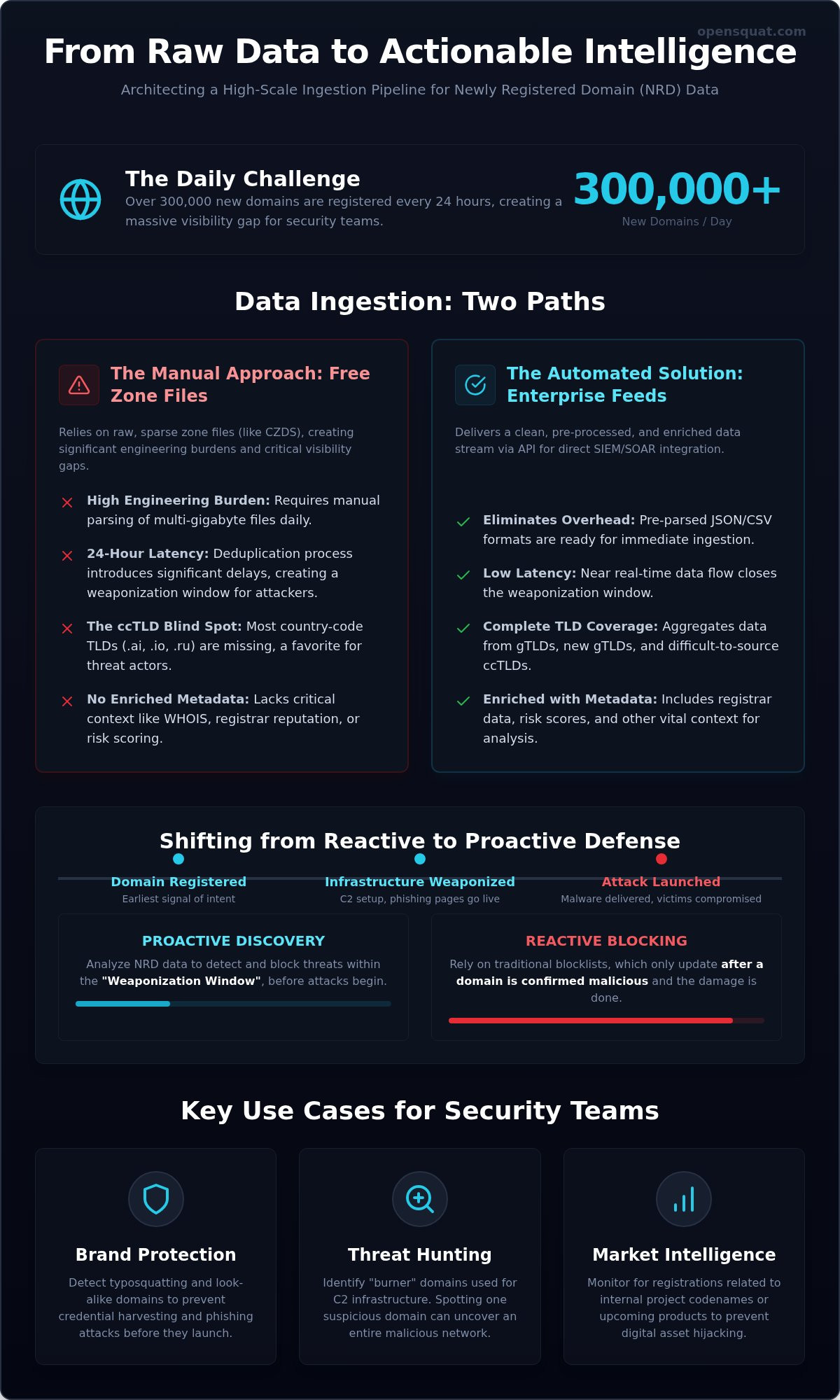
Standard security postures often rely on reactive blocklists. These lists only update after a domain is identified as malicious, which usually occurs after the initial attack phase. Relying on this method means your SOC is always one step behind the threat actor. In contrast, bulk newly registered domain data allows for proactive discovery. You can analyze registration patterns, registrar choices, and naming conventions to flag suspicious activity before the infrastructure goes live. The weaponization window is the critical period between a domain's initial registration and its active deployment in a cyberattack. Reducing the time to detection within this window is the primary objective of a high-scale ingestion pipeline. It allows you to neutralize threats before they reach the inbox or the endpoint.
Key Use Cases for Security Teams
Security teams utilize this telemetry for three core operational objectives. First, brand protection relies on detecting typosquatting and look-alike domains. Identifying a registration that mimics a corporate domain allows for mitigation before the site is used for credential harvesting. Second, threat hunting teams use NRD feeds to identify "burner" domains. These are often used as Command and Control (C2) nodes. Because adversaries frequently register domains in clusters, spotting a single suspicious registration can expose an entire malicious network. Third, market intelligence involves monitoring for specific keywords. This includes tracking registrations related to internal project codenames or upcoming product launches to prevent digital asset hijacking. This methodical approach ensures that security resources are directed toward the most probable vectors of attack.
Data Sources: CZDS vs. Enterprise-Grade NRD Feeds
Selecting a data source is the first architectural decision in building a detection pipeline. For many, the Centralized Zone Data Service (CZDS) is the starting point. It provides a centralized gateway to request access to zone files for generic Top-Level Domains (gTLDs). While the service is free, the technical cost of ingestion is high. You must manage individual registrar approvals and maintain infrastructure capable of downloading and processing multi-gigabyte compressed files every 24 hours. This creates a significant engineering burden that often outweighs the initial cost savings.
The Limitations of Free Zone Files
Raw zone files are intentionally sparse. They contain DNS resource records but lack critical context like WHOIS information or registration timestamps. When you ingest bulk newly registered domain data from these sources, you're responsible for the heavy lifting of deduplication. You have to compare today's snapshot against yesterday's to identify which domains are actually new. This process is computationally expensive and introduces a 24-hour latency that threat actors exploit.
Perhaps the most critical weakness is the "ccTLD Blind Spot." Most country-code TLDs (.ai, .io, .cn, .ru) do not participate in CZDS. Threat actors favor these extensions because they are harder for standard security tools to monitor. This visibility gap is frequently used for large-scale fraud and brand impersonation. Without a mechanism to capture these registries, your threat intelligence remains incomplete and reactive.
The Enterprise Feed Advantage
Enterprise-grade feeds eliminate the infrastructure overhead of manual parsing. These services aggregate data from gTLDs, new gTLDs, and difficult-to-source ccTLDs into a single, normalized stream. Instead of managing raw zone files, you receive pre-parsed JSON or CSV formats ready for immediate ingestion into your SIEM or SOAR. This clinical efficiency allows your team to focus on analysis rather than data engineering.
Modern feeds also include integrated metadata that raw files lack. This includes registrar reputation scoring and registration risk levels based on algorithmic analysis of the domain string. By utilizing Commercial API Access, you can replace a complex, high-latency ETL process with a streamlined integration that delivers high-signal telemetry. This shift reduces the time between a domain's registration and its arrival in your detection queue, which is vital for closing the weaponization window. Consuming bulk newly registered domain data through a specialized instrument ensures your security operations remain vigilant and responsive to global registration trends.
Technical Requirements for Bulk Data Ingestion
Architecting a system to handle bulk newly registered domain data requires an Extract, Transform, Load (ETL) pipeline capable of processing over 300,000 records per day. This isn't just a matter of storage; it's a matter of normalization. Registrars and registries often provide data in disparate formats. A robust pipeline must standardize these into a unified schema to enable cross-source analysis. For storage, search engines like Elasticsearch are preferred for real-time lookups and keyword matching, while time-series databases provide the necessary structure for analyzing registration trends over time.
While some teams start by pulling from the Centralized Zone Data Service, the raw output requires significant processing before it becomes actionable. The ingestion layer must handle data bursts and perform initial filtering to discard non-malicious registrations, such as those from reputable cloud providers or known benign entities, before they consume expensive storage resources. This clinical approach ensures that your hardware is utilized for high-signal telemetry rather than junk data.
The Ingestion Pipeline Architecture
A scalable architecture utilizes message brokers like Kafka or RabbitMQ to decouple data collection from processing. This ensures that sudden spikes in registration volume don't overwhelm downstream services. High-efficiency filtering logic should reside at the edge of the pipeline to drop duplicates and noise. The ideal storage format for NRD telemetry is a structured, indexed JSON object that prioritizes rapid searchability while maintaining the integrity of raw registration metadata. This modular design allows you to scale individual components as your monitoring requirements expand.
Algorithmic Detection of Phishing Domains
Detection logic must go beyond simple string matching. Implementing Levenshtein distance algorithms allows for the identification of typosquatting by calculating the edit distance between a registered domain and a protected brand. However, modern threats frequently utilize homoglyphs, characters from different alphabets that look identical to the human eye. Your ingestion layer should include automated punycode conversion and homograph detection to flag these subtle impersonations. Reducing false positives requires incorporating historical registration context. A new domain registered by a known malicious actor carries a higher risk score than one registered through a reputable registrar with a clean history. This methodical approach ensures that your alerting remains high-signal and actionable for the SOC.
Evaluating NRD Data Quality and Signal
High-scale ingestion is only as effective as the underlying data quality. In the context of bulk newly registered domain data, quality is measured by the signal-to-noise ratio. A feed containing millions of records is a liability if it lacks the precision required for automated action. You must evaluate feeds based on four technical pillars: freshness, completeness, enrichment, and deduplication. These factors determine whether your pipeline provides actionable intelligence or merely adds to the volume of unmanaged telemetry.
Latency is the primary enemy of proactive defense. If a domain is registered at 08:00 UTC but doesn't appear in your pipeline until 20:00 UTC, the weaponization window has already narrowed. High-quality feeds minimize registration-to-ingestion latency, often delivering records in near real-time. This speed is essential for detecting infrastructure before it's used to host phishing kits or C2 servers. Without rapid discovery, your SOC remains in a reactive state, responding to incidents rather than preventing them.
Metrics for Data Feed Evaluation
Effective evaluation requires quantifiable metrics. Time-to-discovery measures the interval between a domain's appearance in a registry and its availability in your feed. The False Discovery Rate (FDR) tracks how often automated brand alerts trigger on benign registrations. Finally, TLD Breadth assesses the percentage of global TLDs covered. A provider that only monitors gTLDs leaves you vulnerable to the ccTLD blind spot discussed earlier. You need a feed that offers a comprehensive view of the global namespace to ensure no malicious registrations bypass your filters.
Enrichment and Contextualization
Raw domain strings provide limited utility. To achieve clinical efficiency, you must enrich bulk newly registered domain data with secondary telemetry. This includes WHOIS history to identify actors who frequently rotate domains. It also involves cross-referencing registrations with SSL certificate transparency logs and IP reputation databases. When a look-alike domain is registered and immediately issues a Let's Encrypt certificate, the risk score should escalate automatically. This multi-layered approach transforms a simple domain list into a specialized instrument for threat detection.
Visualizing these high-risk events is critical for non-technical stakeholders. You can utilize a Brand Monitoring Dashboard to consolidate these enriched signals into a single pane of glass. This centralized view allows for rapid triage without requiring manual queries across multiple disparate tools. Deduplication logic ensures that unique records are maintained even when sourcing from multiple registries, preventing alert fatigue and optimizing storage costs.
Operationalizing openSquat for Enterprise Security
Transitioning from the openSquat open-source tool to a production environment requires a fundamental shift in how you consume bulk newly registered domain data. While the open-source version provides a robust framework for local testing and research, enterprise security demands high availability and minimal latency. Operationalizing this intelligence involves integrating these feeds directly into your existing security stack. This ensures that detection logic is applied consistently across all incoming telemetry without the maintenance burden of local data collection scripts.
From Open Source to Enterprise API
Moving to the Commercial API replaces local processing overhead with a managed, high-availability data stream. This transition allows your team to access enterprise threat intelligence feeds through a single, stable endpoint. By offloading the collection and normalization of bulk newly registered domain data to a specialized instrument, you ensure that your detection pipeline remains operational even during high-volume registration periods. You can still customize detection logic within the openSquat ecosystem, but you gain the reliability of commercial-grade infrastructure that supports 300,000+ daily records with clinical efficiency.
Building the Proactive Defense Workflow
Integrating these feeds into Security Orchestration, Automation, and Response (SOAR) platforms enables an automated defense posture. You can configure the system to generate high-confidence tickets automatically when a domain matches specific look-alike criteria or exhibits high-risk registration metadata. This reduces the manual triage burden on analysts and ensures that the most dangerous registrations are prioritized. The Brand Monitoring Dashboard provides the necessary visibility for non-technical stakeholders, allowing them to track impersonation trends and evaluate the effectiveness of the proactive defense strategy over time.
Scaling your threat hunting capabilities requires a methodical approach to daily domain registration lists. Instead of reactive blocking, your team can use these lists to identify patterns in adversary infrastructure setup. This vigilance allows you to stay ahead of emerging threats and protect corporate assets before a single phishing email is sent. Explore openSquat Enterprise Feeds for your SOC to begin architecting your proactive defense workflow and securing your brand against the next wave of registration-based threats.
Architecting Your Proactive Defense Pipeline
Effective threat detection in 2026 requires moving beyond reactive blocklists toward a state of professional readiness. You've seen how architecting a scalable ETL pipeline allows your SOC to process bulk newly registered domain data with clinical efficiency. By eliminating the ccTLD blind spot and prioritizing low registration-to-ingestion latency, you close the weaponization window that adversaries rely on. This systematic approach ensures your team identifies malicious infrastructure before it launches.
Transitioning to enterprise-grade telemetry ensures your infrastructure handles high-signal, low-noise intelligence without the engineering burden of manual zone file parsing. openSquat remains a trusted instrument for global security researchers, offering comprehensive gTLD and ccTLD coverage designed for high-scale, modular environments. This methodical approach transforms raw registration logs into a proactive safeguard for your digital perimeter. You can now replace fragmented lists with a centralized, automated feed that respects your technical proficiency.
Take the next step in automating your brand protection and threat hunting capabilities. Request Commercial API Access for openSquat to integrate real-time registration feeds into your detection workflows today.
Frequently Asked Questions
What exactly is considered "bulk" newly registered domain data?
Bulk data refers to the total volume of all new domain registrations across the global DNS namespace. In 2026, this volume averages 300,000+ records daily. It includes gTLDs and ccTLDs, providing a comprehensive telemetry stream for security analysis. Processing bulk newly registered domain data requires high-scale ETL pipelines to normalize inconsistent registrar formats into a single, structured dataset suitable for automated threat detection.
How often are the daily domain registration lists updated?
Updates occur continuously through real-time streams rather than static daily snapshots. While traditional zone files are released once every 24 hours, enterprise-grade feeds provide near real-time telemetry as domains are added to registry databases. This frequency is critical for reducing the weaponization window. It ensures that security teams receive high-signal data within minutes of a domain's initial registration, enabling proactive identification of emerging malicious infrastructure.
Does bulk NRD data include ccTLDs like .de, .uk, or .cn?
Yes, comprehensive feeds include visibility into country-code Top-Level Domains (ccTLDs) that are often missing from standard zone files. These extensions are frequently utilized by threat actors for brand impersonation because they operate outside the Centralized Zone Data Service. Professional feeds aggregate telemetry from diverse registries globally, ensuring your monitoring covers the full spectrum of the DNS namespace without the common "ccTLD blind spot" found in free datasets.
Can I integrate openSquat data feeds into my existing SIEM?
Integration is handled through a Commercial API that delivers data in standardized JSON or CSV formats. These formats are compatible with major SIEM and SOAR platforms like Splunk, Microsoft Sentinel, or Palo Alto Networks Cortex XSOAR. By consuming bulk newly registered domain data through a single endpoint, you eliminate the need for custom parsing scripts. This allows your SOC to automate alert generation and threat hunting workflows with minimal engineering overhead.
What is the difference between a raw list and an enriched threat feed?
A raw list contains only the domain string and basic DNS records. An enriched threat feed adds critical context such as registrar reputation scores, WHOIS history, and SSL certificate transparency data. This enrichment transforms a simple list into a specialized instrument for risk assessment. It allows for algorithmic scoring, which separates benign registrations from high-probability threats, reducing the false discovery rate in automated brand protection systems.
How does openSquat help with typosquatting detection specifically?
The system utilizes advanced fuzzy matching algorithms to identify domain strings that mimic protected brand names. It goes beyond basic Levenshtein distance by incorporating homograph detection and bitquatting analysis. This identifies domains using visually similar characters from non-Latin alphabets. By applying these algorithms at the ingestion layer, the tool flags suspicious registrations immediately, allowing security researchers to monitor infrastructure setup before phishing campaigns are actively deployed.
Is there a limit to the number of brands I can monitor?
Enterprise-grade monitoring capabilities are designed for high-scale environments and don't impose the restrictive limits found in basic tools. You can monitor extensive lists of keywords, product names, and executive identities across the global registration stream. The centralized Brand Monitoring Dashboard provides a modular view of these alerts, ensuring that large-scale monitoring remains manageable. This scalability is essential for organizations managing diverse portfolios or protecting multiple international trademarks.
How do you handle data privacy and GDPR compliance in NRD feeds?
Data feeds focus on publicly available DNS telemetry and registration metadata rather than private individual identifiers. Following the implementation of GDPR and subsequent WHOIS redaction policies, feeds prioritize technical indicators like registrar identity, nameservers, and registration timestamps. This ensures that threat intelligence remains actionable and compliant with global privacy regulations. We maintain transparency in data sourcing, providing structured formats that respect both security requirements and contemporary privacy standards.

