
By the time a phishing link reaches an inbox, the malicious infrastructure has likely been active for hours. In 2026, the scale of the domain landscape is unprecedented, with over 300,000 domains registered daily across more than 1,000 TLDs. Security teams frequently encounter information overload from these massive lists, compounded by high latency and a lack of actionable metadata. You know that raw data alone isn't enough; you need a way to filter the noise and act before a site goes live. These visibility gaps are where brand impersonation thrives.
This article explains how to leverage high-velocity newly registered gTLD data feeds to identify and mitigate threats at the point of creation. We'll show you how to reduce your mean-time-to-detect (MTTD) by utilizing high-signal telemetry instead of static lists. You'll learn how to achieve seamless API integration into your existing SOAR or SIEM workflows for automated response. We also preview the technical shifts in the 2026 ICANN Registration Data Policy, ensuring your monitoring strategy remains compliant and effective in a rapidly evolving threat environment.
Key Takeaways
- Identify the shift toward high-risk gTLDs like .top and .sbs to proactively detect phishing campaigns beyond traditional .com namespaces.
- Leverage high-velocity newly registered gTLD data feeds to gain real-time visibility into over 1,200 gTLDs before malicious infrastructure is deployed.
- Evaluate feed quality based on latency and metadata precision to ensure monitoring covers the 300,000+ daily registrations accurately.
- Operationalize threat detection by applying Levenshtein distance and fuzzy matching algorithms to incoming domain telemetry.
- Reduce mean-time-to-detect (MTTD) by integrating high-signal intelligence directly into existing SOAR and SIEM workflows via Commercial API access.
The Evolution of Threat Landscapes: Why gTLD Data Feeds Matter
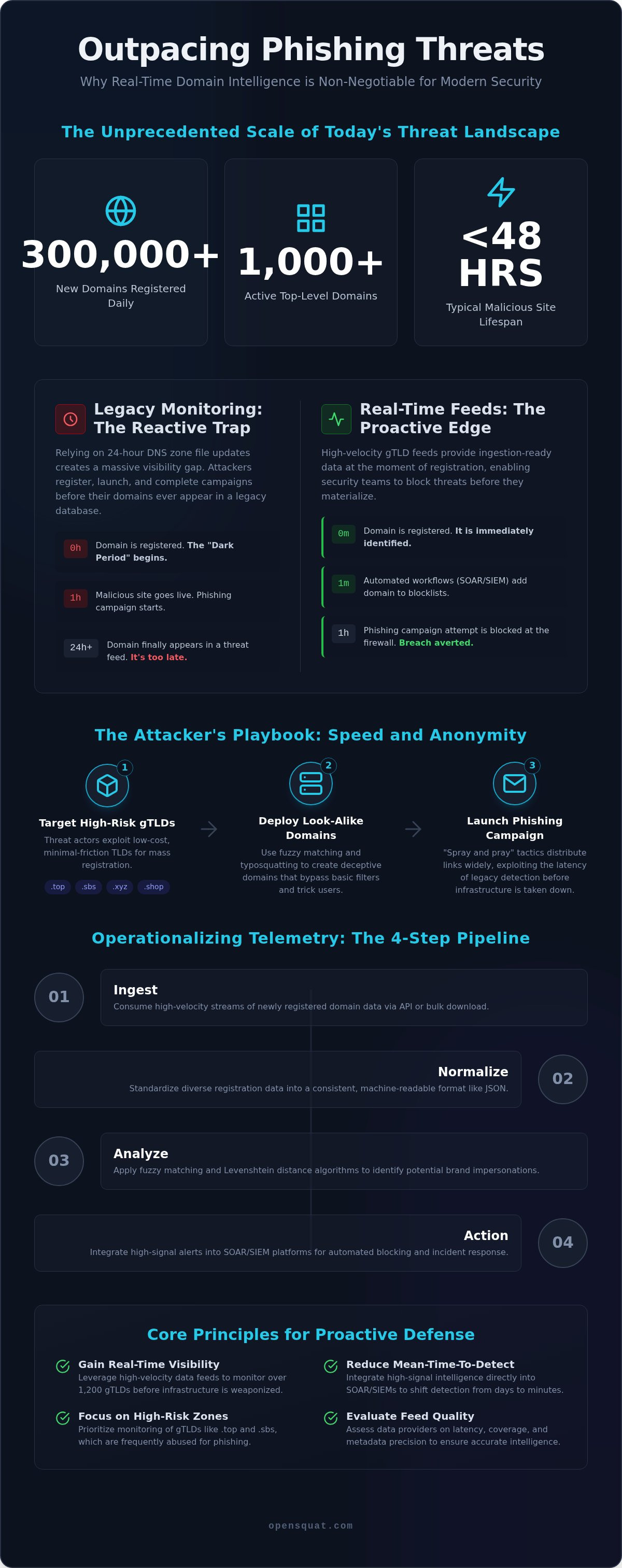
The threat landscape is shifting away from legacy namespaces. As of 2026, threat actors increasingly exploit the vast expansion of Generic top-level domains (gTLDs) to build disposable attack infrastructure. Newly registered gTLD data feeds provide the technical telemetry required to observe these registrations as they occur. These feeds function as near real-time logs, capturing every new domain entry before it's weaponized. This visibility is critical for mapping activities within the MITRE ATT&CK framework, specifically the Reconnaissance (TA0043) and Resource Development (TA0042) tactics. By monitoring registrations, security teams identify the acquisition of infrastructure before the first phishing email is sent. With over 300,000 domains registered daily across more than 1,000 TLDs, manual oversight is no longer a viable strategy for enterprise defense.
High-Risk gTLDs and Malicious Intent
Threat actors prioritize gTLDs that offer low friction and minimal cost. Extensions like .top, .sbs, and .xyz frequently appear in high-velocity phishing campaigns because they allow for the rapid deployment of short-lived sites. Low registration fees enable attackers to register thousands of domains for "spray and pray" tactics. Data suggests that malicious registrations often correlate with seasonal events or specific brand launches. For instance, a surge in .shop registrations often precedes major retail holidays. Attackers use these extensions to create "look-alike" domains that bypass basic spam filters. Monitoring these specific high-risk zones through newly registered gTLD data feeds allows for targeted detection rather than broad, inefficient scanning. This proactive stance is essential when dealing with infrastructure that may only exist for 48 hours.
The Limitations of Legacy Domain Monitoring
Standard security tools often rely on refreshed DNS zone files or retrospective web crawling. This approach creates a significant latency gap. Zone file updates might only occur once every 24 hours, leaving a "Dark Period" where a domain is registered, active, and hosting a credential harvester before it ever appears in a legacy database. Modern attackers exploit this window, completing their campaign lifecycle in hours. If you're relying on traditional monitoring, you're reacting to yesterday's infrastructure. Dedicated gTLD telemetry bypasses these delays by providing ingestion-ready data at the point of registration. It's an approach that eliminates the reliance on third-party scanners that only discover malicious sites after they've already been indexed or reported by victims. For enterprise SOCs, this real-time visibility is the difference between blocking a domain at the firewall and responding to a successful breach.
Technical Requirements for Ingesting Bulk gTLD Registration Data
Ingesting newly registered gTLD data feeds requires a pipeline capable of handling high-velocity streams. With daily registration volumes exceeding 300,000 records, your infrastructure must process data without introducing latency. Standardizing this data is the first hurdle. Generic TLDs are managed by diverse registries, each with varying levels of registration detail and RDAP implementation. Normalization ensures that whether a domain is a .top or a .sbs, the output in your security stack remains consistent. JSON is the industry standard for this task because it supports the complex, nested metadata required for advanced security automation. While CSV is functional for simple lists, it lacks the flexibility needed for multi-field threat intelligence.
Effective ingestion aligns with ICANN's framework for responding to security threats, which emphasizes the registry's role in mitigating abuse. By normalizing and filtering these feeds at the point of ingestion, security teams can focus on high-risk signals rather than raw volume. Choosing between API access and bulk downloads depends on your specific use case. Real-time APIs are essential for immediate alerting, while bulk downloads support retrospective hunting and large-scale trend analysis.
Infrastructure for High-Velocity Data Ingestion
Bulk data ingestion for NRD feeds is the systematic process of collecting, normalizing, and storing large volumes of domain registration records from multiple sources into a centralized security database. Storage is a primary consideration. Historical analysis requires keeping months of registration data to identify patterns in attacker behavior. To prevent database bloat, implement filtering logic at the ingestion layer. Use regular expressions or fuzzy matching to discard irrelevant registrations while retaining those that match brand profiles or high-risk patterns. This pre-processing stage ensures that your storage resources are dedicated to high-signal data.
API Integration Strategies
Real-time visibility depends on how you bridge the data provider and your internal tools. Leveraging Commercial API access allows for direct streaming into SIEM platforms like Splunk or Microsoft Sentinel. This integration enables automated triage. When a new gTLD registration matches a predefined watch-list, your SOAR platform can trigger an immediate investigation. Automating the initial assessment of newly registered gTLD data feeds reduces the burden on human analysts. It moves the workflow from manual searching to exception-based alerting, ensuring that your team only reviews domains with a high probability of malicious intent. This methodical approach transforms raw data into a functional component of your defense-in-depth strategy.
Assessing Feed Quality: Latency, Coverage, and Metadata Precision
Quality in newly registered gTLD data feeds is defined by the delta between a domain's creation and its availability in your security stack. High-volume data is useless if it arrives after an attack has concluded. For a feed to be considered enterprise-grade, it must provide comprehensive coverage across the 1,200+ available gTLDs. Many generic providers focus on high-volume extensions like .com or .net while overlooking the phishing risks associated with new TLDs such as .zip, .mov, or .icu. A high-signal feed doesn't just list domain names; it provides the context necessary to distinguish between a legitimate startup and a disposable phishing node. This requires a sophisticated approach to the signal-to-noise ratio, filtering out the noise of domain parking and bulk legitimate registrations that often bloat raw data sets.
Metadata precision is the second pillar of feed evaluation. Raw logs often lack the technical depth required for automated triage. Effective newly registered gTLD data feeds enrich every record with authoritative telemetry, including the sponsoring registrar, IP address, and nameserver configurations. This enrichment transforms a simple string of characters into actionable threat intelligence. By analyzing these data points, security teams can identify infrastructure patterns that indicate malicious intent before a single packet is sent from the new host.
Latency Benchmarks for Enterprise Feeds
In the current threat environment, a 24-hour delay is an unacceptable security gap. Threat actors often register, weaponize, and discard domains within a single business day. To bridge this gap, enterprise feeds must move away from full list refreshes in favor of incremental updates. Incremental delivery ensures that your SIEM is updated as new records are processed, rather than waiting for a daily batch file. openSquat optimizes for low-latency discovery by utilizing high-velocity ingestion pipelines that minimize the time between registration and detection. This speed is critical for preventing "Dark Period" exploitations where attackers operate in the window before a domain is indexed by traditional scanners.
The Value of Enriched Metadata
Actionable intelligence relies on identifying connections between disparate registrations. Enriched metadata allows analysts to detect "Registrar Hopping" patterns, where attackers rotate through specific registrars known for lax enforcement. Nameserver telemetry is equally vital; it enables security teams to link new gTLD registrations to known malicious clusters or hosting providers favored by botnet operators. Furthermore, SSL/TLS certificate transparency logs provide an additional layer of validation. When a new gTLD registration is immediately followed by a certificate request for a brand-related term, the probability of malicious intent nears 100%. Utilizing these technical markers allows for a proactive defense that targets the infrastructure itself, not just the individual domain.
Operationalizing gTLD Feeds within Modern Security Workflows
Operationalizing newly registered gTLD data feeds requires more than simple keyword matching. Efficient workflows utilize Levenshtein distance algorithms to calculate the edit distance between core brand terms and new registrations. A distance of '1' identifies simple typosquatting. A distance of '2' or '3' captures more complex character substitutions. Automating this fuzzy matching process isolates high-risk domains from the daily noise. This technical filter is the first stage in a tiered alert system. Categorize results into risk levels: 'Informational' for broad matches and 'Critical' for exact brand strings combined with high-risk gTLDs. This systematic approach ensures that analyst time is reserved for the most credible threats.
A critical step in modern security operations is cross-referencing this registration intelligence with internal telemetry. Compare incoming gTLD data against your web proxy and DNS logs. If an internal asset attempts to resolve a domain registered less than 24 hours ago, it indicates early-stage compromise. This correlation allows your SOC to detect threats that bypass standard reputation-based filters. Most legacy filters lack data on nascent infrastructure. By linking external registration telemetry with internal traffic patterns, you create a more resilient defense. You can't rely on third-party reputations for domains that have only existed for minutes.
Building a Brand Monitoring Dashboard
Effective brand protection requires a centralized view of the threat landscape. A Brand Monitoring Dashboard transforms raw registration logs into actionable visualizations. By aggregating data from multiple gTLDs, security teams can identify coordinated registration spikes that signal an impending campaign. Visualizing these trends helps in allocating resources toward the extensions currently favored by threat actors. This move from raw data to a structured interface ensures that brand protection teams can manage alerts without experiencing information fatigue. It provides the high-signal clarity needed for rapid decision-making.
Proactive Hunting vs. Reactive Blocking
The ultimate goal of monitoring newly registered gTLD data feeds is to move from reactive remediation to proactive hunting. Use this intelligence to update web proxy and firewall blocklists before a domain is fully weaponized. This pre-emptive sinkholing prevents users from ever reaching a malicious site. Vigilance must extend beyond the initial registration period. Many attackers register domains and leave them dormant for weeks to age the infrastructure. Continuous monitoring ensures that when these dormant domains finally resolve to a malicious IP, your defenses are already in place. This vigilance is the cornerstone of a proactive security posture.
Scaling Brand Protection with openSquat Enterprise Feeds
openSquat bridges the operational gap between open-source agility and the rigorous reliability required by enterprise security teams. While the open-source core tool provides a community-vetted methodology, the commercial infrastructure delivers the sustained throughput necessary for global threat monitoring. We monitor over 300,000 newly registered domains daily across more than 1,000 TLDs. This scale requires more than raw data access; it demands high-signal newly registered gTLD data feeds that prioritize actionable intelligence over sheer record volume. The modular design of our data delivery ensures that your security stack processes high-velocity streams without technical friction. Specialized threat intelligence researchers utilize this data because it adheres to a clinical, data-driven standard that avoids the hyperbole often found in generic security marketing.
Enterprise-Grade Threat Intelligence
Accessing curated telemetry is the first stage in identifying malicious infrastructure before it can be weaponized. Our newly registered gTLD data feeds provide the raw technical logs required for deep analysis, while the Brand Monitoring Dashboard centralizes these findings for distributed security teams. This centralized approach allows for the visualization of registration trends, moving your team from reactive individual searches to a state of global telemetry ingestion. Academic validation reinforces this methodology. A June 2024 study in the Journal of Information Security and Cybercrimes Research documented that openSquat successfully identified 960 active phishing websites and 53 domains with suspicious certificates. This evidence confirms the tool's role as a precise instrument for professional readiness and proactive defense.
Seamless Migration and Integration
Moving from the openSquat open-source tool to commercial-grade data feeds is a methodical progression for mature security operations. Commercial API Access provides the integration-readiness needed for custom security tool development and seamless ingestion into SOAR or SIEM platforms. This API delivers data in structured formats that respect your team's technical proficiency, allowing for immediate automation of look-alike detection and registrar analysis. We support enterprise workflows with dedicated technical assistance, ensuring that your data pipelines remain alert and responsive. This transition eliminates the latency of manual scripts and replaces them with a high-velocity, reliable safeguard that operates quietly in the background of your SOC. If you're ready to enhance your brand protection strategy, contact openSquat today for a technical demonstration of our gTLD telemetry and learn how to secure your brand at scale.
Proactive Defense for the 2026 Domain Landscape
Effective brand protection requires a transition from reactive blocking to proactive infrastructure monitoring. The sheer volume of daily registrations, which now exceeds 300,000, makes manual oversight impossible. Security teams must prioritize low-latency ingestion and enriched metadata to bypass the noise of legacy namespaces. By operationalizing newly registered gTLD data feeds, your SOC can detect phishing and typosquatting clusters before they impact your users. This strategy transforms raw registration data into a functional component of your defense-in-depth architecture, closing the window of opportunity that threat actors have traditionally exploited.
openSquat provides the technical precision needed to scale these efforts. Our methodology is built on community-vetted open-source principles and refined for enterprise reliability. We specialize in the early identification of malicious registrations, providing the high-signal telemetry required by modern threat hunters. You can integrate these insights directly into your security stack via our Commercial API for high-velocity automation. It's time to eliminate the visibility gaps in your domain monitoring. Secure your brand with openSquat Enterprise Feeds and gain the technical advantage in an evolving threat environment. Your team is ready to move from detection to prevention.
Frequently Asked Questions
What is a newly registered gTLD data feed?
A newly registered gTLD data feed is a technical telemetry stream that provides near real-time logs of every new domain entry under generic Top-Level Domains. These feeds act as an early warning system for security teams, capturing the acquisition of digital infrastructure before it's weaponized for phishing or malware distribution. By monitoring these logs, organizations gain visibility into the more than 1,200 available gTLDs currently exploited by threat actors for disposable attack campaigns.
How often is the gTLD registration data updated?
Update frequency depends on the service tier, ranging from daily batch files to near real-time incremental updates. In a high-velocity environment where over 300,000 domains are registered daily, enterprise-grade newly registered gTLD data feeds prioritize low-latency delivery. Incremental updates ensure that your security stack receives data as soon as it's processed by the registry, eliminating the dangerous "Dark Period" associated with traditional 24-hour zone file refreshes.
Can these feeds detect typosquatting in real time?
Yes, these feeds enable real-time typosquatting detection when integrated with specialized analysis algorithms. By applying fuzzy matching and Levenshtein distance calculations to the incoming telemetry, security teams can automatically identify domains that mimic core brand terms. This proactive approach identifies malicious infrastructure at the point of registration, allowing for pre-emptive blocking in firewalls and web proxies before the first phishing email's ever dispatched to a target asset.
How do I integrate a domain feed into my SIEM?
Integration's typically achieved through Commercial API access, which allows for the automated ingestion of JSON or CSV formatted records into platforms like Splunk or Microsoft Sentinel. You'll configure your SIEM to poll the API at regular intervals or receive a data stream, then apply custom filtering logic to isolate high-risk registrations. This process transforms raw newly registered gTLD data feeds into actionable alerts within your existing security orchestration and response workflows.
What is the difference between NRD feeds and WHOIS data?
NRD feeds are event-driven logs that signal the creation of a new domain, whereas WHOIS is a directory service used to query specific registration details. While WHOIS provides metadata like registrar and name servers, it's often subject to redaction due to privacy regulations. NRD feeds focus on the timing and existence of the domain itself, providing the high-signal starting point for further investigation using modern protocols like RDAP for technical enrichment.
Why are new gTLDs more dangerous than traditional extensions?
New gTLDs are frequently exploited because they offer a low financial barrier to entry and minimal registration friction. Extensions such as .top, .sbs, and .xyz allow threat actors to register thousands of disposable domains for the cost of a single traditional extension. This high volume of short-lived infrastructure's specifically designed to overwhelm legacy reputation-based filters, which often fail to categorize new domains before an attack campaign has already concluded.
Does openSquat provide domain takedown services?
No, openSquat doesn't offer domain takedown services or managed SOC operations. The organization functions strictly as a data provider, specializing in the identification of malicious domain registrations through high-signal threat intelligence. The focus remains on delivering precise, community-vetted telemetry that empowers internal security teams to perform their own mitigation and blocking. Organizations requiring takedowns should coordinate with their legal departments or specialized third-party remediation services.
Is there an API available for bulk domain data ingestion?
Yes, Commercial API access is available for organizations requiring bulk data ingestion and high-velocity integration. This API supports structured data formats like JSON, facilitating seamless ingestion into enterprise security tools and custom-built hunting platforms. It provides the scale necessary to process hundreds of thousands of daily records while offering custom quotas and technical support. This programmatic access is the preferred method for SOCs that need to automate their brand protection and threat intelligence workflows.


