
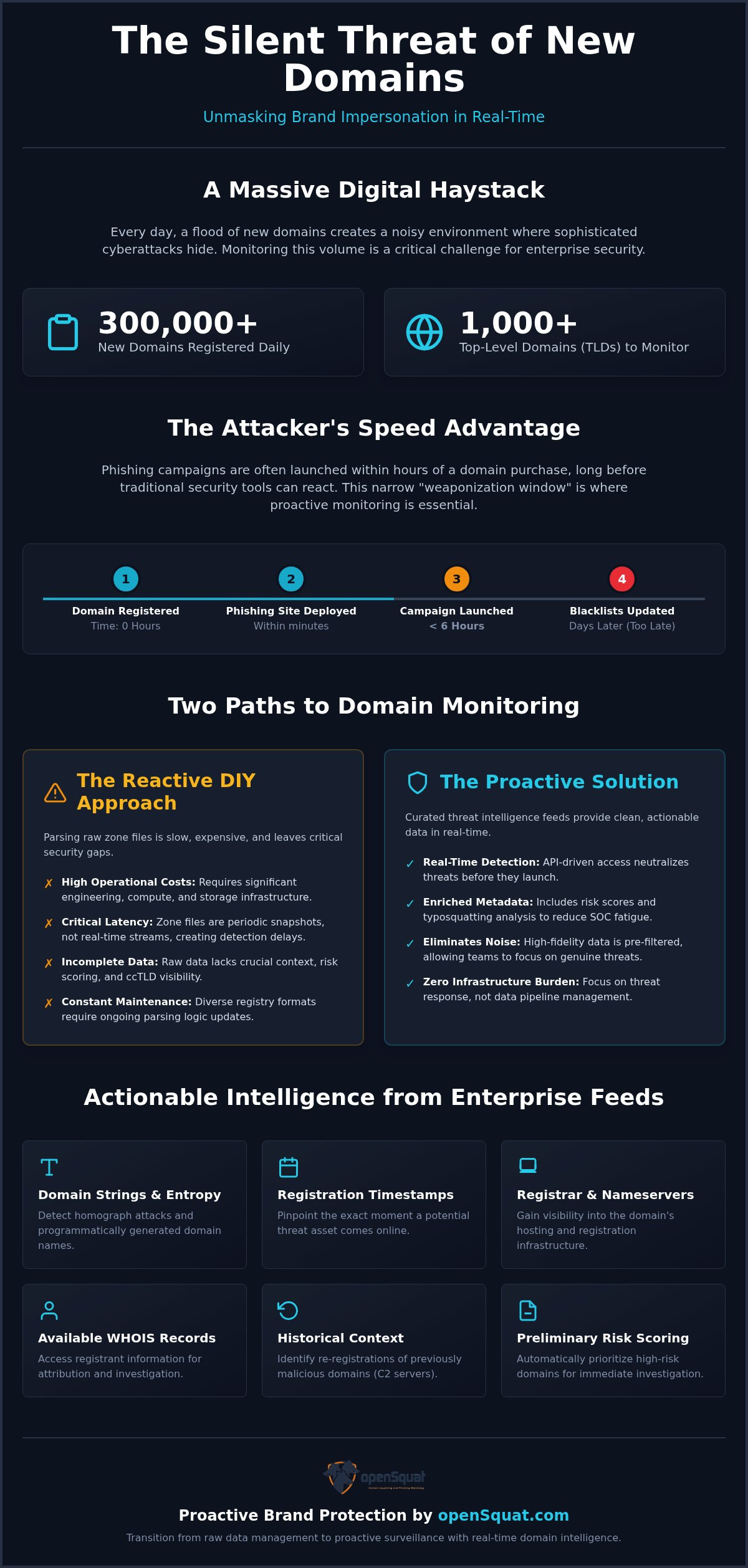
Over 300,000 new domains are registered every single day across more than 1,000 top-level domains. For enterprise security teams, this volume represents a massive noise floor that frequently masks sophisticated brand impersonation attempts. You already know that the infrastructure cost of parsing raw zone files is prohibitive; the latency between a registration and its detection often gives attackers the window they need. Relying on manual lookups or delayed datasets isn't a viable strategy when phishing campaigns can launch within minutes of a domain purchase.
Securing high-fidelity newly registered domain database access is the only way to move from reactive mitigation to proactive defense. This technical guide outlines how to implement real-time surveillance and automated phishing discovery using commercial API integration. We'll break down the transition from raw data ingestion to actionable intelligence, ensuring your security stack can neutralize threats before they impact your users. You'll learn how to leverage specialized feeds and dashboards to maintain a vigilant, clinical oversight of the global domain landscape without the burden of managing raw infrastructure.
Key Takeaways
- Understand the technical differences between raw ICANN zone files and high-fidelity datasets to optimize your detection window.
- Evaluate the infrastructure costs of parsing 300,000+ daily registrations versus implementing a direct, curated commercial feed.
- Secure streamlined newly registered domain database access to automate the identification of typosquatting and phishing threats.
- Integrate real-time domain intelligence into existing SOC workflows to neutralize brand impersonation before it reaches your users.
- Transition from raw data management to proactive surveillance using centralized dashboards and programmatic API triggers for clinical efficiency.
What is a Newly Registered Domain Database?
A newly registered domain database is a high-velocity repository containing every domain name added to the global DNS within the previous 24 to 48 hours. It serves as a centralized point of truth for security analysts who must monitor the digital perimeter for emerging threats. These databases aggregate entries from over 1,000 generic Top-Level Domains (gTLDs), including the surge of new extensions like .ai and .tech, alongside diverse Country-Code Top-Level Domains (ccTLDs). Beyond simple domain strings, these datasets include critical metadata such as registration timestamps, registrar identities, and available WHOIS records. This structured information is essential for maintaining high-fidelity newly registered domain feeds that fuel modern threat hunting operations.
The Critical Window: Why the First 24 Hours Matter
Adversaries prioritize speed to bypass static security controls. They often register a domain, configure a landing page, and distribute phishing payloads in one continuous, automated motion. Traditional reputation-based blacklists often take days to update, which creates a massive gap in defensive coverage. Proactive security requires newly registered domain database access that mirrors registry updates in near real-time. The weaponization window is the narrow timeframe between domain creation and its use in an active exploit, which frequently occurs in under six hours. Security teams that monitor this window can intercept malicious campaigns before they reach the end user's inbox.
Data Points Included in Enterprise Access
Enterprise-grade access provides the raw material for sophisticated algorithmic analysis. This includes domain strings and entropy scores, which help detect homograph attacks or programmatically generated names. Registrar details and nameserver configurations are extracted directly from the DNS zone file to provide visibility into the domain's hosting infrastructure. Historical context is another vital component. It allows analysts to determine if a domain is a fresh registration or a re-registration of an asset previously associated with command-and-control (C2) activity. By evaluating these parameters, automated systems can assign risk scores to new entries, allowing analysts to prioritize high-risk domains for immediate investigation. This level of detail transforms a simple list of names into a strategic intelligence asset that's ready for SOC integration.
The Mechanics of Domain Data Acquisition: CZDS vs. Direct Feeds
Acquiring domain data requires a choice between raw registry sources and pre-processed streams. The Centralized Zone Data Service (CZDS) serves as a primary gateway for gTLD zone files. While ICANN provides this access at no cost for approved users, it delivers raw data that lacks ccTLD visibility. For comprehensive newly registered domain database access, security teams often find that the "free" nature of CZDS is offset by high operational costs. Raw data is noisy; it requires significant engineering to transform into a usable security asset.
The Technical Debt of DIY Zone File Parsing
Parsing raw zone files is a resource-intensive engineering task. Each day, registries release multi-gigabyte compressed files that your systems must ingest, clean, and deduplicate. Because registries use varying formats, your parsing logic must remain flexible and requires constant maintenance. Storage overhead is substantial. You aren't just storing a list of names; you're building the infrastructure to process them. Latency remains a critical failure point. Zone files are periodic snapshots, not real-time event streams. By the time a file is downloaded and processed, a malicious actor may have already launched their campaign. Organizations with inconsistent domain adoption are particularly vulnerable to cybersquatting, making the delay in raw data processing a significant liability.
The Advantage of Curated Threat Intelligence Feeds
Commercial feeds eliminate the noise problem by delivering high-fidelity data that's already filtered for relevance. Instead of managing the compute power required to parse raw files, your team can focus on threat response. These feeds include enriched metadata, such as preliminary risk scoring and typosquatting analysis, which reduces SOC alert fatigue. High-volume environments benefit from bulk newly registered domain data pipelines that integrate directly into existing security lakes. This clinical approach ensures that your newly registered domain database access provides immediate utility. If you need to scale your defenses without the engineering burden, utilizing commercial API access can streamline your detection workflows.
- Input: Automated ingestion of gTLD and ccTLD data streams.
- Process: Algorithmic cleaning, deduplication, and risk scoring.
- Output: High-signal intelligence ready for automated blocklists or analyst review.
Evaluating Access Methods: Raw Lists vs. Commercial API Integration
Selecting a delivery mechanism for domain intelligence requires a choice between static snapshots and dynamic streams. Raw lists, commonly delivered in CSV or JSON formats, provide a comprehensive record of registration activity over a specific period. While these formats are suitable for offline analysis or periodic reporting, they lack the agility necessary for active threat suppression. High-fidelity newly registered domain database access via a commercial API provides the programmatic interface required to trigger defensive actions the moment a suspicious registration occurs. This transition from manual downloads to automated ingestion is a prerequisite for enterprise-grade security.
When to Use a Bulk Download Approach
Bulk downloads are most effective for specific, non-critical use cases where real-time response isn't the primary objective. Academic researchers utilize daily CSV files to study long-term trends in DNS abuse or registry growth. Startups with low-frequency monitoring needs may also find manual downloads cost-effective for building internal historical databases. However, this approach creates significant technical debt. Your team must build and maintain the pipelines to ingest, index, and query these files. Without dedicated data science resources, raw lists often become "dark data" that provides little immediate value to front-line security responders.
The Power of High-Throughput Security APIs
In a modern SOC environment, speed is the primary metric of success. Implementing a specialized NRD API for security teams allows for the complete automation of the discovery-to-blocklist pipeline. Programmatic access enables real-time alerting based on complex regex patterns or specific brand-related keywords. This ensures that your security stack identifies potential impersonation attempts as they propagate through the DNS. Unlike static files, APIs facilitate "look-back" queries. These allow analysts to correlate current suspicious activity with historical registration patterns, identifying persistent threat actors who recycle infrastructure across different TLDs.
Integration with SIEM and SOAR platforms is seamless when using a high-throughput API. This facilitates the orchestration of multi-stage workflows; for example, a high-entropy domain detection can automatically trigger an investigative ticket. For non-technical brand stakeholders, these APIs often feed into a Brand Monitoring Dashboard. This provides a clear visualization of the threat landscape without requiring users to navigate raw datasets. By leveraging newly registered domain database access through a commercial API, you ensure your defensive posture remains proactive and clinically efficient.
Implementing NRD Intelligence into SOC Workflows
Operationalizing domain intelligence requires a transition from passive observation to active surveillance. Effective newly registered domain database access enables security teams to build a modular pipeline that processes high volumes of registrations with minimal human intervention. This clinical approach ensures that suspicious assets are identified and neutralized before they can be weaponized in a phishing campaign. The workflow follows a logical input-process-output sequence designed for maximum efficiency.
- Ingest: Configure an automated data pull via commercial API to direct new registrations into a centralized security lake or SIEM.
- Filter: Apply brand-specific keywords and advanced typosquatting algorithms to isolate high-risk entries from the daily noise.
- Analyze: Cross-reference the filtered results with existing Enterprise Threat Intelligence Feeds and reputation scores to validate malicious intent.
- Act: Trigger immediate alerts for security analysts or initiate pre-emptive DNS blocking for matches that exceed a specific risk threshold.
Automating Phishing Domain Discovery
Adversaries rely on visual deception to trick users. SOC teams must employ fuzzy matching techniques to identify look-alike domains that swap characters, such as "0penSquat" for "openSquat". Surveillance should also account for homograph attacks by converting Punycode strings into their visual equivalents during the analysis phase. Automated discovery reduces the time-to-detect (TTD) by flagging suspicious registrations hours before they are utilized in active email campaigns. This proactive stance is the only way to counter the speed of modern automated registration tools.
Integrating with SIEM and SOAR
Seamless integration involves mapping NRD data fields to common security information schemas; this ensures that registration timestamps and registrar data are searchable within your SIEM. Automation playbooks can then use this data to create dynamic watchlists for newly registered assets that interact with your network. By utilizing pre-scored Enterprise Threat Intelligence Feeds, organizations significantly reduce the manual workload placed on analysts. This allows the SOC to focus on high-signal events rather than raw data triage. For teams looking to scale their brand protection, integrating commercial API access provides the necessary high-throughput infrastructure for real-time defense.
Scaling Brand Protection with openSquat Enterprise Solutions
Scaling a brand protection program requires a transition from manual oversight to automated, high-precision infrastructure. While community tools provide a baseline for discovery, enterprise environments demand a higher level of data reliability and system uptime. Secure newly registered domain database access through openSquat provides the high-fidelity feeds necessary to identify impersonation attempts before they reach a critical mass. This commercial infrastructure supports the clinical efficiency required by modern security teams, moving beyond the limitations of raw, unparsed datasets discussed in previous sections.
Enterprise solutions focus on the "signal" within the 300,000+ daily registrations. By utilizing Enterprise Threat Intelligence Feeds, organizations can cross-reference new registrations against known malicious patterns in real-time. This proactive approach ensures that your security stack isn't just listing domains, but actively neutralizing threats. The transition to a commercial service provides the engineering rigor needed to maintain a vigilant, 24/7 defensive posture without the overhead of managing raw zone file ingestion.
The openSquat Brand Monitoring Dashboard
The Brand Monitoring Dashboard provides a centralized, high-signal view of all potential brand threats. It's designed for stakeholders who require rapid decision-making capabilities without navigating raw API outputs. You can configure alerting thresholds tailored to your specific enterprise risk tolerance, ensuring that only high-probability threats escalate to an analyst's attention. The interface prioritizes clinical efficiency, presenting look-alike domains and homograph attacks in a structured format that facilitates immediate review. This visualization layer transforms raw newly registered domain database access into a strategic asset for both technical and non-technical brand protectors.
Enterprise API Access for Specialized Security Needs
For organizations with high-throughput requirements, Commercial API Access offers the most direct path to SOC integration. These endpoints are engineered for stability and speed, delivering structured data formats that respect the technical proficiency of your engineering team. You don't have to worry about the latency issues inherent in community-driven lists or the technical debt of DIY parsing. These feeds operate quietly in the background, providing a reliable stream of intelligence that integrates seamlessly with your SIEM or SOAR platforms. By leveraging high-throughput endpoints, you ensure your security stack remains as fast and responsive as the data it processes, allowing you to maintain a proactive defense against the evolving landscape of domain-based attacks.
Advancing to Proactive Domain Surveillance
Managing the noise of 300,000 daily registrations requires more than raw zone files. The technical debt of manual parsing creates a latency window that adversaries exploit. Securing high-fidelity newly registered domain database access is the foundation of a modern SOC; it enables the transition from reactive triage to automated discovery. By implementing structured API feeds and centralized visualization, you ensure that brand impersonation is identified at the point of registration rather than after an attack launches.
openSquat delivers the clinical precision required for high-throughput security workflows. Access enterprise-grade NRD feeds and the Brand Monitoring Dashboard with openSquat to achieve real-time detection of brand impersonation and typosquatting. Our commercial-grade API is trusted by enterprise security teams for proactive threat intelligence, operating quietly in the background to safeguard your digital perimeter. It's time to replace raw data with a reliable, engineered solution. Build a more resilient defense today.
Frequently Asked Questions
How often is the newly registered domain database updated?
Commercial databases update in near real-time or at 24-hour intervals depending on registry release schedules. Our newly registered domain database access ensures your systems receive the latest entries as soon as they are processed from global registries. This frequency is critical for maintaining a proactive defensive posture against rapidly evolving phishing campaigns that launch shortly after a domain purchase.
Does your database access include ccTLDs or only gTLDs?
High-fidelity access includes both generic Top-Level Domains (gTLDs) and Country-Code Top-Level Domains (ccTLDs). While free services like ICANN’s CZDS only provide data for gTLDs, enterprise feeds cover over 1,000 extensions including .ai, .io, and regional codes. This comprehensive coverage is essential for detecting brand impersonation attempts that utilize less common extensions to bypass standard security filters and keyword monitoring tools.
Can I access historical registration data through the API?
You can access historical registration data through specialized API endpoints designed for retroactive threat hunting. This feature allows security analysts to perform "look-back" queries to identify when a specific domain was first registered or to find patterns across previous malicious campaigns. Accessing historical logs helps in building a more complete profile of threat actor infrastructure and identifying dormant assets that may be weaponized in the future.
What is the difference between a raw zone file and a curated NRD feed?
A raw DNS zone file is a technical snapshot containing domain names and nameservers that requires significant compute power to parse. In contrast, a curated NRD feed is pre-processed to remove benign registrations and enriched with metadata like entropy scores and registrar details. Curated feeds reduce technical debt and allow SOC teams to focus on high-signal alerts rather than raw data engineering and deduplication tasks.
How can I integrate NRD database access into my existing SIEM?
Integration is achieved through programmatic API calls that deliver structured JSON data directly into your security lake or SIEM. You can map NRD fields to standard security schemas to enable automated alerting based on keyword matches or high-risk entropy scores. This process facilitates the orchestration of multi-stage workflows, such as automatically creating investigative tickets in SOAR platforms when a suspicious domain registration is detected.
Is there a limit to the number of keywords I can monitor?
Enterprise solutions don't impose restrictive limits on the number of keywords or regex patterns you can monitor. The Brand Monitoring Dashboard allows you to configure complex surveillance parameters tailored to your specific risk tolerance and brand assets. This scalability ensures that large organizations can track multiple product names, trademarks, and executive identities across the entire global domain landscape without compromising on detection speed or accuracy.
Do you provide WHOIS data for all newly registered domains?
WHOIS data is provided where available; however, many personal details are now redacted due to privacy regulations like GDPR. Enterprise feeds prioritize technical metadata such as registration timestamps, registrar identities, and nameserver configurations. These data points offer sufficient signal for risk scoring and infrastructure mapping even when specific registrant contact information is restricted by privacy policies or proxy registration services.
What is the "weaponization window" for a newly registered domain?
The weaponization window is the timeframe between a domain's registration and its use in an active attack, which frequently occurs within six hours. Adversaries move quickly to exploit the gap before a domain is flagged by reputation services. Maintaining newly registered domain database access with low latency is the only way to intercept these threats during this critical period before they reach target environments.


