
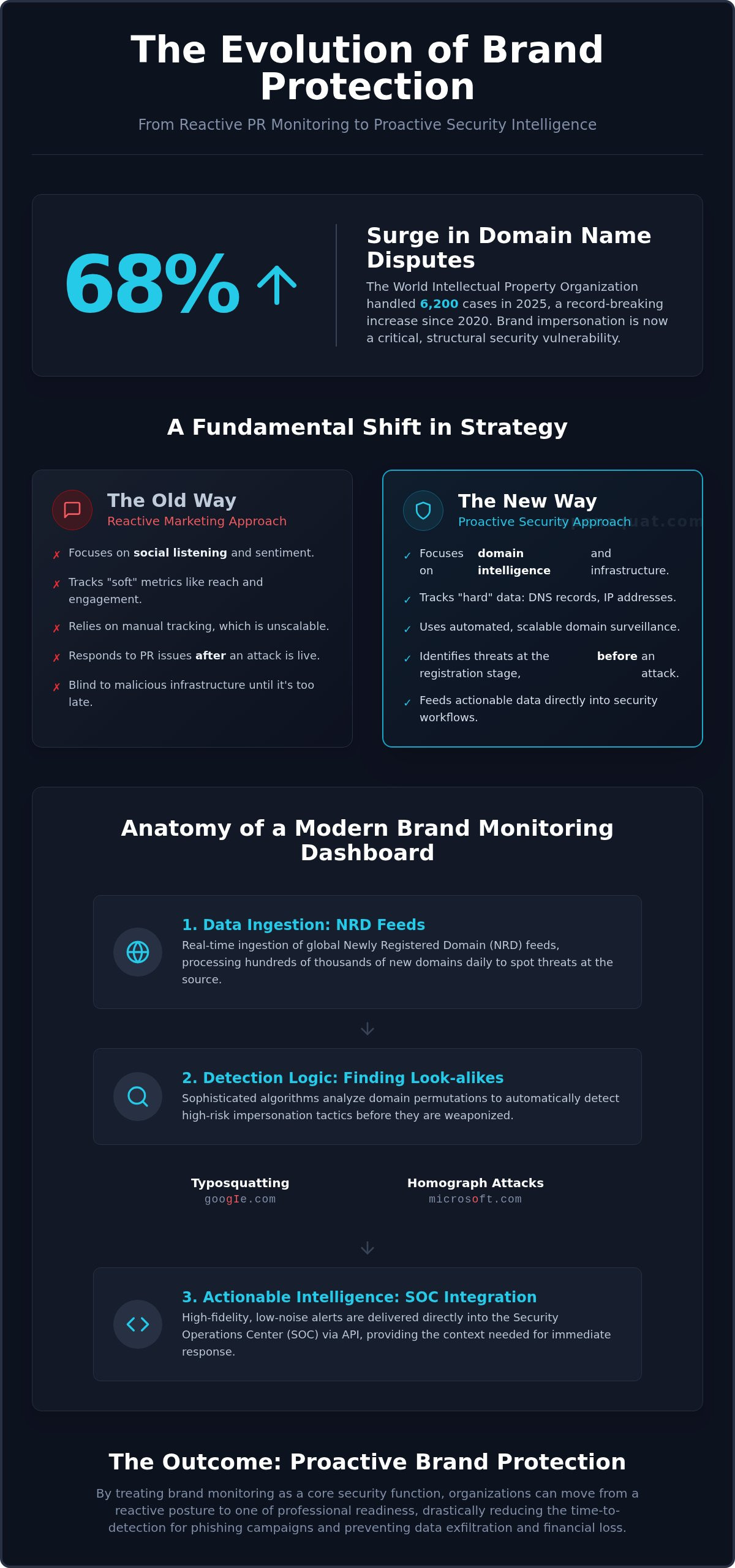
In 2025, the World Intellectual Property Organization handled 6,200 domain name disputes, marking a 68% increase since 2020. This record-breaking surge confirms that brand impersonation is no longer a PR problem; it's a structural security vulnerability. Many enterprise teams still rely on social listening tools that prioritize sentiment over infrastructure, leaving them blind to malicious registrations until a phishing campaign is already live. A specialized brand monitoring dashboard changes this dynamic by shifting focus from keywords to domain intelligence. It provides the technical precision needed to identify look-alike domains before they weaponize your reputation.
You likely recognize the inefficiency of drowning in social noise while manual tracking remains unscalable. It's a common friction point when brand alerts fail to integrate with existing security workflows. This article demonstrates how to transition to a clinical, security-first approach using a centralized brand monitoring dashboard. You'll learn to reduce time-to-detection for phishing attacks and leverage API integrations to feed high-fidelity domain data directly into your SOC tools. We'll examine the mechanics of real-time domain surveillance and the process of automating the identification of typosquatting and homograph attacks.
Key Takeaways
- Shift focus from sentiment-based social listening to infrastructure-level surveillance to identify malicious registrations early.
- Implement a specialized brand monitoring dashboard designed for real-time ingestion of global NRD feeds to ensure high-fidelity threat detection.
- Prioritize technical metrics like DNS records and domain permutations over soft marketing data to reduce the risk of successful phishing campaigns.
- Automate the detection of typosquatting and homograph attacks by integrating specialized intelligence feeds into existing SOC workflows via API.
- Transition from manual tracking to scalable domain surveillance using clinical instruments that provide clear, actionable data for security experts.
Beyond Social Listening: The Evolution of Technical Brand Monitoring
Traditional brand monitoring focuses on the narrative. It tracks social mentions and sentiment analysis to gauge public perception. Technical brand monitoring, however, operates at the infrastructure layer. It involves the persistent surveillance of digital assets to identify unauthorized impersonation at the network level. While marketing tools prioritize "soft" metrics like reach or engagement, a security-focused brand monitoring dashboard tracks "hard" data points: DNS records, IP addresses, and Newly Registered Domains (NRDs). This shift is necessary because attackers don't care about your brand's sentiment; they care about its utility as a phishing lure.
The 2026 threat landscape requires a move away from passive PR monitoring. Detection must happen at the registration stage, not after a customer reports a scam. This evolution expands the user base of monitoring tools. While Marketing Managers still use these tools to protect brand equity, Threat Intelligence Analysts now rely on them to map adversarial infrastructure. The goal is no longer just awareness; it is the proactive identification of risk before it manifests as an active exploit.
The Infrastructure of Brand Abuse
Look-alike domains serve as the primary delivery mechanism for modern impersonation. Attackers utilize NRDs to stage phishing campaigns, often registering these assets only hours before launching an attack. Typosquatting and homograph attacks exploit subtle visual similarities in characters to deceive users. These activities erode customer trust by targeting the fundamental connection between a brand and its digital identity. Comprehensive brand protection strategies must account for these infrastructure-level threats to prevent data exfiltration and financial loss. Monitoring must be constant because the window between domain registration and weaponization is shrinking.
From Awareness to Adversarial Detection
The industry is seeing a shift from measuring "how people feel" to "what attackers are building." Because the consequences of a missed detection now include massive data breaches rather than mere PR gaffes, security teams are increasingly absorbing brand protection budgets. This shift requires a brand monitoring dashboard capable of clinical precision. Data ingestion must be high-signal and low-noise to avoid alert fatigue. It must provide analysts with the specific technical indicators needed to trigger defensive workflows. By focusing on adversarial detection, organizations can move from a reactive posture to one of professional readiness, treating brand monitoring as a core component of the security stack.
Core Architecture of a High-Fidelity Brand Monitoring Dashboard
A professional brand monitoring dashboard operates as a specialized instrument for data processing rather than a simple visual interface. Its effectiveness depends on a modular input-process-output flow designed for high-volume telemetry. The system must ingest raw data, apply multi-layered detection logic, and deliver actionable intelligence to the Security Operations Center (SOC). This architecture ensures that security teams don't just see threats but receive the technical context required for immediate response. Effective brand risk monitoring requires this clinical focus on infrastructure rather than surface-level mentions.
Data Ingestion: The Power of NRD Feeds
The input layer relies on the real-time ingestion of global Newly Registered Domain (NRD) feeds. Monitoring NRDs is the gold standard for early detection because most phishing campaigns are staged on domains registered within the last 24 to 48 hours. A high-fidelity system processes hundreds of thousands of registrations daily, moving beyond static bulk lists to identify patterns in registrar behavior and TLD selection. By focusing on the registration event, the dashboard identifies adversarial infrastructure before a single malicious email is sent. You can explore how these feeds operate by reviewing the openSquat open source tool, which demonstrates the foundational mechanics of domain discovery.
Detection Logic: Beyond Exact Match
The processing layer applies sophisticated algorithms to the ingested NRD data to find impersonation attempts that bypass simple keyword filters. Detection logic must go beyond exact matches to identify complex variants. Key technical requirements include:
- Levenshtein Distance: Calculating the edit distance between your brand and a new registration to catch typosquatting.
- Homograph Detection: Identifying visually identical characters from different alphabets, such as Cyrillic look-alikes, which are often used in high-stakes phishing.
- Bit-squatting Analysis: Detecting domains that differ by a single bit, targeting hardware-induced memory errors.
This stage also involves noise reduction. The system filters registrations based on high-risk TLDs and suspicious registrar patterns to maintain a low false-positive rate. The goal is to isolate high-probability threats, ensuring that every alert in the brand monitoring dashboard represents a legitimate risk. Finally, the output must be delivered in exportable formats like JSON or CSV, allowing for seamless integration into downstream security orchestration and automated blocking workflows.
Security Dashboard vs. Marketing Dashboard: A Clinical Comparison
Marketing dashboards measure perception. A security-focused brand monitoring dashboard measures risk. The signal-to-noise ratio in marketing tools is inherently high because they ingest public discourse, where every mention is treated as a data point. Security dashboards prioritize high-fidelity technical indicators like DNS changes and WHOIS updates. They filter out the noise of social sentiment to focus on the infrastructure of an impending attack. This distinction is critical for enterprise protection where the goal isn't engagement, but the prevention of unauthorized access.
The cost of failure differs by orders of magnitude between these two approaches. A missed social mention results in a PR gaffe or a minor drop in brand sentiment. A missed domain registration leads to a full-scale phishing campaign. According to a 2025 IBM report, the average cost of a phishing attack is $4.8 million. This financial risk necessitates a shift from passive observation to proactive readiness. While marketing teams track "how people feel," security teams must track "what attackers are building" by shifting their data sources from social APIs to NRD feeds.
The Fallacy of Social-Only Monitoring
Attackers don't announce their intentions on social media. They build infrastructure in silence. There's a critical gap between the moment a domain is registered and the moment it appears in a social mention. A look-alike domain can exist for weeks, hosting a dormant landing page, before a PR tool flags it. By then, the phishing campaign is likely already in its execution phase. Security teams need to see the registration event. Relying on social mentions for brand protection is a reactive posture that allows attackers to maintain a significant head start.
Metrics That Matter for the SOC
Effective brand protection requires metrics that align with existing security frameworks. The SOC doesn't care about "brand reach" or "share of voice." It requires data that supports rapid response and mitigation. Key performance indicators for a brand monitoring dashboard include:
- Mean Time to Detection (MTTD): The duration between a domain registration and its appearance on the dashboard.
- Alert Fidelity: The ratio of actionable malicious registrations versus total system alerts.
- Integration Depth: The speed at which dashboard data feeds into SIEM and SOAR platforms for automated blocking.
These metrics allow the SOC to treat brand threats like any other network vulnerability. High-quality integration ensures that when the dashboard identifies a threat, the data flows immediately into automated workflows. This reduces the burden on analysts and ensures that the response is as fast as the data ingestion itself.
Implementing a Proactive Brand Protection Workflow
Operationalizing a security-focused workflow requires a structured, sequential approach. It isn't about passive observation; it's about active defensive engineering. To begin, security teams must define their core brand assets and generate common typosquatting permutations. This includes homograph variants and TLD extensions that attackers frequently exploit. Once defined, configure your brand monitoring dashboard to ingest real-time NRD feeds. This ensures that detection occurs at the moment of registration, providing the earliest possible warning of adversarial intent.
Establish a triage process to manage the resulting telemetry. You must monitor for indicators of weaponization, such as the issuance of SSL certificates or changes to MX records. These technical shifts signal that a domain has moved from a dormant asset to an active staging point for a phishing campaign. By tracking these specific infrastructure changes, analysts can prioritize threats that are ready for deployment.
Triage and Risk Scoring
Differentiating between a legitimate fan site and a malicious landing page requires clinical assessment. Use metadata such as registrar reputation, domain age, and geographic origin to score risk. A domain registered through a high-abuse registrar with a hidden WHOIS record should trigger a higher priority alert. Automate the "ignore" list for known-safe entities to reduce analyst fatigue and focus resources on high-probability threats. This methodical scoring ensures that the SOC spends time on actionable intelligence rather than background noise.
API Integration and Automation
A brand monitoring dashboard that operates in isolation is a bottleneck. High-fidelity data must flow directly into your existing security stack. Use webhooks for real-time alerting in platforms like Slack or Teams, ensuring that the team sees high-risk registrations immediately. For large-scale operations, commercial API access allows you to push blocklist updates directly to firewalls and email security gateways. This automation transforms brand intelligence from a static report into a dynamic defensive layer. Using bulk NRD data for proactive threat hunting allows your team to map entire clusters of adversarial infrastructure before they launch.
The openSquat Advantage: Precision Domain Intelligence
openSquat serves as a specialized instrument for enterprise domain surveillance, bridging the gap between community-led detection and commercial-grade defense. Many organizations initiate their protection programs with the openSquat open source tool. However, as the threat landscape scales, enterprise requirements necessitate a transition to high-throughput feeds. The centralized brand monitoring dashboard provides a clinical interface for this data, offering the structured visibility required for professional security operations. It transforms raw domain telemetry into actionable intelligence, ensuring that your team maintains a proactive defensive posture.
The openSquat Commercial API delivers this intelligence with high efficiency. It's designed for experts who require data-driven results over marketing hyperbole. Version 2.3.0, released in April 2026, introduced enhanced API modes and audit hardening to meet these rigorous standards. By integrating these capabilities, security teams can automate the ingestion of domain-based threats, reducing the manual burden on analysts and ensuring that detection keeps pace with adversarial registration cycles. The API supports multiple data formats, including JSON and CSV, ensuring compatibility with SIEM and SOAR platforms.
Enterprise-Grade Threat Feeds
High-throughput environments require data engineered for zero-fluff security workflows. openSquat provides real-time, high-fidelity Newly Registered Domain Feeds at scale, allowing global brands to monitor for impersonation across all top-level domains. Our feeds are optimized for integration, providing the high-signal inputs necessary for modern SOC tools. This throughput is essential for supporting global brands that face constant, automated typosquatting and homograph attacks. The focus remains entirely on technical precision and functional utility, providing Enterprise Threat Intelligence Feeds that respect the user's technical proficiency.
A Trusted Partner in Brand Safety
Our philosophy is rooted in technical honesty and engineering rigor. We position openSquat as a background safeguard for your digital assets, operating quietly to provide persistent surveillance. We value open-source principles and peer-reviewed methodology, ensuring that our detection engines remain at the forefront of the industry. This approach creates a sense of momentum and reliability, allowing your team to focus on mitigation rather than data cleaning. You can request access to the openSquat brand monitoring dashboard to integrate these specialized intelligence feeds into your security stack today.
Securing the Digital Perimeter through Technical Surveillance
Transitioning from passive social listening to proactive infrastructure monitoring is a requirement for modern enterprise security. Technical brand protection relies on the persistent surveillance of Newly Registered Domains to identify adversarial staging before campaigns go live. By focusing on DNS records and domain permutations, organizations move beyond the limitations of marketing tools and address the structural risks of brand impersonation.
Implementing a clinical brand monitoring dashboard ensures that your security team receives high-fidelity telemetry without the noise of social sentiment. This high-signal data allows for faster Mean Time to Detection and immediate integration into existing SOC workflows. Professional readiness starts with the right instruments to map and mitigate look-alike domain threats at scale.
openSquat provides specialized domain threat intelligence engineered for security experts. Our high-throughput commercial API and real-time NRD feeds cover the global registration landscape, providing the technical precision needed for seamless SOC integration. It's time to operationalize your defense against brand abuse. Explore openSquat Enterprise Brand Monitoring. Strengthen your posture and maintain persistent visibility across the domain landscape.
Frequently Asked Questions
What is the difference between brand monitoring and brand tracking?
Brand monitoring is a proactive security function focused on identifying infrastructure level threats like look-alike domains. Brand tracking is a marketing function that measures long term brand health and consumer sentiment. While tracking looks at how people feel, monitoring focuses on what attackers are building. A security first brand monitoring dashboard prioritizes technical indicators over market research metrics to prevent data breaches and reputation loss.
How does a brand monitoring dashboard detect typosquatting?
Detection occurs through algorithmic analysis of domain registrations using techniques like Levenshtein distance and bit-squatting discovery. The dashboard ingests real time feeds and compares new registrations against your core brand assets. It identifies permutations that involve character swaps, omissions, or visually similar homographs. This clinical approach ensures that even subtle variations intended to deceive users are flagged for triage before they can be weaponized in phishing campaigns.
Can I integrate my brand monitoring dashboard with my existing SIEM?
Integration is achieved via commercial API access or structured data exports like JSON and CSV. This allows high fidelity domain alerts to flow directly into your Security Information and Event Management (SIEM) or SOAR platforms. Automated integration reduces the Mean Time to Detection by triggering defensive workflows immediately upon registration. It ensures that brand intelligence becomes a functional component of your existing security stack rather than a siloed reporting tool.
What are Newly Registered Domain (NRD) feeds, and why are they important?
NRD feeds are real time streams of every domain registration globally within a specific timeframe, typically the last 24 hours. They're critical because most phishing infrastructure is hosted on domains registered just before an attack launches. By monitoring these feeds, a brand monitoring dashboard identifies malicious staging environments in their infancy. This provides security teams with a significant head start over reactive tools that wait for social mentions or blacklists.
Is brand monitoring only for large enterprises?
No, brand monitoring is essential for any organization with a digital presence, though the scale of implementation varies. Small and medium sized businesses often utilize the openSquat open source tool for foundational surveillance. Large enterprises typically require the high throughput capabilities of commercial feeds and API access to manage thousands of permutations. Given that the average phishing attack cost $4.8 million in 2025, proactive domain intelligence is a cost effective safeguard for organizations of all sizes.
How often should a brand monitoring dashboard be updated?
Updates should occur in near real time to match the pace of global domain registrations. High fidelity dashboards ingest data from NRD feeds continuously, ensuring that new registrations appear for analysis within minutes. Delaying this process increases the window of opportunity for attackers to weaponize a look-alike domain. A persistent, high signal update frequency is necessary to maintain professional readiness and ensure that defensive actions are taken before a phishing campaign reaches its target.
Does openSquat provide domain takedown services?
No, openSquat doesn't provide domain takedown services or 24/7 managed SOC services. We specialize in providing the high fidelity data and technical instruments needed to identify malicious registrations. Our focus is on technical precision through NRD feeds, enterprise threat intelligence, and a centralized brand monitoring dashboard. Organizations use our data to trigger their own internal response protocols or to provide evidence to third party legal and takedown providers.
What is the difference between a social listening tool and a domain surveillance tool?
Social listening tools track public discourse and sentiment across social networks to manage brand narrative. Domain surveillance tools monitor technical infrastructure, such as DNS records and WHOIS data, to identify impersonation attempts. Attackers rarely use social media to announce their intentions; they build phishing sites on look-alike domains. While social tools measure reach, domain surveillance measures risk, providing the clinical data necessary to block attacks at the network level.


