
By the time a URL appears on a standard blacklist, the phishing campaign has usually already reached its peak effectiveness. Reactive security measures fail because they rely on historical data rather than real-time registration surveillance. Integrating a high-signal domain reputation data feed allows your team to analyze infrastructure during the weaponization phase, long before the first email is sent.
You're likely overwhelmed by the daily volume of newly registered domains and the difficulty of distinguishing legitimate infrastructure from malicious assets. Basic blacklists often result in high false-positive rates that drain your team's operational capacity. This guide demonstrates how these data feeds function as a proactive security layer to identify malicious infrastructure before it targets your brand. You'll learn a clear framework for evaluating data quality and see how to achieve a measurable reduction in successful phishing attacks through early detection. We'll also cover the technical requirements for seamless, API-based integration of threat intelligence into your existing security stack. This approach moves beyond static scoring, treating reputation as a dynamic signal derived from continuous surveillance.
Key Takeaways
- Traditional blacklists are reactive; learn how a dynamic domain reputation data feed provides real-time signals to identify threats during the weaponization phase.
- Analyze the technical architecture of data ingestion and heuristic analysis to detect look-alike domains and typosquatting attempts automatically.
- Evaluate why monitoring newly registered domains (NRDs) is essential, as domain age functions as a primary indicator of inherent infrastructure risk.
- Implement a structured framework for operationalizing threat intelligence through automated API ingestion and internal log filtering.
- Determine when to transition from open-source tools to enterprise-grade feeds for high-throughput environments requiring commercial API access.
Understanding Domain Reputation Data Feeds in the Modern Threat Landscape
Modern security operations require more than reactive blocking. A domain reputation data feed is a structured stream of intelligence that assigns risk scores to domains based on their registration metadata and infrastructure characteristics. Unlike static blacklists, these feeds provide dynamic signals that evolve as an adversary prepares their environment. This intelligence allows security teams to move from a posture of reaction to one of proactive surveillance.
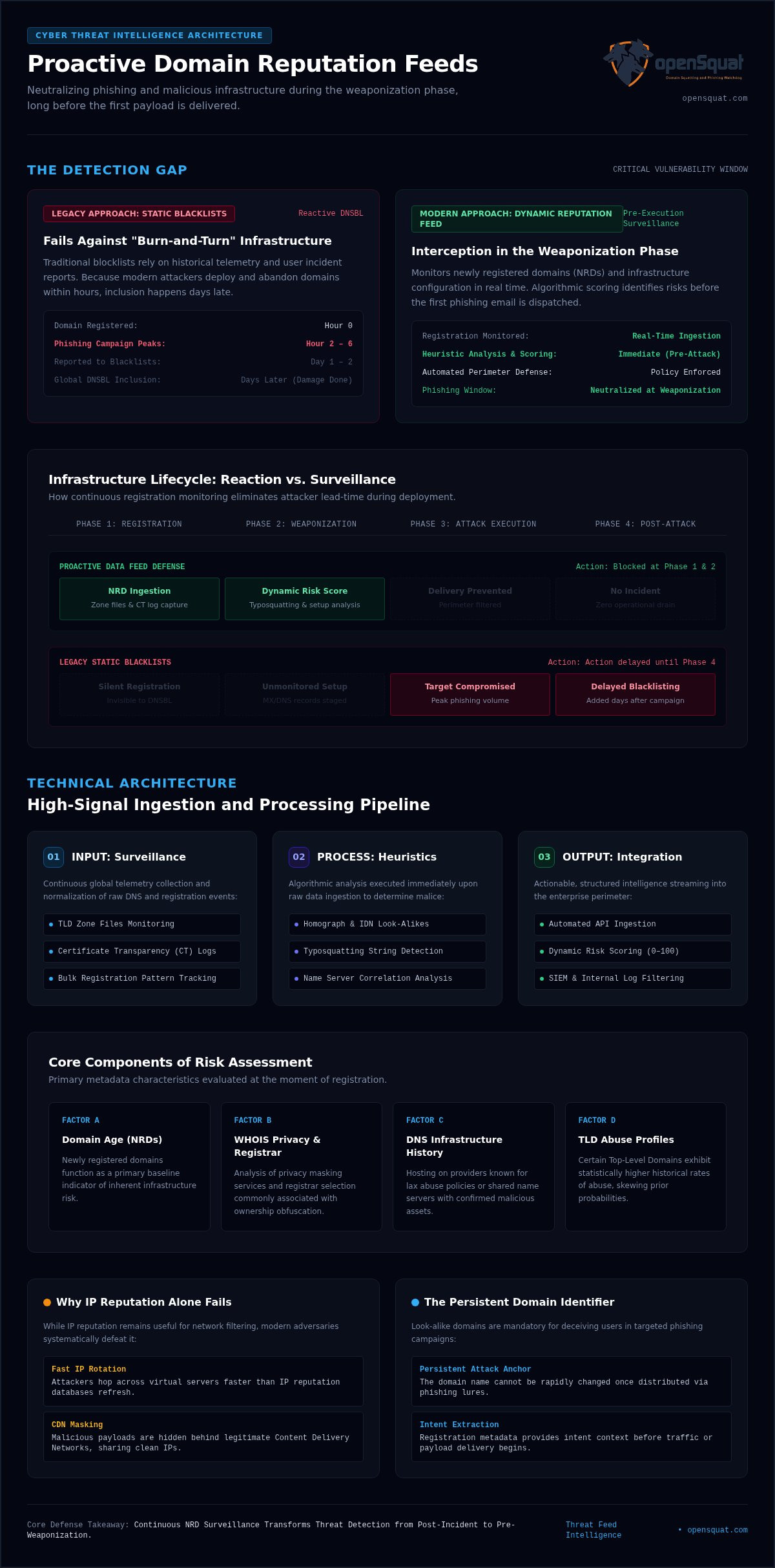
Phishing and malware delivery rely on look-alike domain names to bypass human scrutiny and automated email filters. While IP reputation remains a useful metric for network-level filtering, it's often insufficient. Attackers frequently rotate IPs or hide behind legitimate Content Delivery Networks (CDNs), making the domain the only persistent identifier of the threat. Domain-level intelligence provides the context needed to understand the intent behind a registration before it's weaponized.
The Core Components of a Reputation Signal
Risk assessment begins at the point of registration. High-signal feeds analyze registrar choices and the use of WHOIS privacy services, which can indicate an intent to obfuscate ownership. DNS infrastructure history also plays a critical role. If a domain is hosted on a provider known for lax abuse policies or shares name servers with previously identified malicious assets, its risk score increases. Additionally, certain Top-Level Domains (TLDs) exhibit higher historical rates of abuse, providing a baseline probability of malice before any traffic is even observed.
Why Traditional Blacklists are No Longer Sufficient
Legacy systems rely on Domain Name System blocklists (DNSBL) to mitigate known threats. However, modern adversaries utilize "burn-and-turn" infrastructure, where domains are registered, used for a single campaign, and abandoned within hours. This creates a significant time-to-detection gap. By the time a domain is reported and added to a reactive list, the damage is already done. The delay between registration and blacklist inclusion often spans days, leaving a window of opportunity for attackers.
A proactive domain reputation data feed addresses this by focusing on newly registered domains (NRDs). High-frequency data updates ensure that security teams can ingest intelligence as soon as a domain enters the global ecosystem. This allows for the implementation of defensive measures during the weaponization phase. Transitioning from reactive mitigation to proactive surveillance is necessary to counter automated attack frameworks that deploy hundreds of unique domains in minutes. Precise data ingestion ensures that your perimeter defense stays ahead of these rapid infrastructure shifts.
The Technical Architecture of a High-Signal Reputation Feed
Constructing a reliable domain reputation data feed requires an engineered pipeline capable of processing massive datasets in near real-time. This architecture transforms raw internet telemetry into actionable intelligence through a structured input-process-output model. Security teams rely on this precision to automate defensive actions before an attack reaches the network perimeter. A high-signal domain reputation data feed ensures that these automated systems operate on the most current infrastructure data available.
Input: Global Domain Surveillance
Data ingestion in domain surveillance is the continuous collection and normalization of registration records and DNS updates from global sources. This process involves monitoring Top-Level Domain (TLD) zone files and Certificate Transparency (CT) logs to identify infrastructure as it's provisioned. By aggregating these signals, the system detects bulk registration patterns that often precede automated phishing campaigns. Following standards like the NIST SP 800-81 Rev. 3 Secure DNS Deployment Guide helps ensure that the underlying DNS controls are robust enough for enterprise-grade perimeter defense.
Process: Heuristics and Pattern Recognition
Once data is normalized, it undergoes algorithmic analysis to identify specific threat indicators. Heuristics detect homograph attacks, where internationalized domain names (IDN) use look-alike characters to mimic legitimate brands. The system also monitors for bit-squatting variations and registrar-hopping, which are common tactics used to evade detection. Analyzing the entropy of a domain name helps distinguish between human-readable strings and machine-generated algorithms used by malware. Keyword distance calculations then determine how closely a new registration resembles a protected asset.
This raw data is finally weighted to produce a machine-readable reputation score. These scores categorize domains into specific risk levels, allowing SOC teams to set automated thresholds for blocking or inspection. To maintain interoperability with existing security stacks, the intelligence is delivered in standardized formats like JSON, STIX/TAXII, or CSV. SOC teams can streamline this process through commercial API access, ensuring that high-throughput environments receive updates without manual intervention. This modular approach ensures that the data remains functional and easy to integrate into complex security orchestration workflows.
Beyond Blacklists: Why Newly Registered Domains (NRD) Redefine Reputation
Domain age serves as a primary indicator of trust in modern network defense. Most established domains possess a multi-year history of legitimate traffic and consistent DNS records. A high-quality domain reputation data feed recognizes that the absence of history is itself a signal. New domains lack this telemetry, making them the preferred vehicle for short-lived, high-impact attacks. By focusing on the registration event, security teams can identify threats during the setup phase, well before an adversary initiates a campaign.
Adopting a proactive stance requires moving beyond reactive blocklists. While traditional feeds wait for a domain to exhibit malicious behavior, a domain reputation data feed utilizing NRD data treats newness as a risk factor. This approach provides an early warning layer that is essential for brand protection and credential harvesting prevention. Integrating newly registered domain feeds into threat hunting workflows allows analysts to monitor infrastructure as it's provisioned, rather than after it's weaponized.
NRD Feeds vs. Standard Reputation Feeds
Standard reputation feeds are built on observed malice. A domain must first target a user or deliver a payload to be indexed. This creates a detection window that often spans several days. In contrast, NRD feeds focus on suspicious new registrations, reducing the detection window to hours. These feeds provide the raw material for custom brand monitoring, allowing organizations to flag domains that mimic their own corporate assets immediately after registration. This predictive capability is the difference between stopping a phishing email at the gateway and investigating a successful compromise.
The Anatomy of a Malicious Registration
Domains registered for phishing campaigns often exhibit specific characteristics, such as unusual naming conventions or the use of cheap, high-abuse TLDs. Adversaries frequently engage in domain squatting to facilitate credential harvesting, creating look-alike URLs that deceive employees and customers. A brand monitoring dashboard enables SOC teams to visualize registration spikes and identify these patterns in real-time. Implementing this intelligence within CISA's Protective DNS Resolver architecture allows for the automated sinkholing of suspicious queries. This architecture ensures that even if a user clicks a malicious link, the connection is terminated at the resolver level based on the reputation signal.
Operationalizing Domain Intelligence: From Data Ingestion to Incident Response
Transforming a domain reputation data feed into a functional security control requires a structured operational workflow. Raw data provides little value until it's integrated into the tools your SOC team uses daily. This process moves through four distinct stages: ingestion, enrichment, visualization, and enforcement. By automating these stages, organizations can respond to infrastructure threats at machine speed, reducing the window of vulnerability from days to seconds. A well-architected pipeline ensures that your domain reputation data feed remains a proactive asset rather than a source of alert fatigue.
- Step 1: Ingestion. Utilize a security API for domain feeds to automate the delivery of newly registered domain data directly into your environment.
- Step 2: Enrichment. Filter and cross-reference the feed against internal DNS logs and SIEM events to identify existing connections to high-risk infrastructure.
- Step 3: Visualization. Aggregate high-signal alerts within a SOC dashboard to provide analysts with a clear view of emerging brand impersonation campaigns.
- Step 4: Enforcement. Implement proactive blocking or DNS sinkholing for domains that exceed your organization's risk threshold.
API-First Integration Strategies
An API-first approach prioritizes programmatic access to data, ensuring that threat intelligence is consumed directly by security orchestration tools rather than through manual interfaces. This strategy allows security teams to leverage a domain threat intelligence API for real-time lookups during incident triage. Automating the discovery of look-alike domains within SOAR playbooks ensures that defensive measures are deployed consistently across the enterprise. This integration reduces the manual burden on analysts, allowing them to focus on complex threat hunting tasks rather than data collection.
Reducing Noise and False Positives
High-signal data requires precise filtering to remain useful. Set risk thresholds based on your specific organizational threat model, prioritizing assets that target your brand or executive leadership. Combine your reputation data with internal allow-lists to prevent the accidental blocking of critical partner infrastructure. It's also vital to account for reputation decay; the risk level of a domain changes over time as more telemetry becomes available. Dynamic feeds must update these scores continuously to reflect the current state of the domain's activity. To start building a high-scale defense, explore commercial API access for seamless integration into your existing security stack.
Scaling Your Perimeter Defense with openSquat Enterprise Feeds
The openSquat open-source tool provides a foundation for identifying brand impersonation, but enterprise-scale operations require higher throughput and data reliability. Moving to a professional domain reputation data feed ensures that your security stack receives prioritized telemetry without the latency associated with community-driven data collection. This transition allows SOC teams to focus on mitigation rather than managing the underlying data ingestion infrastructure. Clinical precision in data delivery is a requirement for modern security operations, where the speed of registration often outpaces traditional detection methods. By utilizing a domain reputation data feed, your team can maintain a vigilant posture against rapidly evolving infrastructure threats.
Enterprise-Grade vs. Community Tools
Community versions often lack the Service Level Agreements (SLAs) necessary for protecting critical infrastructure. Enterprise feeds provide guaranteed data reliability and access to bulk newly registered domain lists, which are essential for deep historical analysis and long-term threat hunting. Customization options allow you to tailor enterprise threat intelligence feeds to your specific organizational risk profile, ensuring that the signals you receive are relevant to your protected assets. This engineering rigor supports high-throughput environments where missing a single registration could lead to a successful breach. Organizations can rely on structured data formats that respect the technical proficiency of their engineering teams, allowing for predictable integration into existing workflows.
Getting Started with openSquat
Centralizing your brand surveillance is achieved through the brand monitoring dashboard, which provides a unified view of registration trends and potential typosquatting. Evaluating the feed involves testing its performance against your specific brand monitoring needs and existing security ecosystem. Integration is streamlined through commercial API access, allowing for the direct ingestion of high-signal data into your SIEM or SOAR platforms. This approach ensures that your analysts spend less time triaging noise and more time neutralizing verified threats. Use the data to build a proactive defense that identifies malicious infrastructure before it is weaponized against your users.
To begin protecting your infrastructure, Request access to the openSquat Enterprise Feed. This step moves your organization from a reactive posture to a proactive defense model built on real-time domain surveillance.
Strengthening Your Infrastructure Against Emerging Domain Threats
Effective perimeter defense requires a transition from reactive blocklists to real-time registration surveillance. By treating domain age as a primary risk indicator, security teams identify malicious infrastructure during the weaponization phase. Integrating a high-signal domain reputation data feed into your existing SOAR or SIEM environment ensures that your defensive posture remains alert to new threats without the overhead of manual triage. This engineering-led approach provides the clinical precision needed to distinguish between legitimate registrations and brand impersonation attempts at scale.
Specialized newly registered domain intelligence and a high-throughput commercial API allow your SOC to operate with the same speed as the adversaries you track. Transitioning to professional-grade telemetry is the most direct path to reducing successful phishing attacks through early detection. It's time to move beyond static scoring and adopt a dynamic signal built for modern enterprise requirements. Secure your brand with the openSquat Enterprise Data Feed. Maintaining a vigilant, data-driven defense is the most effective safeguard for your digital perimeter.
Frequently Asked Questions
What is the difference between a domain reputation feed and a DNS blacklist?
A DNS blacklist is typically a reactive list of known malicious domains, whereas a domain reputation data feed provides proactive scoring based on registration metadata. Blacklists rely on observed abuse, while reputation feeds analyze infrastructure characteristics before weaponization occurs. This allows security teams to identify high-risk assets earlier in the attack lifecycle, moving beyond static lists to dynamic signals derived from real-time registration surveillance.
How often is the domain reputation data updated?
Data updates occur continuously as new registrations and DNS changes are detected across global TLD zone files. High-throughput environments require real-time telemetry to stay ahead of automated attack frameworks. Enterprise-grade feeds ensure that registration events are ingested and scored shortly after appearing in the global DNS ecosystem, providing the most current visibility available for your perimeter defense and brand monitoring efforts.
Can I integrate this data feed into my existing SIEM or SOAR platform?
Yes, the feed is designed for seamless integration into existing security orchestration stacks through standardized data formats. Automated ingestion allows SOAR playbooks to trigger defensive actions based on specific risk thresholds. This programmatic approach ensures that your SOC can operationalize threat intelligence without manual intervention, streamlining the response to potential brand impersonation campaigns and reducing the burden on your security analysts.
Does a domain reputation feed include newly registered domains (NRDs)?
Specialized focus on newly registered domain data is a core component of a high-signal domain reputation data feed. Since new domains lack a historical trust record, they're inherently higher risk. Monitoring NRDs allows for the detection of "burn-and-turn" infrastructure used in phishing and malware delivery. This early warning layer is essential for proactive brand protection strategies, identifying threats before the first email is sent.
What technical formats are available for the data feed?
Enterprise consumption is supported through multiple machine-readable formats, including JSON, CSV, and STIX/TAXII. These formats ensure interoperability with a wide range of firewall, proxy, and endpoint security solutions. Providing structured data allows your engineering team to ingest and process intelligence using existing automation tools, maintaining a fast-paced and methodical security workflow that respects the technical proficiency of your internal security operations.
How does openSquat identify potential typosquatting or look-alike domains?
Identification relies on algorithmic analysis and heuristics that detect variations in brand-related keywords. The system analyzes homograph attacks, bit-squatting, and unusual naming conventions. By calculating keyword distance and analyzing registration patterns, the feed flags domains that mimic protected assets. This engineering-led approach ensures high-signal detection while minimizing false positives for the SOC team, focusing only on relevant infrastructure threats that target your brand.
Is there an API available for automated domain reputation lookups?
Commercial API access is available for high-scale security operations requiring automated lookups. The API enables real-time queries against the reputation database, supporting high-throughput integration for incident triage and threat hunting. This programmatic access allows your security stack to verify domain risk levels instantly, facilitating faster decision-making during active investigations and ensuring your defense remains as fast as the malicious data it processes.
Does openSquat provide domain takedown services as part of the feed?
No, openSquat doesn't provide domain takedown or registration services. The platform specializes in providing enterprise-grade newly registered domain feeds and threat intelligence for proactive detection. Organizations utilize the provided data and brand monitoring dashboard to identify malicious infrastructure. Once a threat is confirmed, teams follow their internal incident response protocols or engage with specialized third-party providers for takedown execution and legal enforcement.


