
The window between a domain's registration and its use in a phishing campaign is shrinking, often leaving security teams with only minutes to respond. Relying on reactive reputation databases means you're defending against yesterday's threats while today's infrastructure is currently being staged. You understand that the primary challenge isn't just getting data; it's filtering out the noise and reducing the latency between registration and detection. High-volume feeds often create more friction than they solve if they aren't properly integrated into an automated workflow.
This article provides a technical roadmap to master the integration of a security API for domain feeds. You'll learn how to ingest real-time newly registered domain (NRD) data to identify look-alike domains and malicious patterns before attacks launch. We'll cover the mechanics of high-throughput data ingestion, the logic for automated identification of typosquatting, and the specific API calls needed for seamless SOC workflow integration. By moving from manual oversight to programmatic surveillance, you can transform raw intelligence into actionable defense.
Key Takeaways
- Shift from reactive defense to proactive surveillance by ingesting Newly Registered Domain (NRD) data at the moment of registration.
- Identify core engineering requirements for a security API for domain feeds, specifically focusing on sub-hour data freshness and enterprise-grade throughput.
- Establish a modular ingestion layer to normalize raw domain intelligence for seamless integration with internal SOAR and SIEM schemas.
- Evaluate threat intelligence providers based on signal-to-noise ratios and latency benchmarks to reduce alert fatigue in the SOC.
- Navigate the transition from open-source domain monitoring to high-signal commercial API access for enterprise-scale infrastructure discovery.
The Evolution of Domain Surveillance: Why Security APIs are Critical
Modern threat landscapes require a fundamental shift in how security teams perceive domain data. A security API for domain feeds isn't merely a lookup tool; it's a high-throughput ingestion engine designed to pipe millions of raw registration records directly into your analytical environment. Traditional defensive postures rely heavily on blacklists, which are inherently reactive. By the time a domain appears on a reputation list, the phishing campaign has likely already reached its peak impact. This reliance on post-incident indicators creates a dangerous delay that attackers exploit with precision.
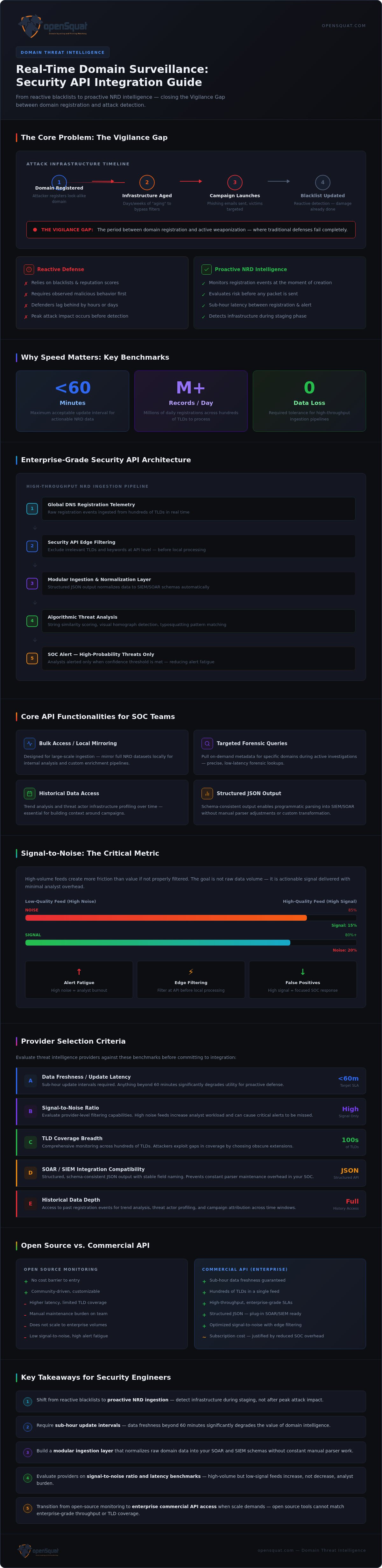
Newly Registered Domain (NRD) data serves as the foundation for identifying malicious infrastructure during the reconnaissance and staging phases. Attackers often register domains days or weeks before launching a campaign to age the infrastructure and bypass basic security filters. We refer to the period between registration and active weaponization as the Vigilance Gap. Closing this gap requires sub-hour visibility into DNS registration events as they occur, rather than waiting for third-party validation or manual reports.
From Reputation Scores to Registration Intelligence
Relying on reputation scores is often a terminal mistake in brand protection. These scores are lagging indicators that require observed malicious behavior to trigger a change in status. In contrast, registration intelligence focuses on the metadata of the domain itself at the moment of creation. The technical advantage of a security API for domain feeds lies in its ability to deliver this raw data without the latency inherent in manual lookups. Monitoring DNS registrations at the source allows security teams to evaluate the risk profile of a domain before a single packet is sent. NRD intelligence acts as the proactive layer of a modern SOC by shifting focus from observed malicious activity to the infrastructure enabling it.
Automating the Hunt for Look-alike Domains
Manual surveillance of the global domain space is impossible. With hundreds of thousands of new registrations daily, security teams need algorithmic analysis to identify typosquatting and homograph attacks. APIs enable this scale by feeding high-signal data into automated detection engines that calculate string similarity and visual resemblance in real time. Integrating these capabilities with a brand monitoring dashboard concept allows for automated workflows that alert analysts only when a high-probability threat is detected. This automation ensures that brand surveillance remains constant and scalable without increasing the administrative burden on the SOC.
Technical Specifications of an Enterprise-Grade Security API
An enterprise security API for domain feeds operates as the gateway between global registration telemetry and your internal security stack. Performance in this context is defined by technical precision and engineering rigor. High-throughput feeds require sub-hour update intervals to remain actionable for proactive defense. Any latency beyond sixty minutes significantly reduces the utility of NRD data, as attackers often weaponize infrastructure shortly after registration. Systems must be engineered to ingest millions of daily records across hundreds of TLDs without data loss or significant processing delays.
Schema consistency is critical for automated parsing. A structured JSON output allows your SIEM or SOAR platforms to ingest data programmatically without constant manual adjustment to parser logic. This modularity ensures that your surveillance capabilities can scale alongside your infrastructure. Additionally, edge filtering capabilities allow you to reduce noise before the data ever reaches your local systems. By excluding irrelevant TLDs or specific keywords at the API level, you optimize local storage and processing resources while maintaining high signal-to-noise ratios.
Core API Functionalities for SOC Teams
SOC teams must select the ingestion model that matches their operational requirements. Bulk access models are designed for large-scale ingestion where you mirror NRD data locally for internal analysis. Targeted queries, conversely, support specific forensic investigations by allowing analysts to pull metadata on demand. Historical data access is another essential functionality; it provides the context needed for trend analysis and profiling threat actor infrastructure over time. Utilizing a domain threat intelligence API allows analysts to enrich raw domain records with deeper contextual metadata for better decision-making.
Reliability and Uptime in Critical Infrastructure
Enterprise security data feeds require strict SLA standards to ensure continuous monitoring. Redundancy and failover mechanisms are essential to prevent gaps in CTI delivery during regional outages or infrastructure maintenance. Technical honesty in API documentation is a trust-builder because it allows security engineers to architect systems based on actual performance limits rather than marketing projections. To ensure your stack is built on verified telemetry, consider integrating commercial API access from a specialized provider. This approach guarantees that your automated workflows are supported by reliable, high-signal data feeds designed for expert use.
Architecting High-Throughput Workflows for NRD Ingestion
Establishing a robust defensive pipeline requires a modular architecture that prioritizes speed and data integrity. Your ingestion layer should utilize a security API for domain feeds via standard RESTful calls to pull raw registration data at regular intervals. Once received, normalize this data immediately to align with your internal security schemas. This normalization ensures that downstream analytical tools process the information without encountering formatting errors or missing fields. It's the first step in transforming raw telemetry into actionable intelligence.
After normalization, apply heuristic and fuzzy matching algorithms to the domain strings to identify potential brand infringements. You should look for common typosquatting patterns, visual similarities, or character substitutions. Enrich these flagged domains with WHOIS, SSL, and DNS reputation data to confirm their risk profile and determine the intent behind the registration. Finally, configure your workflow to trigger automated response actions in your SOAR platform. This might include generating a high-priority alert for human review or automatically updating web proxy blocklists for high-confidence threats.
Integrating with SIEM and SOAR Platforms
Determining the delivery method is a critical architectural choice for your SOC. A "pull" model provides better control over ingestion rates and resource consumption, while a "push" model through webhooks offers the lowest possible latency. Map your API outputs to common security data models like STIX or TAXII to maintain interoperability across your entire security stack. Pre-ingestion filtering is essential to reduce alert fatigue; don't let every new registration reach your analysts. Filter by TLD risk scores or keyword density at the edge to ensure only high-signal alerts enter the SOC queue.
Scaling Surveillance for Global Brands
Monitoring global brands requires managing high-volume TLD data across multiple jurisdictions simultaneously. This includes tracking legacy gTLDs, newer nTLDs, and specific ccTLDs that are frequent targets for impersonation. You must also account for Internationalized Domain Names (IDNs) and Punycode variations that attackers use to bypass simple string matching. Selecting the right data source is paramount for achieving this scale. Use established newly registered domain feeds evaluation criteria to ensure your provider handles the throughput of the modern domain landscape without dropping critical telemetry.
Critical Selection Criteria for Domain Threat Intelligence APIs
Selecting a security API for domain feeds requires a framework that prioritizes data utility over raw volume. You must evaluate the technical architecture of the provider to ensure the telemetry is both timely and accurate. Breadth of coverage is the first benchmark. An enterprise-grade solution must monitor the entire DNS landscape, including legacy gTLDs, diverse ccTLDs, and the rapidly growing set of nTLDs. Gaps in TLD coverage create blind spots that attackers specifically target to avoid detection by regional or limited monitoring services.
Latency benchmarks are equally vital. Measure the delta between a domain registration event and its availability within the API. If this interval exceeds sixty minutes, you're effectively defending against stale infrastructure. High-throughput environments also require robust technical support. Access to engineering-level assistance during the integration phase ensures that your RESTful calls and parsing logic are optimized for performance. This level of support is often the deciding factor in maintaining a resilient surveillance pipeline.
The Signal-to-Noise Ratio in NRD Feeds
Bulk data without intelligent filtering is a liability for SOC teams. Ingesting every registration without prior analysis leads to alert fatigue and excessive compute costs. Algorithmic scoring plays a critical role here by identifying high-risk registrations based on string patterns, entropy, and registrar reputation before delivery. While the openSquat open-source tool provides a strong foundation for identification, commercial API precision offers the scale and refinement needed for enterprise environments. It reduces the noise at the source, allowing your analysts to focus on genuine threats rather than false positives.
Total Cost of Ownership (TCO) for Security APIs
Calculating the TCO for security APIs involves more than comparing subscription prices. You must factor in integration time, data storage requirements, and the analyst hours spent on manual review. Low-quality or high-latency feeds carry hidden costs that manifest as missed threats or bloated SIEM licenses. High-signal data reduces these downstream expenses by streamlining the detection process. Evaluating the ROI of proactive brand protection shows that preventing an attack at the staging phase is significantly more cost-effective than post-incident remediation. To secure your infrastructure with high-precision telemetry, integrate commercial API access into your security stack today.
Implementing openSquat’s Commercial API for Real-Time Defense
openSquat's commercial architecture is engineered for high-signal output, moving beyond the constraints of localized open-source deployments. While the open-source tool remains a standard for targeted keyword hunting, the security API for domain feeds provides the global infrastructure required for persistent, real-time surveillance. It removes the operational burden of managing local DNS collection and delivers pre-filtered, low-latency NRD data directly into your analytical environment. This clinical precision ensures that your security stack processes only the registrations that present a documented risk, effectively reducing the computational load on your internal analysis engines.
Enterprise API Features and Capabilities
The enterprise tier provides high-throughput access tailored for SOC and CTI teams who require reliable, programmatic ingestion at scale. Unlike generic threat intelligence feeds that aggregate stale indicators, openSquat focuses on the registration event itself. It captures malicious infrastructure during the staging phase before it reaches a weaponized state. Granular filtering options allow for targeted brand surveillance across all active TLDs, including complex ccTLDs and nTLDs that are often overlooked by regional providers. Commercial users also gain access to direct engineering support to assist with complex enterprise integrations, ensuring that RESTful calls are optimized for the specific throughput requirements of your SIEM or SOAR platform.
Getting Started with openSquat Enterprise
Transitioning to the commercial tier is a methodical process designed to respect the technical proficiency of your engineering team. Start by requesting API documentation and sandbox access to verify schema compatibility with your existing security data models. Once the connection is established, use the security API for domain feeds to set up your first brand monitoring workflow by defining your primary keyword sets and TLD focus. This enables automated phishing domain discovery that operates in the background, alert-driven and purposeful. The system identifies look-alike domains and typosquatting attempts in real time, allowing your SOC to respond before the first phishing email is sent. To begin integrating high-precision telemetry into your defensive stack, Request Commercial API Access for openSquat.
Transitioning to Proactive Domain Infrastructure Surveillance
Modern defensive strategies depend on the ability to identify threat infrastructure before it becomes active. By shifting from reactive reputation lookups to real-time registration intelligence, security teams can close the vigilance gap that attackers exploit. Integrating a high-throughput security API for domain feeds into your existing stack ensures that your SOC receives actionable telemetry with minimal latency. This methodology replaces manual oversight with automated, high-signal surveillance across the global DNS landscape.
openSquat's enterprise solutions provide clinical precision in NRD data delivery; they're engineered specifically for seamless SOC integration. You can maintain a vigilant posture by leveraging low-latency updates that identify look-alike domains at the moment of registration. It's time to move beyond the limitations of legacy blacklists and adopt a proactive stance against typosquatting and phishing staging operations.
Access the openSquat Commercial API for Enterprise Threat Intelligence to secure your environment with verified registration telemetry and engineering-grade support.
Frequently Asked Questions
What is the primary difference between a security API for domain feeds and a standard reputation API?
The primary difference lies in the defensive timing. A security API for domain feeds provides visibility into infrastructure at the moment of registration, allowing for proactive defense. Standard reputation APIs are reactive; they depend on observed malicious activity to flag a domain. By the time a reputation score drops, the phishing campaign's usually already launched. Registration-based intelligence captures the threat during the staging phase before weaponization occurs.
How quickly are newly registered domains available in the openSquat API?
Data freshness is a core engineering requirement for enterprise security. Newly registered domains are typically available within sub-hour update intervals via the commercial API. This low-latency delivery is critical for closing the gap between a domain's creation and its use in an attack. High-throughput feeds ensure your SOC has access to the most recent global registration telemetry as it happens across hundreds of TLDs.
Can I integrate the openSquat API directly into my SIEM or SOAR platform?
Yes, the API's designed for seamless integration with modern SIEM and SOAR platforms. It uses standard RESTful calls, allowing security engineers to establish a modular ingestion layer quickly. You can choose between a pull model for controlled resource consumption or a push model via webhooks for immediate alerting. This flexibility ensures that domain intelligence flows directly into your existing automated response workflows without manual intervention.
Does the API support bulk ingestion for enterprise-scale threat hunting?
The commercial API's specifically engineered for bulk ingestion at an enterprise scale. It handles millions of daily registration records across legacy gTLDs, nTLDs, and ccTLDs. Rate limits are structured to support high-volume surveillance, making it a reliable tool for global brand monitoring. This high-throughput capability allows you to mirror the global NRD data locally for deeper internal analysis or large-scale threat hunting operations.
What data formats are supported for the domain threat intelligence feeds?
All data is delivered in structured JSON format to ensure high-speed automated parsing. This consistency allows your security stack to ingest records without the need for frequent parser adjustments. The schema's designed to be compatible with common security data models such as STIX and TAXII. Using standardized formats simplifies the normalization process and ensures that domain metadata's immediately usable across different analytical tools within your SOC.
How does openSquat ensure a high signal-to-noise ratio in its NRD feeds?
openSquat utilizes algorithmic scoring and edge filtering to maintain a high signal-to-noise ratio. The system analyzes domain strings for entropy, visual similarity to known brands, and registrar reputation before the data reaches your API endpoint. This pre-filtering reduces the volume of irrelevant records, ensuring your analysts focus only on high-risk registrations. It prevents alert fatigue by delivering actionable intelligence rather than raw, unfiltered data dumps.
Is historical domain registration data available via the API?
Yes, historical domain registration data's available for forensic analysis and threat actor profiling. Accessing these records allows security teams to identify patterns in infrastructure staging and track the evolution of specific threat groups over time. This historical context is essential for building long-term defensive strategies and understanding the lifecycle of malicious domains. It provides the depth needed for comprehensive investigations beyond the immediate registration event.
Does openSquat provide domain takedown services through the API?
No, openSquat doesn't provide domain takedown services. The platform's a specialized threat intelligence provider focused exclusively on the identification and analysis of malicious domain registrations. It isn't a 24/7 managed SOC or a domain registrar. It's our objective to deliver high-signal telemetry that empowers your internal security team to execute their own response actions and remediation protocols within their established workflows.


