
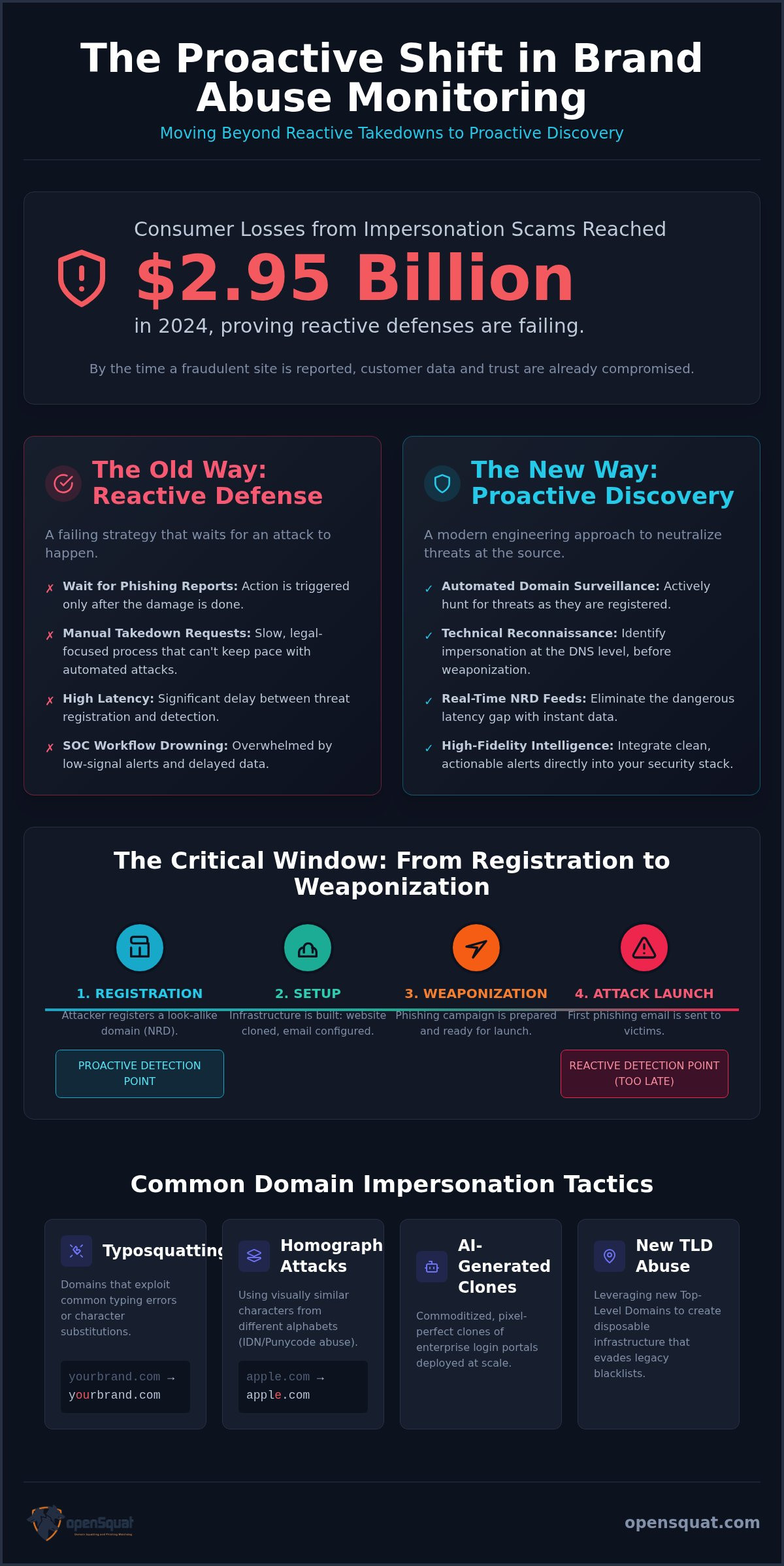
Why are you still waiting for a phishing campaign to land in your inbox before you act? Effective brand abuse monitoring isn't a legal exercise in filing takedown requests; it's a technical engineering challenge of reconnaissance. In 2024, consumer losses from impersonation scams reached $2.95 billion. This proves that reactive defenses are failing. By the time a fraudulent site is reported, the data is often already compromised. You must identify threats at the source, long before they weaponize.
It's exhausting to manage a SOC workflow that's drowning in low-signal alerts and expensive, delayed threat data. You want high-fidelity intelligence that integrates directly into your existing systems without the noise. This article provides the technical frameworks required to master brand abuse monitoring through high-signal domain intelligence. We'll explore how to automate the discovery of typosquatting, utilize newly registered domain (NRD) feeds, and reduce your time-to-detection. You'll learn to move beyond reactive brand protection and build a proactive discovery engine that identifies impersonation at the point of registration.
Key Takeaways
- Transition from manual protection to automated domain surveillance to counter modern, automated impersonation tactics.
- Identify Newly Registered Domains (NRDs) as the primary technical vector for typosquatting and look-alike attacks.
- Prioritize proactive identification over reactive takedowns to eliminate the dangerous latency between registration and weaponization.
- Streamline your SOC workflow by integrating high-signal brand abuse monitoring feeds directly into existing security stacks.
- Leverage centralized visibility through an enterprise-grade dashboard to manage high-throughput domain intelligence at scale.
The Evolution of Brand Abuse Monitoring in 2026
The threat landscape in 2026 is defined by high-velocity, automated impersonation. Attackers no longer rely on manual phishing setups. They use sophisticated scripts to deploy thousands of look-alike domains across multiple registrars simultaneously. Traditional Brand protection strategies, which often rely on manual reporting and reactive legal takedowns, cannot keep pace with this algorithmic scale. Modern brand abuse monitoring must function as a technical reconnaissance operation. It requires clinical efficiency to filter out the noise of the global DNS and identify high-signal threats before they reach the victim's browser.
Emerging Impersonation Tactics
AI-generated content has commoditized the creation of pixel-perfect clones of enterprise login portals. Attackers combine these clones with targeted homograph attacks, where internationalized domain names use visually similar characters to bypass human detection. A 2026 survey of CISOs revealed that 75% of security leaders expect social media impersonation and defamation to be their primary external threats. These campaigns often leverage the rapid registration of new Top-Level Domains (TLDs) to create temporary, disposable infrastructure that evades legacy blacklists. The speed of these registrations makes manual oversight impossible for global organizations.
Why Enterprise Visibility Matters
The critical window for defense exists between domain registration and the first phishing email sent. Identifying this gap is essential for proactive security. In 2024, consumer losses from impersonation scams reached $2.95 billion. These losses represent a direct failure of reactive monitoring. When a brand waits for a customer to report a fake site, the damage to trust and revenue is already locked in. The FTC Impersonation Rule, effective since April 1, 2024, highlights the legal gravity of these scams, but regulatory penalties don't recover lost customer confidence.
Transitioning from a legal-led to a security-led strategy is the only way to achieve necessary speed. Security teams need direct access to domain intelligence to automate discovery. This shift moves the focus from "how do we take this down?" to "how do we detect this before it launches?". Effective brand abuse monitoring provides the data ingestion capabilities required to scan newly registered domains in real-time. It enables SOC teams to treat brand impersonation as a network security event rather than a trademark dispute. By focusing on the source, enterprises can neutralize threats during the setup phase before they scale.
The Mechanics of Domain-Based Brand Impersonation
Domain-based impersonation starts at the registry level. Newly Registered Domains (NRDs) serve as the primary vector for these attacks. They offer a clean slate with no historical reputation. This lack of history allows malicious domains to bypass traditional reputation-based security filters. To implement effective brand abuse monitoring, security teams must analyze the high volume of DNS registrations occurring every hour. The engineering challenge lies in the math. With hundreds of thousands of new registrations daily, identifying the specific domains targeting your brand requires precise algorithmic filtering rather than manual oversight. Catching these threats at the DNS level before they resolve to a live server is the only way to prevent initial access.
Typosquatting and Homograph Attack Detection
Attackers employ several techniques to create deceptive domains. Character substitution and bit-squatting are common. Bit-squatting is a specialized technique that relies on hardware errors flipping a bit in memory, which leads a user to a slightly different IP address than intended. We also see a rise in Punycode and Internationalized Domain Name (IDN) abuse. These use non-Latin characters that appear identical to standard letters in many browsers. Recent government reports on brand impersonation confirm that these technical nuances remain the backbone of credential harvesting campaigns. Utilizing typosquatting detection tools allows for the automated discovery of these permutations. It removes the need for security analysts to guess every possible variant of their brand name.
The Importance of Real-Time NRD Feeds
Latency represents a significant security risk in domain surveillance. If your data is 24 hours old, the attacker has likely already finalized their campaign setup and launched their first wave of phishing. Real-time access to newly registered domain feeds is mandatory for enterprise-scale protection. These feeds provide the raw data required for high-signal threat hunting. Integrating these feeds into your SOC stack enables immediate analysis of domain metadata, such as name server patterns and registrar choices. This input-process-output flow ensures that your security team isn't reacting to an incident but is instead monitoring the infrastructure as it is built. For organizations requiring high-throughput data, accessing a commercial API provides the necessary signal to identify threats at the point of registration.
Proactive Surveillance vs. The Takedown-First Myth
Reliance on takedown services as a primary defense strategy is a critical security misconception. A takedown is a legal action; it isn't a technical control. While many organizations believe a successful takedown solves the problem, the technical reality of attacker speed renders this approach insufficient. Attackers can register a new look-alike domain in seconds, often before the previous one has been fully processed by a registrar's legal department. This creates a high-latency environment where the brand remains vulnerable. Effective brand abuse monitoring shifts the focus from reactive disruption to proactive reconnaissance. Visibility is the most powerful tool for internal policy enforcement. When you identify a threat during the infrastructure setup phase, you can block the domain at the firewall or mail gateway level before a single user clicks a link.
The Limitations of Takedown Services
Takedowns often involve navigating complex international jurisdictions. Many registrars operate in regions where intellectual property laws are loosely enforced, leading to weeks of delay. This delay is the window of opportunity for an attacker. We see a "Whack-a-Mole" effect where one site goes down and three more appear using different TLDs. openSquat focuses on clinical intelligence rather than legal services. We provide the data required to identify these threats, but we don't engage in the legal process of removal. Our role is to act as a trusted instrument for security teams who value immediate technical visibility over protracted legal battles. Comprehensive monitoring brand impersonation online is the only way to maintain a persistent defense against high-volume attackers.
The Power of Early Reconnaissance
Early detection allows security teams to map attacker infrastructure before a campaign launches. By analyzing registration patterns, such as shared name servers or registrar choices, you can identify clusters of malicious activity. Using automated domain surveillance, organizations can scale their defense to match the volume of modern DNS registration. This intelligence-led approach provides the reputation data needed to quantify risk. It ensures your SOC isn't chasing every typo, but is instead focused on high-signal indicators of intent. Integrating these reconnaissance frameworks into your brand abuse monitoring workflow reduces the total time-to-detection and protects the enterprise at the source. By the time a site is weaponized, your internal defenses should already be in place.
Implementing a High-Signal Monitoring Workflow
Building an effective brand abuse monitoring workflow requires moving from manual inspection to an automated ingestion pipeline. The process begins with the integration of Newly Registered Domain (NRD) feeds into your existing Security Operations Center (SOC) stack. This ingestion should be programmatic. Raw data is ingested, normalized, and then passed through an algorithmic filter that identifies permutations of your high-value brand assets. By automating this discovery-to-alert pipeline, you eliminate the latency associated with manual keyword searches. Centralizing this data is critical for visibility. Leveraging a brand monitoring dashboard allows analysts to view emerging threats across the global DNS from a single interface. This structured approach ensures that every new registration is evaluated against your specific threat model immediately upon entry into the system.
API Integration for Enterprise Teams
High-throughput environments require direct data access via commercial endpoints. Mapping brand protection APIs to internal SIEM or SOAR platforms allows for seamless orchestration. For example, when a squatting domain is detected, the API can trigger an automated lookup of the domain's name servers and IP reputation. This data enrichment happens before an analyst ever sees the alert. Pre-filtering threat intelligence in this manner significantly reduces analyst fatigue. Instead of reviewing thousands of benign registrations, the team only interacts with high-signal alerts that meet pre-defined risk thresholds. This modular workflow treats domain intelligence as just another telemetry source within the broader security architecture.
Criteria for Brand Risk Monitoring Software
Selecting the right instrumentation for brand abuse monitoring involves evaluating three technical pillars: scale, signal quality, and integration flexibility. First, the software must handle the global DNS volume without dropping packets or introducing lag. Second, it must prioritize signal over noise. Raw NRD lists are useful, but actionable intelligence requires sophisticated string distance algorithms to identify subtle typosquatting. Finally, avoid closed-box solutions that lack transparency. An open API architecture is essential for teams that need to export data into custom reporting tools or external databases. For teams ready to implement these technical frameworks, you can access commercial API documentation to begin the integration process.
Scaling Brand Protection with openSquat Enterprise
Transitioning from community-based tools to enterprise-grade infrastructure is a necessary stage for organizations managing global digital footprints. While the openSquat open-source tool provides a robust starting point for localized detection, enterprise-scale brand abuse monitoring requires high-throughput data ingestion that community versions cannot sustain. Global brands face thousands of new domain registrations daily. Processing this volume requires a dedicated commercial infrastructure designed for clinical efficiency. By moving to enterprise-grade feeds, security teams gain access to the raw signal required for proactive surveillance without the throughput limitations of rate-limited community APIs. This transition moves your defense from a manual search process to an automated, high-fidelity data pipeline.
The openSquat Advantage
The value of openSquat lies in its engineering rigor and total transparency. Founded in 2020, the platform evolved from a popular open-source heritage into a specialized tool for threat intelligence professionals. We prioritize functional utility over marketing hyperbole; our focus remains on the data. Our enterprise threat intelligence feeds deliver high-signal information derived from exhaustive DNS analysis and newly registered domain (NRD) tracking. We maintain a commitment to open-source principles by providing clear documentation and structured data formats. This transparency allows your team to understand the logic behind every detection. It positions openSquat as a trusted instrument rather than a closed-box service, giving your SOC the objective data it needs to make rapid security decisions.
Getting Started with Enterprise Monitoring
Implementing a professional monitoring strategy begins with a methodical evaluation of your current risk exposure. You must identify which high-value assets are most vulnerable to typosquatting and impersonation. Once these assets are defined, you can request commercial API access for high-volume testing. This allows your team to validate signal quality within your specific environment. Our API supports seamless integration with existing SIEM and SOAR platforms, ensuring that domain intelligence flows directly into your automated workflows. This input-process-output logic leads to a measurable reduction in time-to-detection. It ensures that your security posture is as fast and responsive as the data it processes. Secure your perimeter by identifying threats at the point of registration, long before they reach your customers.
Scale your brand abuse monitoring with openSquat and integrate high-signal domain intelligence into your enterprise security stack today.
Securing the Enterprise Perimeter with High-Signal Intelligence
Effective brand abuse monitoring requires a fundamental shift from reactive legal strategies to technical reconnaissance. You've seen how attackers leverage Newly Registered Domains (NRDs) and automated scripts to deploy impersonation at scale. To counter these threats, your security operations must prioritize early detection and high-fidelity data ingestion. By integrating automated surveillance into your SOC workflow, you neutralize look-alike domains during the infrastructure setup phase, long before they can weaponize against your customers.
openSquat provides the technical framework needed for this proactive stance. Our clinical precision in domain threat intelligence is backed by a proven heritage in open-source security. We offer high-throughput commercial APIs that ensure seamless integration into your existing SIEM or SOAR platforms. This enables your team to maintain a vigilant, data-driven defense without the noise of low-signal alerts. It's time to move beyond the limitations of manual protection and implement a professional discovery engine. Access Enterprise-Grade Brand Monitoring Data today and take control of your digital footprint with speed and technical honesty. You can build a more resilient brand through superior intelligence.
Frequently Asked Questions
What is the difference between brand abuse monitoring and domain takedowns?
Brand abuse monitoring is the technical reconnaissance used to identify malicious infrastructure, while domain takedowns are the legal actions taken to remove it. openSquat focuses on the identification phase through high-signal intelligence. We don't offer legal or takedown services. This distinction is critical for security teams who need to detect impersonation attempts long before they would typically be reported through manual channels or reactive legal processes.
How does openSquat identify look-alike domains so quickly?
We utilize high-throughput ingestion of Newly Registered Domain (NRD) feeds combined with sophisticated string distance algorithms. This process allows us to scan hundreds of thousands of daily registrations in real-time. By analyzing domain metadata and name server patterns immediately upon registration, we identify look-alike domains before they resolve to live phishing sites. This proactive approach relies on data-driven results rather than manual keyword searches, ensuring comprehensive coverage of the global DNS.
Can I integrate openSquat feeds into my existing SIEM or SOAR?
Yes. Integration is a core function of our Commercial API Access. The API is designed for seamless ingestion into enterprise SIEM and SOAR platforms, allowing you to automate the discovery-to-alert pipeline. This modular approach ensures that domain intelligence becomes a standard telemetry source within your existing security architecture. It reduces analyst fatigue by delivering pre-filtered, high-signal alerts directly into the tools your team already uses for incident response.
Does brand abuse monitoring cover social media and the dark web?
openSquat specializes specifically in domain-based infrastructure and DNS surveillance. Our primary focus is the identification of malicious registrations through enterprise-grade NRD feeds. While social media and dark web impersonation are significant threats, our technical frameworks are engineered for the clinical monitoring of domain names and look-alike URLs. This specialization ensures high-signal accuracy in detecting the technical infrastructure used in phishing and credential harvesting campaigns rather than broad social listening.
How many new domains are registered daily and how do you filter them?
On average, several hundred thousand new domains are registered every single day. We filter this massive volume using a clinical, input-process-output methodology. Our algorithms evaluate each registration against your specific brand assets using technical indicators such as Levenshtein distance and character substitution. This automated filtering reduces millions of raw data points into a manageable list of high-signal threats, which are then delivered through our Brand Monitoring Dashboard.
What makes openSquat different from open-source tools like DNSTwist?
While tools like DNSTwist are excellent for point-in-time scans, openSquat is built for continuous, enterprise-scale surveillance. We provide real-time access to global NRD feeds and a centralized Brand Monitoring Dashboard that open-source tools lack. Our commercial infrastructure supports the high-throughput requirements of global brands and offers API integration for automated workflows. We maintain our open-source heritage while delivering the premium data quality and scale required for professional security operations.
Is a commercial API necessary for small security teams?
A commercial API is essential for any team that requires automated discovery or high-volume testing. Small teams often face limited resources and cannot afford the time required for manual domain lookups. The API provides the automation needed to scale their brand abuse monitoring without increasing headcount. It delivers structured data formats that respect the user's technical proficiency, allowing even small teams to maintain a vigilant, enterprise-grade defense against sophisticated impersonation tactics.
How do squatting domain alerts help prevent phishing?
Squatting domain alerts provide the early warning needed to block malicious infrastructure before a phishing campaign launches. By identifying a look-alike domain at the point of registration, you can update your mail gateway and firewall rules proactively. This technical reconnaissance eliminates the window of opportunity attackers rely on. Instead of reacting to a compromised user, your team can neutralize the threat at the DNS level, effectively preventing the phishing email from ever reaching an inbox.


