
Waiting for a malicious site to go live before initiating a takedown isn't a strategy; it's a post-mortem. By the time a URL hits your threat logs, the damage to your reputation and customer trust is already underway. Effective monitoring brand impersonation online is a surveillance discipline, not a legal one. It requires identifying hostile infrastructure at the moment of registration, long before a campaign launches. The goal is to see the setup, not just the attack.
Security teams are often buried under generic alerts and manual verification processes that fail to scale. You've likely seen look-alike domains slip through the cracks until they weaponize. This article provides a blueprint for transitioning to a clinical, data-driven surveillance model. You'll discover how to use newly registered domain intelligence to achieve a higher signal-to-noise ratio. We'll detail the process of integrating high-fidelity data feeds into your existing workflows, allowing you to identify threats before they reach your customers. It's time to stop reacting to incidents and start monitoring the infrastructure that creates them.
Key Takeaways
- Recognize that reactive takedown strategies leave a 48-hour vulnerability window that only proactive infrastructure surveillance can close.
- Implement monitoring brand impersonation online by integrating Newly Registered Domain (NRD) feeds to detect hostile infrastructure at the moment of registration.
- Prioritize high-fidelity data ingestion over generic AI models to improve the signal-to-noise ratio in your brand surveillance workflows.
- Automate the discovery of look-alike domains through commercial API access and clinical fuzzy matching algorithms.
- Understand why scaling enterprise security requires moving beyond basic open-source tools toward commercial-grade threat intelligence.
The Takedown Fallacy: Why Your Monitoring Strategy is Reactive
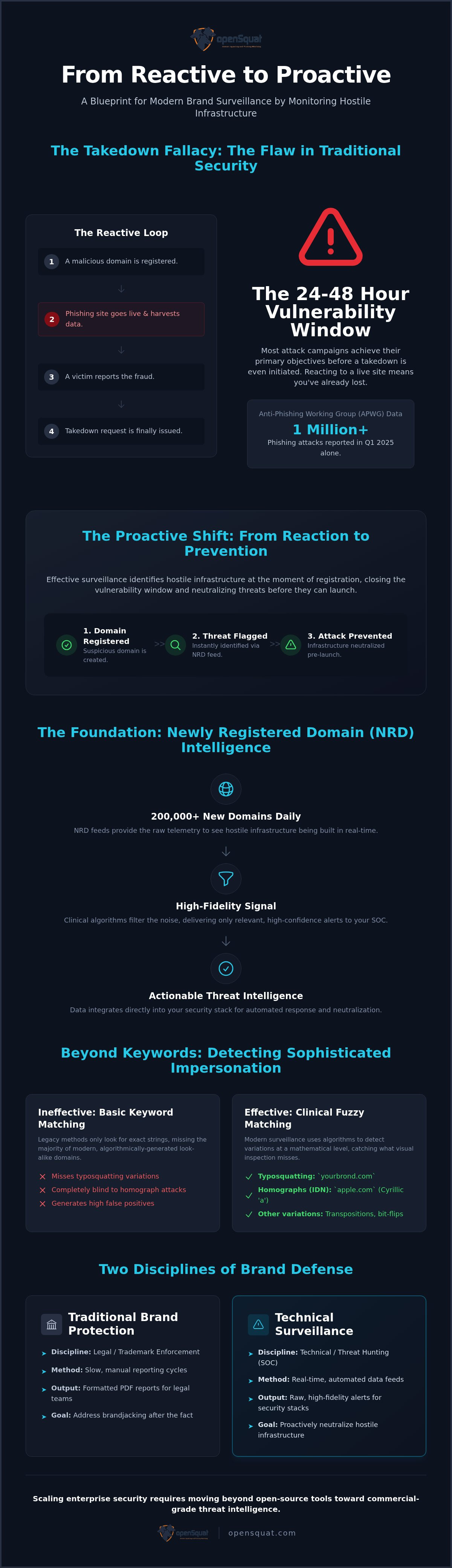
Traditional security models rely on a reactive loop. A domain is registered, content is uploaded, a victim reports the fraud, and finally, a takedown request is issued. This sequence is fundamentally flawed. It treats the symptom rather than the source. Effective monitoring brand impersonation online shifts the focus from content removal to proactive infrastructure surveillance. It's about seeing the weapon being forged, not just responding after it's drawn.
Operating under a "takedown-first" mentality creates a significant vulnerability window. Statistics from the Anti-Phishing Working Group show that phishing attacks reached record volumes in early 2025, with over 1 million attacks in Q1 alone. Most of these campaigns achieve their primary objectives within the first 24 to 48 hours. If your response begins only after a site is live, you're operating behind the attacker's timeline. Infrastructure-level defense is the 2026 standard. It requires identifying malicious intent at the point of registration before any traffic is directed to the site.
The Danger of Ephemeral Phishing Domains
Attackers now favor "burn and turn" infrastructure. They register domains, execute a high-velocity campaign, and abandon the assets before traditional blacklists can even synchronize. Waiting for a site to display a functional login page is a failed security posture. This delay provides attackers with the "dwell time" they need to harvest credentials. Automation is the only viable path to reducing time-to-detection. By analyzing Newly Registered Domain (NRD) data in real-time, teams can flag look-alike domains before they transition from a passive state to an active threat.
Monitoring Brand Impersonation Online vs. Brand Protection
Security professionals must distinguish between legal trademark enforcement and technical threat hunting. Traditional brand protection often addresses Brandjacking through slow, manual reporting cycles designed for legal teams. In contrast, technical surveillance is a data-driven discipline. SOC teams don't need formatted PDF reports; they need raw, high-fidelity data feeds. Clinical monitoring identifies infrastructure at the registration level, providing a technical advantage over purely legal approaches. This allows for the integration of domain intelligence directly into existing security stacks, ensuring that detection is as fast as the registration itself.
NRD Intelligence: The Clinical Foundation of Surveillance
Newly Registered Domain (NRD) feeds represent the primary telemetry for modern security operations. Unlike social media monitoring, which often flags content after it has gained traction, NRD intelligence identifies the underlying infrastructure before any malicious payload is delivered. In 2026, threat actors prioritize domain squatting because it provides a level of technical control over email (MX) records and SSL/TLS certificates that social media impersonation cannot match. This control is essential for bypassing modern email security filters and establishing trust with victims.
Generic keyword matching is insufficient for effective monitoring brand impersonation online. While basic tools look for exact strings, sophisticated attackers utilize algorithmic variations to evade detection. Clinical surveillance requires a transition to algorithmic typosquatting detection, which accounts for bit-flipping, homoglyphs, and character transposition. To understand the scale of these threats, one can look at FTC data on impersonation scams, which quantifies the billions lost to these deceptive practices. Security teams can gain a tactical advantage by performing an evaluation of newly registered domain feeds to ensure their surveillance model is built on high-fidelity data.
Typosquatting and Homograph Attack Mechanics
Attackers have moved beyond simple misspellings. The current threat landscape is dominated by Punycode and Internationalized Domain Name (IDN) homograph attacks. These techniques use characters from different scripts, such as Cyrillic or Greek, that are visually identical to Latin characters. A clinical surveillance system identifies these character substitutions at the binary level. It doesn't rely on visual inspection. Instead, it flags registrations that deviate from legitimate brand assets based on mathematical distance and character mapping. This precision reduces false positives while catching sophisticated look-alike domains that manual reviews would miss.
The Lifecycle of a Malicious Domain Registration
The lifecycle of a malicious registration often begins with WHOIS privacy masking and the staging of DNS records. There is frequently a "quiet period" between the initial registration and the deployment of a phishing kit. Monitoring this period is critical for SOCs. It provides the necessary lead time to block the domain at the firewall or mail gateway before the first phishing email is sent. Patterns in bulk registrations across diverse Top-Level Domains (TLDs) often signal a coordinated campaign. Identifying these clusters early is essential for monitoring brand impersonation online at scale. For teams looking to operationalize this data, exploring commercial API access provides the necessary throughput for real-time detection and integration.
Myth-Busting: Does 'AI' Replace Data Quality?
The brand protection industry has developed an unhealthy over-reliance on "black-box" AI. Marketing narratives often suggest that machine learning can predict every malicious registration without human intervention. This is a technical fallacy. AI is an analytical layer, not a data source. If the underlying telemetry is incomplete or delayed, the most sophisticated algorithm will still fail. Effective monitoring brand impersonation online requires high-throughput data ingestion from the source, rather than a reliance on opaque models that promise to "predict" threats without showing the work.
Transparency in security data provenance is essential for enterprise SOC teams. You can't defend what you can't audit. Generic machine learning models often produce high volumes of false positives or, worse, suffer from "algorithmic blindness" by ignoring registrations that don't fit a pre-defined training set. Research indicates that nearly 83% of scam emails now utilize AI language models to increase their efficacy. To counter this, defenders must prioritize the fidelity of their raw data feeds over the perceived "magic" of an automated solution. Data quality is the only objective metric in threat hunting.
Data Fidelity vs. Algorithmic Magic
A comprehensive NRD feed provides more defensive value than a "smart" alert generated from a sampled dataset. Managed brand protection portals often hide their data gaps behind a user-friendly interface. This creates a risk where look-alike domains are missed because they didn't trigger a specific heuristic. openSquat prioritizes data-driven results over marketing hyperbole. We focus on the clinical ingestion of every newly registered domain, ensuring that your security stack has access to the full spectrum of potential infrastructure before an algorithm attempts to categorize it.
The Role of Human-in-the-Loop Surveillance
Automated discovery is a force multiplier, but it doesn't replace the need for clinical analyst review. Technical experts require a brand monitoring dashboard to validate high-confidence alerts and investigate suspicious patterns. This human-in-the-loop approach balances the speed of automation with the nuance of professional judgment. By focusing on high-signal intelligence feeds, teams can reduce dashboard fatigue and concentrate their resources on legitimate threats. Monitoring brand impersonation online is most effective when automation handles the bulk ingestion and fuzzy matching, while human analysts perform the final verification of intent.
How to Automate Brand Impersonation Discovery
Transitioning to a proactive security stance requires a structured, four-stage automation pipeline. This process moves beyond manual checks to a continuous surveillance model that operates at the speed of registration. By treating domain intelligence as a programmatic input, you can identify hostile assets before they are used in active campaigns. The goal is to create a repeatable workflow that delivers high-fidelity alerts directly to your response teams.
The automation lifecycle begins with the ingestion of daily bulk NRD data. Using commercial API access ensures your security stack receives every new registration without the latency associated with manual lookups. Once the data is ingested, the system applies fuzzy matching and homograph detection algorithms. These mathematical models identify permutations, such as character substitutions or bit-flipping, that traditional keyword filters often miss. This stage is critical for effective monitoring brand impersonation online at scale.
Following detection, the system must filter results by Top-Level Domain (TLD) reputation and SSL certificate issuance patterns. Malicious actors frequently utilize specific registrars and free certificate authorities to stage their infrastructure. By analyzing these technical indicators, you can isolate high-risk domains from the daily noise. The final stage is integration. You must push these validated findings into existing SIEM or SOAR workflows. This allows for proactive blocking at the perimeter, ensuring that your defense is ready before the first phishing email is sent.
API-First Integration Strategies
Manual searching is a bottleneck that scales poorly. Leveraging a security API for domain feeds allows for the direct injection of intelligence into threat hunting tools. This architectural approach enables real-time risk scoring based on domain reputation data. It eliminates the need for analysts to pivot between multiple portals. By automating the ingestion of newly registered domain lists, your SOC can focus on investigation rather than data collection. This creates a more resilient infrastructure that adapts to the volume of modern registrations.
Building a High-Signal Alerting Framework
Accuracy depends on how you define high-risk characteristics for your specific brand. Noise reduction is achieved by ignoring legitimate third-party registrations, such as those from authorized partners or internal marketing campaigns. Using squatting domain alerts as a proactive defense layer ensures that your team only investigates registrations with a high probability of malicious intent. This methodical approach minimizes false positives and maximizes analyst efficiency. For organizations ready to operationalize these workflows, commercial API access provides the necessary throughput for enterprise-grade automation.
Transitioning to Enterprise-Grade Domain Intelligence
Enterprises often start with open-source tools like DNSTwist for basic domain permutation analysis. These tools are effective for point-in-time checks but lack the persistence required for global monitoring brand impersonation online. Scaling operations to match the volume of daily registrations requires a shift from manual execution to automated, commercial-grade threat intelligence feeds. This transition ensures that your surveillance is continuous rather than episodic. You can't defend what you can't see in real-time.
From Open Source to Commercial API Access
The openSquat open-source tool provides a robust foundation for identifying squatting attempts. However, global security teams eventually encounter the throughput limits of standalone scripts. Moving to commercial API access eliminates these bottlenecks. It provides a reliable stream of high-fidelity data with guaranteed uptime and continuity. This programmatic approach allows for the ingestion of millions of domain records without the latency inherent in manual searching. It's the difference between a periodic scan and a persistent surveillance net. Enterprise threat hunting requires this level of industrial-scale data ingestion.
The openSquat Advantage: Precision over Hyperbole
Generic brand protection portals often bundle detection with managed SOC services and takedown requests. This approach creates vendor lock-in and dilutes the technical focus of the tool. openSquat maintains a clinical focus on detection. We provide the world's most comprehensive NRD feeds, allowing your internal team to retain control over the response phase. By specializing in the identification of malicious infrastructure, we ensure that our data is the most precise instrument in your security stack. The Brand Monitoring Dashboard provides the centralized visualization needed to manage this intelligence at an enterprise scale. Integrate openSquat's Enterprise Threat Intelligence today.
Operationalizing Infrastructure-Level Defense
Relying on content removal is a legacy security posture that ignores the technical reality of modern phishing. You've seen why the 24 to 48 hour window after registration is the most critical period for defense. Effective monitoring brand impersonation online requires moving upstream to the point of registration. By prioritizing high-fidelity NRD telemetry over black-box AI, your SOC gains the clinical precision needed to block threats before they weaponize. Success in 2026 depends on seeing the infrastructure, not just the attack.
Scaling this model across a global enterprise demands more than basic tools. It requires a dedicated data pipeline that integrates directly into your existing workflows. You can scale your domain surveillance with openSquat's Enterprise API to access real-time NRD data feeds and a centralized brand monitoring dashboard. Our technology is already used by global enterprise security teams to maintain a proactive, vigilant stance. Transitioning to a data-driven surveillance model ensures your brand remains a hard target. You have the blueprint; it's time to operationalize your defense.
Frequently Asked Questions
What is the difference between brand monitoring and brand protection?
Brand monitoring is a technical surveillance discipline focused on identifying hostile infrastructure, while brand protection often encompasses legal trademark enforcement and content removal. Monitoring provides the raw intelligence needed to understand the threat landscape before an attack occurs. openSquat specializes in the high-fidelity detection of malicious registrations. We provide the telemetry required for proactive defense, allowing your internal team to maintain control over the response phase without relying on external legal services.
Can brand impersonation monitoring detect phishing domains before they are used?
Yes, monitoring brand impersonation online allows for the detection of phishing domains during the quiet period after registration but before weaponization. Attackers typically stage DNS records and SSL certificates 24 to 48 hours before launching a campaign. By identifying these assets at the registration level, security teams can implement proactive blocks at the email gateway or firewall, effectively neutralizing the threat before it reaches an end-user's inbox.
How do newly registered domain (NRD) feeds help in identifying look-alike domains?
Newly Registered Domain (NRD) feeds provide a daily bulk list of every new registration across global TLDs. This data serves as the raw input for discovery algorithms. By applying fuzzy matching and homograph detection to these feeds, organizations can identify permutations of their brand name in real-time. This methodical approach ensures that look-alike domains are flagged the moment they appear in the global DNS registry, providing a significant lead time over reactive blacklists.
What are homograph attacks and how can I monitor them online?
Homograph attacks utilize visually identical characters from different scripts, such as Cyrillic or Greek, to mimic legitimate brand names. These are also known as IDN homograph attacks. To monitor these online, you must use tools that decode Punycode and perform bit-level character mapping. openSquat utilizes specific algorithms to identify these substitutions within NRD feeds, ensuring that visually deceptive domains are flagged even when they bypass traditional keyword-based filters.
Why is manual searching for brand impersonation insufficient for large enterprises?
Manual searching is insufficient because it lacks the scale and frequency required to track modern threat actors. Hundreds of thousands of new domains are registered daily. Human analysts cannot feasibly parse this volume to find sophisticated typosquats or homoglyphs. Manual processes introduce unacceptable latency, often missing the critical window where a domain is registered but not yet active. Automated API ingestion is the only way to maintain a persistent surveillance net.
Do I need a takedown service to effectively monitor brand impersonation?
No, a takedown service is not a requirement for effective monitoring. Intelligence and response are two distinct stages of the security lifecycle. Monitoring focuses on the clinical identification of infrastructure, providing the data needed for internal defensive actions like DNS sinkholing or mail filtering. While some firms bundle these services, openSquat maintains a specialized focus on high-fidelity detection, providing the raw intelligence that allows internal SOC teams to manage their own response.
How can SOC teams integrate brand impersonation intelligence into their workflows?
SOC teams integrate brand impersonation intelligence by ingesting high-fidelity data feeds directly into SIEM or SOAR platforms via a commercial API. This allows for the automated cross-referencing of NRD data against internal logs. When a look-alike domain is detected, the SOAR playbook can automatically update blocklists or trigger an investigation. This programmatic approach ensures that monitoring brand impersonation online becomes a seamless, high-signal component of the existing security architecture.
What makes openSquat different from other brand protection software?
openSquat differs by prioritizing raw data fidelity and technical transparency over marketing hyperbole. We provide enterprise-grade NRD feeds and a centralized brand monitoring dashboard without the distraction of managed SOC or takedown services. Our open-core heritage reflects a commitment to engineering rigor and peer-reviewed methodology. We function as a trusted instrument for experts, delivering the high-signal intelligence needed for proactive threat hunting rather than just providing a generic reporting portal.


