
Most security teams are fighting yesterday's battles because their domain intelligence arrives hours after the adversary's infrastructure is already live. By the time a suspicious URL hits a standard blocklist, the phishing campaign has often already concluded its primary phase. You recognize that bulk domain lists usually provide more noise than actionable signal. Relying on stale feeds makes it impossible to achieve the sub-hour latency required for effective defense. Utilizing real-time NRD data is the only way to intercept malicious infrastructure during the critical setup window. Filtering through thousands of generic registrations to identify a single look-alike domain is an inefficient use of engineering resources without high-precision tools.
This technical guide demonstrates how to master the requirements for ingesting and utilizing these streams to neutralize threats before they launch. You'll learn to architect a pipeline that moves from raw ingestion to automated identification. We'll examine the technical specifications for high-throughput API integration, the mechanics of algorithmic filtering to reduce false positives, and the implementation of zero-latency workflows within your existing security orchestration. By the end of this analysis, you'll have the framework necessary to transform raw domain streams into a proactive surveillance asset.
Key Takeaways
- Understand the critical distinction between static bulk lists and real-time NRD data to reduce the window between domain registration and threat detection.
- Architect a scalable ingestion pipeline based on the modular Input-Process-Output model to process over 100,000 daily registrations.
- Evaluate feed performance using specific KPIs that prioritize sub-hour latency and surgical filtering to minimize false positives.
- Automate the identification of look-alike domains through seamless API integration into your existing SIEM and SOAR orchestration workflows.
- Scale surveillance capabilities by transitioning from open-source tools to commercial-grade feeds for higher signal density and enterprise reliability.
Defining Real-Time NRD Data for Enterprise Defense
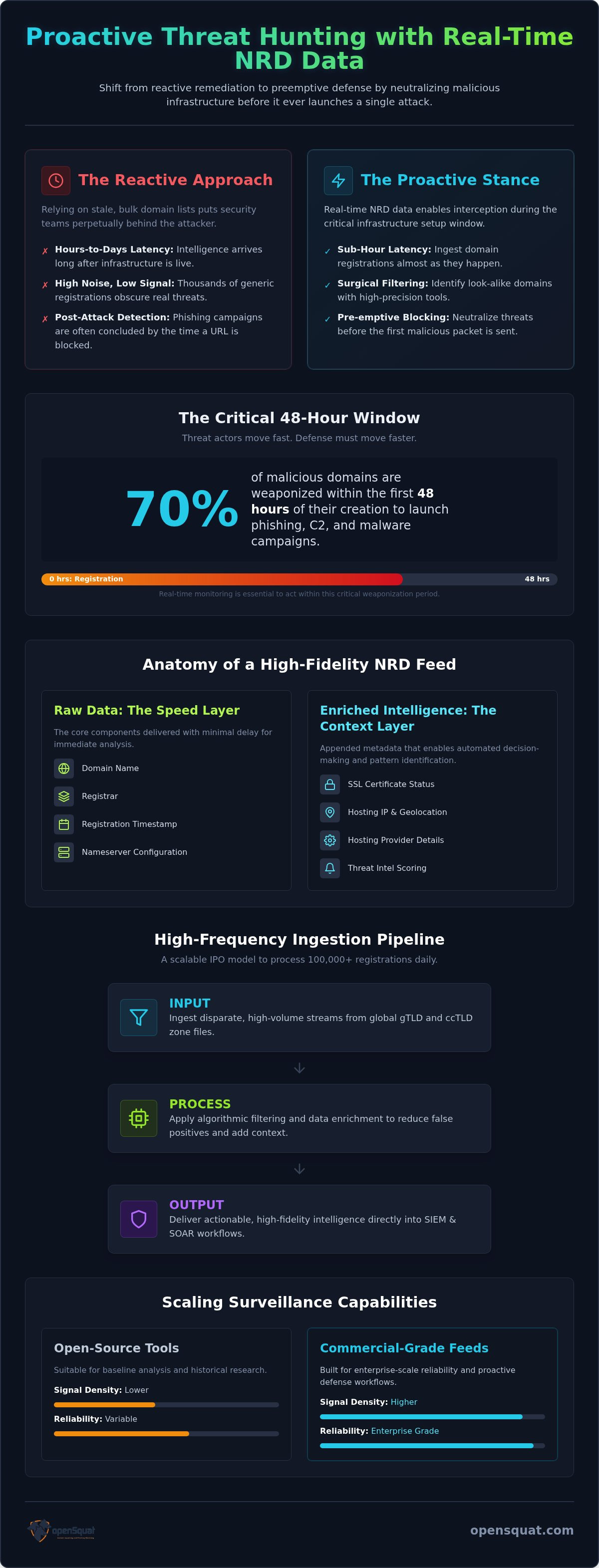
NRD data represents the primary signal for identifying infrastructure-based threats. By definition, it encompasses the stream of domain names registered across global Top-Level Domains (gTLDs) and country-code Top-Level Domains (ccTLDs) within the previous 24 hours. However, the term "real-time" introduces a critical performance requirement. While bulk domain lists are often updated on a daily or weekly cadence, real-time NRD data provides sub-hour latency from the moment of registration to the moment of ingestion. This speed is essential for defensive operations. Industry research indicates that approximately 70% of malicious domains are weaponized within the first 48 hours of their creation. Threat actors utilize this brief window to launch phishing campaigns, establish command-and-control (C2) channels, or host malware before reputation-based filters can flag the new assets.
Monitoring these registrations during the reconnaissance phase allows security teams to implement preemptive blocks. During this phase, attackers register domains that mimic legitimate brands or services, configure DNS records, and wait for global propagation. This is the "quiet" period where defense is most effective. By utilizing real-time NRD data, organizations can identify and neutralize infrastructure before the first malicious packet is sent, shifting the security posture from reactive remediation to proactive prevention.
The Anatomy of a Newly Registered Domain Feed
A high-fidelity feed provides more than just a list of strings. The core data points include the domain name, the registrar used for the transaction, a precise registration timestamp, and the initial nameserver configurations. These elements form the baseline for threat hunting. Nameserver information is particularly telling; attackers often use specific bulletproof hosting providers or free DNS services that are disproportionately represented in malicious activity. Advanced feeds append extended metadata such as SSL certificate status, the hosting IP address, and geographic origin. This enrichment allows for the identification of patterns, such as a sudden surge in look-alike domains registered through a specific registrar known for lax abuse policies. Distinguishing between raw data and enriched intelligence is vital. Raw data provides the speed, while enriched feeds provide the context necessary for automated decision-making in a SIEM or SOAR environment.
Latency: The Critical Metric in Threat Intelligence
In the context of DNS, "real-time" is a measurement of the gap between a zone file update and the data's availability in a security tool. Traditional methods rely on periodic polling, which creates blind spots and allows threats to slip through. High-frequency surveillance requires a continuous stream that minimizes this delay. Catching a phishing campaign requires action within minutes of the domain's activation. openSquat focuses on minimizing this gap by providing high-throughput access to registration events as they occur. This proactive stance ensures that security teams aren't working with stale information. By ingesting data at the point of origin, teams can identify and blacklist suspicious infrastructure before it is fully propagated across the internet, ensuring that defense stays ahead of the attack lifecycle.
Technical Architecture of High-Frequency Domain Ingestion
Processing over 100,000 new registrations daily requires more than a simple script. It demands a modular architecture capable of sustained high throughput. The Input-Process-Output (IPO) model provides the necessary framework for this scale. In the Input stage, the system ingests disparate streams from various registrars and zone files. The Process stage applies logic to filter and enrich this raw information. Finally, the Output stage delivers actionable intelligence to security tools. Handling real-time NRD data involves navigating the structural differences between gTLDs and ccTLDs. While gTLD data is often centralized, ccTLD streams remain fragmented and require specialized connectors for proper ingestion. For effective baseline analysis, security teams should leverage bulk newly registered domain data to understand historical registration patterns before applying live filters.
Scalability is achieved by decoupling the ingestion engine from the analysis layer. This prevents bottlenecks when registration volumes spike during peak UTC hours. It's critical to ensure that the ingestion pipeline doesn't drop packets, as missing a single registration could mean missing the setup of a major phishing campaign. By maintaining a steady flow, the architecture supports continuous surveillance without the latency associated with batch processing.
Data Normalization and De-duplication
Raw data arrives in various formats, primarily JSON or CSV. Standardization is the first step in the pipeline. Each entry must be normalized into a consistent schema that includes timestamps, registrar IDs, and nameserver strings. De-duplication prevents redundant processing of the same registration across different update cycles. This stage also includes noise reduction. Algorithmic filters identify and discard parked domains or legitimate corporate registrations that don't match threat profiles. Maintaining a 30-day historical buffer is essential. This buffer allows the system to compare incoming registrations against recent trends to detect burst-registration events. It's a vital component for identifying distributed attack infrastructure.
Automated Filtering and Scoring Engines
The scoring engine is the core of the surveillance system. It uses mathematical models like Levenshtein distance to detect typosquatting. High-entropy domain names often indicate algorithmically generated domains (DGAs) used in C2 infrastructure. Heuristic analysis looks for patterns in nameserver clusters. If twenty new domains are registered simultaneously using the same obscure nameserver, the system flags the entire cluster for investigation. Integrating enterprise-grade feeds with the openSquat open source tool allows teams to combine community-driven detection with high-signal commercial data. This hybrid approach ensures that the scoring engine remains accurate while minimizing the false positive rate that often plagues real-time NRD data streams.
Latency vs. Accuracy: Evaluating NRD Feed Performance
Evaluating a feed requires understanding the inverse relationship between ingestion speed and the signal-to-noise ratio. High-frequency feeds capture registrations almost instantly. However, they often include thousands of benign "parked" domains or legitimate corporate assets. Conversely, delayed lists might offer higher accuracy through post-registration filtering but often miss the critical weaponization window. Effective real-time NRD data must balance these factors through algorithmic pre-sorting and heuristic analysis. If a feed is too slow, the adversary has already established their C2 infrastructure. If it's too noisy, your security analysts will suffer from alert fatigue.
Technical teams should use specific Key Performance Indicators (KPIs) to benchmark NRD providers. These metrics ensure the data is actionable rather than just voluminous. Focus on the following criteria during evaluation:
- Mean Time to Ingestion (MTTI): The specific delta between a domain's registration and its availability in your API stream.
- False Positive Rate (FPR): The percentage of benign domains incorrectly flagged as high-risk by the provider's internal scoring.
- TLD Breadth: The total number of supported extensions, specifically including volatile ccTLDs.
- Update Frequency: Whether the feed is a continuous stream or a batched interval update.
Automated domain surveillance naturally generates false positives because legitimate businesses register thousands of defensive domains daily. Distinguishing between a brand's defensive registration and an attacker's typosquatting attempt requires sophisticated scoring. This is why monitoring newly registered gTLD data feeds is essential for protecting high-value targets. The sheer volume of new generic extensions provides ample cover for sophisticated reconnaissance, making surgical precision a requirement for any enterprise feed.
Coverage and TLD Breadth
Focusing solely on gTLDs like .com or .net is insufficient for a modern defense. Attackers increasingly leverage ccTLDs (country-code Top-Level Domains) due to varying registry requirements and lower visibility in standard Western feeds. Acquiring ccTLD data in real-time is technically challenging. Many national registries don't offer public zone files, requiring specialized collection methods. A provider's value is often determined by their ability to normalize these fragmented sources into a single, unified stream. Without ccTLD coverage, your surveillance has significant blind spots that attackers will exploit.
Enrichment and Contextual Intelligence
A domain string alone lacks the context needed for automated blocking. To move from "newly registered" to "confirmed malicious," a feed must include DNS record updates and WHOIS metadata. Reputation scoring engines analyze these variables to assign risk levels. openSquat provides clinical efficiency here by filtering out the noise of general registrars and focusing on high-signal indicators. This ensures that your SIEM only triggers alerts for domains with a high probability of malicious intent. High-quality real-time NRD data doesn't just deliver a list; it delivers the intelligence required to make an immediate defensive decision.
Implementation: Integrating NRD Streams into SIEM/SOAR
Manual analysis of domain registrations is an unsustainable practice for enterprise security operations. With over 100,000 daily events, automation is the only viable method for processing real-time NRD data at scale. The goal is to move from ingestion to defensive action within minutes. This requires connecting a high-throughput NRD API for security teams directly to existing SIEM or SOAR platforms. By establishing trigger-based alerts for brand-specific keywords, teams can automate the reconnaissance phase of threat hunting. This closes the loop between identifying a new registration and implementing a proactive block on the network perimeter.
Step 1: Establishing the API Connection
Begin by configuring authentication using secure Bearer tokens to access the RESTful API endpoints. For enterprise scale, ensure your ingestion layer handles rate-limiting and supports persistent connections to minimize overhead. Selecting the appropriate data format is critical for interoperability. While JSON offers maximum flexibility for custom scripts, STIX/TAXII formats are preferable for standardized threat intelligence sharing across different security modules. Configure your ingestion endpoint to poll the feed at sub-hour intervals to maintain the integrity of your real-time surveillance pipeline. Robust error handling at this stage prevents data gaps during peak registration periods.
Step 2: Defining Watchlists and Heuristics
Input your core brand keywords and common typosquatting variations into the filtering engine. This includes substituting similar characters or adding common prefixes and suffixes used in phishing campaigns. Setting precise thresholds for "look-alike" scores is essential to minimize SOC fatigue; alerts should only trigger when a domain meets a high-confidence threat profile. Security engineers can utilize an NRD feed for threat hunters to investigate specific campaigns or verify the infrastructure patterns of known adversaries. This targeted approach ensures that real-time NRD data remains a high-signal asset rather than a source of noise.
Step 3: Orchestrating the Response
The final stage involves automating the defensive response through SOAR playbooks. When the system detects a high-risk domain, it should automatically create a "Suspicious Domain" ticket in Jira or ServiceNow for auditor review. Simultaneously, the playbook can push verified malicious domains to firewall and DNS sinkhole blocklists to prevent internal users from reaching the site. It's important to maintain a human-in-the-loop for final takedown decisions, as openSquat focuses on identification rather than external enforcement. This structured workflow ensures that your organization remains vigilant against infrastructure-based threats. To scale these capabilities, you can request commercial API access for high-throughput ingestion and enterprise-grade reliability.
Scaling Surveillance with openSquat Commercial API
Scaling a domain surveillance program requires a shift from manual scripts to high-availability infrastructure. While open-source solutions provide a foundation, enterprise security operations demand the reliability of dedicated data pipelines. Transitioning to the openSquat Commercial API provides the throughput necessary for global monitoring without the maintenance overhead of self-hosted collectors. The platform's primary advantage lies in its delivery of high-signal, low-latency intelligence. It filters out the background noise of millions of benign registrations, allowing teams to focus exclusively on high-risk events. Unlike generic bulk providers that prioritize volume over utility, openSquat applies clinical efficiency to the identification of malicious infrastructure.
Centralized visibility is a requirement for distributed security teams. Accessing the brand monitoring dashboard allows analysts to visualize registration trends and track emerging threats from a single interface. This dashboard aggregates real-time NRD data across all monitored keywords, providing a real-time heat map of adversary activity. It transforms raw data streams into a structured intelligence asset that supports both tactical response and long-term strategic planning.
Enterprise-Level Threat Intelligence Feeds
Modern security environments require seamless integration with existing stacks. The commercial feed is designed for high-volume ingestion, supporting thousands of concurrent queries without performance degradation. It provides continuous updates for both gTLDs and ccTLDs, ensuring that regional campaigns don't bypass your defenses. This global TLD monitoring is essential for proactive detection. By identifying brand impersonation at the point of registration, organizations can neutralize threats before they scale into full-fledged phishing or malware distribution campaigns. The feed's architectural rigor ensures that real-time NRD data remains consistent, formatted, and ready for immediate ingestion into your SOAR playbooks.
Next Steps: Securing Your Domain Perimeter
Securing the domain perimeter begins with an audit of your current detection window. Evaluate your mean time-to-detect for new phishing domains; if it exceeds one hour, your organization is at risk. You can request a trial of the openSquat commercial API to benchmark its performance against your existing providers. This trial allows your engineering team to test ingestion speeds and verify the accuracy of the threat scoring engine in a live environment. Implement proactive surveillance today to reclaim the initiative from infrastructure-based adversaries. Transitioning to an enterprise-grade feed is the final step in building a mature, data-driven defense strategy.
Transitioning to Proactive Domain Surveillance
Effective defense against infrastructure-based threats requires a shift from reactive blocklists to high-frequency ingestion. This guide has outlined the architectural requirements for processing over 100,000 daily registrations with sub-hour latency. Success depends on the ability to filter noise surgically while maintaining global TLD coverage. By integrating real-time NRD data into your SOAR playbooks, you eliminate the visibility gaps that adversaries exploit during their reconnaissance phase. High-signal intelligence allows your security team to identify malicious infrastructure before the first phishing email is delivered. It's the most direct path to reducing your organization's attack surface.
Scaling these operations requires a partner that values engineering rigor. You need a system that offers clinical precision in domain monitoring and enterprise-grade threat intelligence. To begin securing your perimeter, access the openSquat Commercial API for Real-Time NRD Data today. Implementing proactive surveillance is the most effective way to stay ahead of evolving attack lifecycles. Your team is ready to move beyond static lists and embrace a more vigilant defensive posture.
Frequently Asked Questions
What is real-time NRD data and why is it important for security?
Real-time NRD data consists of a continuous stream of domain registrations across gTLDs and ccTLDs with sub-hour latency. It is critical for security because adversaries typically weaponize new infrastructure within 48 hours of registration. By ingesting this data immediately, security teams can implement proactive blocks during the reconnaissance phase. This shifts the defensive posture from reactive remediation to intercepting threats before they launch, providing a vital window for preemptive action against phishing and C2 channels.
How often is the newly registered domain data updated?
The commercial feed is updated continuously to ensure the lowest possible latency between a registry event and its availability in your pipeline. While standard bulk lists might only refresh once every 24 hours, our high-frequency architecture processes zone file updates as they occur. This methodical approach ensures that your surveillance remains synchronized with global registration activity. It provides the speed necessary to detect and neutralize emerging threats before they can propagate across the internet.
Can I filter NRD feeds by specific keywords or TLDs?
Users can apply surgical filters based on specific keywords, regular expressions, and TLD extensions. This capability is essential for brand protection, as it allows you to monitor for typosquatting variations across both generic and country-code extensions. By narrowing the scope of the feed, you reduce the noise of irrelevant registrations. This ensures that your analysts only receive high-signal alerts, improving the efficiency of your internal threat hunting and brand monitoring workflows.
What is the difference between a bulk domain list and a real-time API?
Bulk domain lists are static files delivered at fixed intervals, which often results in a 24-hour visibility gap. In contrast, a real-time API provides a dynamic, high-throughput stream of registration events. This difference is critical for high-frequency domain surveillance. Utilizing real-time NRD data through an API allows for immediate ingestion into automated security tools. It ensures that your defensive perimeter is updated in minutes, closing the window of opportunity for attackers during their setup phase.
How do security teams use NRD data to prevent phishing attacks?
Security teams utilize these feeds to identify brand impersonation attempts at the point of origin. When a suspicious look-alike domain is detected, automated playbooks push the entry to DNS sinkholes and firewall blocklists. This proactive approach prevents users from reaching the site even if they receive a phishing link. By neutralizing the infrastructure during the setup window, organizations can effectively stop phishing campaigns before the first malicious email reaches an employee's inbox.
Does openSquat provide domain takedown services alongside its feeds?
We focus exclusively on providing enterprise-grade threat intelligence and data feeds. We don't offer domain takedown services, domain registration, or managed SOC operations. Our mission is to deliver the technical precision and high-signal data required for your internal teams to make informed defensive decisions. By providing clinical efficiency in domain identification, we empower security engineers to manage their own enforcement actions and takedown requests using our high-fidelity intelligence as the primary evidence.
How do I integrate an NRD feed into my existing SIEM or SOAR platform?
Integration is achieved through a RESTful API that delivers data in structured formats like JSON or STIX/TAXII. You configure your SIEM or SOAR platform to authenticate with secure Bearer tokens and poll the ingestion endpoint at regular intervals. This allows for the seamless flow of domain intelligence into your existing orchestration playbooks. The modular design of the API ensures compatibility with major security tools, enabling automated ticket creation and perimeter updates without requiring manual data entry.
What are the most common indicators of a malicious newly registered domain?
Common indicators include high-entropy domain strings and nameserver configurations associated with known malicious hosting providers. Attackers use Levenshtein distance to create domains visually similar to legitimate brands. Heuristic analysis also flags burst registrations, where multiple domains are created simultaneously using the same registrar. These patterns help distinguish between legitimate corporate activity and the setup of malicious attack infrastructure. This clinical approach allows for more accurate risk scoring within real-time NRD data streams.


