
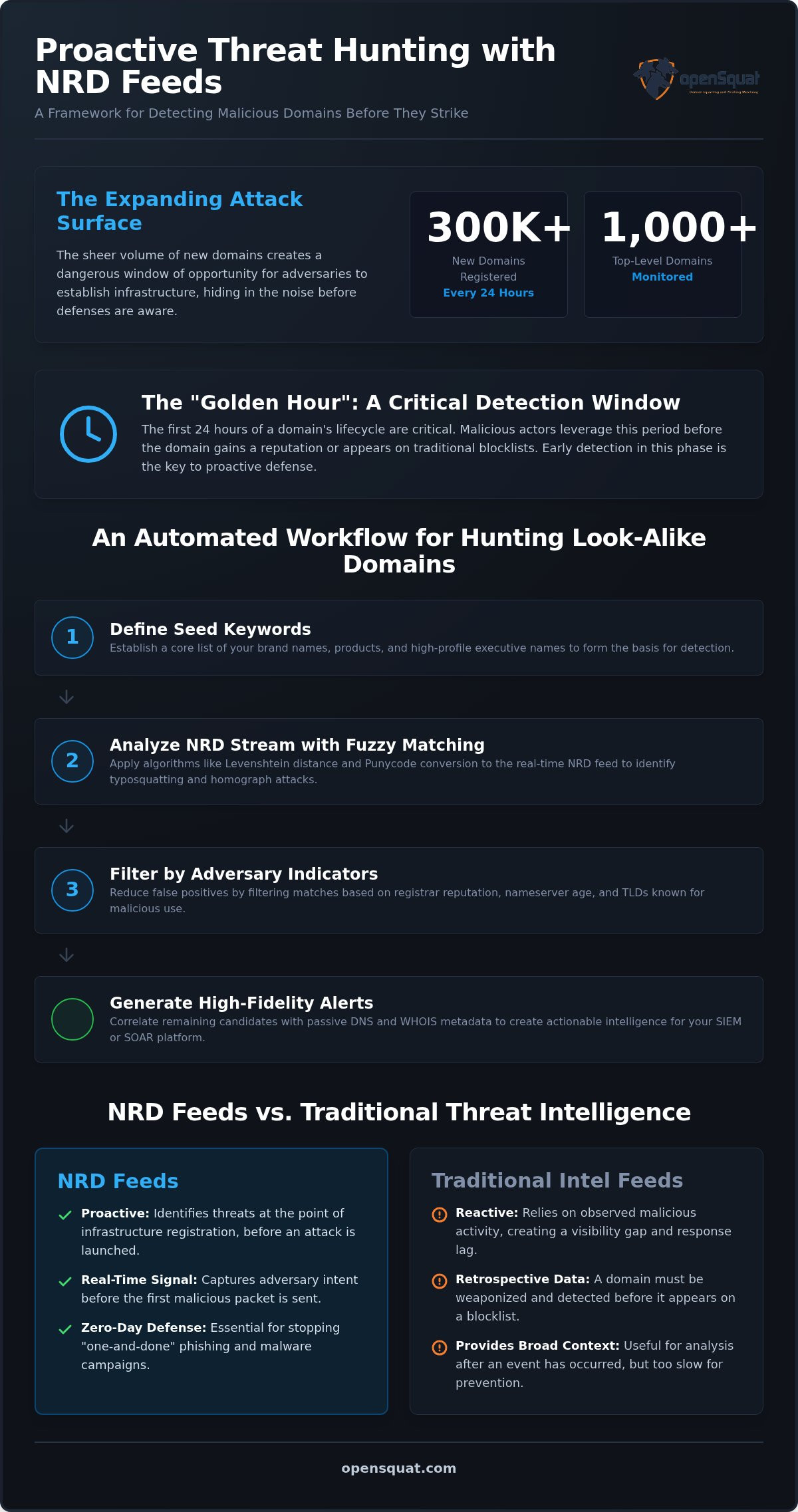
With more than 300,000 newly registered domains appearing across 1,000 top-level domains every 24 hours, the surface area for potential attacks expands faster than most security teams can monitor. You understand that every malicious campaign begins with a registration event, but the high noise-to-signal ratio in a standard NRD feed for threat hunters often results in manual analysis fatigue. This lag between domain registration and active detection creates a dangerous window of opportunity for adversaries to establish infrastructure before defenses are even aware of their existence.
This guide provides a technical framework to transform raw registration data into high-fidelity intelligence for proactive defense. You'll learn a repeatable workflow to identify malicious domains before they launch, utilizing algorithmic automation for look-alike discovery and typosquatting detection. We detail the precise methods for integrating these data streams into your existing SIEM or SOAR stack, shifting your security posture from reactive response to systematic, data-driven prevention. The objective is to move beyond simple monitoring and toward a functional, automated detection pipeline.
Key Takeaways
- Understand the "Golden Hour" of threat detection and why monitoring the first 24 hours of a domain's lifecycle is critical for identifying malicious infrastructure.
- Implement an automated workflow using an NRD feed for threat hunters to discover look-alike domains through fuzzy matching and seed keyword analysis.
- Identify advanced adversary tactics, including registrar-hopping patterns and Domain Generation Algorithm (DGA) seeds, before they are used in active campaigns.
- Optimize data ingestion pipelines to handle high-throughput registration streams, ensuring low-latency correlation within existing SIEM and SOAR architectures.
- Scale surveillance capabilities by transitioning from manual tools to enterprise-grade dashboards that provide centralized visibility into brand-specific threats.
Understanding the Strategic Value of NRD Feeds in Threat Hunting
Newly Registered Domain (NRD) feeds provide a raw, real-time stream of every domain name added to the global DNS registry. This data covers all generic top-level domains (gTLDs) and country-code top-level domains (ccTLDs). For security teams, this information represents the earliest possible indicator of adversary infrastructure. Most malicious campaigns require a domain for command-and-control (C2) communication, phishing landing pages, or malware delivery. By monitoring the point of registration, hunters gain visibility into the adversary's preparation phase before an attack is launched.
The first 24 hours of a domain's existence, often called the "Golden Hour," are critical for detection. During this window, a domain is statistically more likely to be used for malicious activity before it gains a reputation or appears on traditional blocklists. By integrating an NRD feed for threat hunters, analysts can identify and block these assets at the point of creation. This shifts the defense strategy from reactive blacklisting to proactive infrastructure surveillance. It allows teams to neutralize threats like brand impersonation and malware C2 at the source, rather than responding after a breach occurs.
The Anatomy of a Malicious Registration
Adversaries frequently employ specific patterns during the registration process to maximize the success of their campaigns. Typosquatting remains a primary tactic. Attackers register domains that visually mimic legitimate brands by substituting similar-looking characters or adding subtle prefixes. Beyond naming, threat hunters look for the use of "bulletproof" registrars known to ignore abuse reports or specific TLDs with low entry costs and minimal oversight. Bulk NRD data is required to perform effective trend analysis. It allows hunters to identify clusters of domains registered with the same nameserver patterns or registrar-hopping behaviors, signaling a coordinated infrastructure buildup.
NRD vs. Traditional Threat Intelligence Feeds
Traditional threat intelligence feeds are fundamentally retrospective. They rely on observed activity. A domain must be active and detected by a sandbox or honeypot before it is categorized. This creates a dangerous visibility gap. In contrast, NRDs capture intent before the first packet is sent. This speed is vital for stopping "one-and-done" phishing domains that are registered, used for a single targeted campaign, and discarded within hours. While traditional feeds provide broad context, NRD data offers the low-latency signal needed for zero-day defense. For a detailed technical breakdown, consult our evaluation of newly registered domain feeds for enterprise security.
A Technical Workflow for Hunting Look-Alike Domains
Identifying look-alike domains requires a structured ingestion and analysis pipeline. Raw data from an NRD feed for threat hunters is the primary input for this process. The workflow begins by defining "seed" keywords. These include your organization's core brand names, specific product identifiers, and the names of high-profile executives. These seeds form the basis for all subsequent detection logic.
Once seeds are established, apply fuzzy matching algorithms to the incoming NRD stream. This process identifies character substitutions that human analysts might miss. After a match is flagged, the system filters results based on registrar reputation and nameserver age. Adversaries often prefer specific registrars with lenient abuse policies. Cross-referencing these matches with passive DNS and WHOIS metadata provides the final layer of context. This multi-stage approach ensures that analysts focus only on domains with a high probability of malicious intent.
Algorithmic Filtering: Beyond String Matching
Fuzzy matching is a computational method that identifies strings approximately similar to a target keyword, enabling the detection of deliberate character substitutions. Simple string matching is insufficient for modern surveillance. Analysts must implement Levenshtein distance calculations to quantify the number of single-character edits required to change one word into another. This catches subtle typosquatting attempts. Additionally, Punycode conversion is necessary to detect homograph attacks, where attackers use non-Latin characters that appear identical to standard ASCII letters. These algorithmic checks allow for the identification of sophisticated impersonation attempts at scale.
Automating Phishing Domain Discovery
Manual review of 300,000 daily registrations is impossible. Efficiency depends on high-fidelity automation. Security teams should set up automated alerts for high-confidence matches that meet specific risk thresholds, such as a low Levenshtein distance combined with a high-risk registrar. To maintain a low signal-to-noise ratio, implement "known-good" whitelisting. This excludes internal domains, established partners, and legitimate third-party services from the alert queue. Leveraging automated domain surveillance allows teams to manage this volume without increasing headcount. Organizations requiring this level of precision often integrate commercial API access directly into their existing detection stacks to ensure low-latency response capabilities.
Ingesting and Correlating Real-Time NRD Data
Managing a high-volume NRD feed for threat hunters requires an architecture capable of processing over 300,000 daily records without introducing systemic latency. Real-time delivery is essential. Even a few hours of delay can allow a targeted phishing campaign to complete its lifecycle before defenses are in place. To handle this throughput, security teams must utilize commercial APIs that deliver structured JSON or CSV data. This ensures that the information is ready for immediate ingestion into SIEM or SOAR platforms without the need for complex pre-processing or custom scrapers.
Once the data enters your environment, the focus shifts to correlation. Cross-referencing NRD hits with internal DNS logs and outbound proxy traffic is a high-signal activity. This process identifies "patient zero" scenarios where an internal asset has already attempted to resolve or connect to a suspicious, newly registered domain. By linking external registration events with internal network telemetry, analysts can confirm active engagement with malicious infrastructure. This correlation provides the necessary evidence to justify immediate isolation or blocking of the affected internal host.
Bulk Data Ingestion Strategies
SOC teams must choose between "push" and "pull" delivery mechanisms based on their existing infrastructure. Pull-based ingestion via REST APIs allows for controlled, scheduled data retrieval, making it suitable for batch analysis and historical lookups. Push-based streams or webhooks provide the lowest possible latency for immediate alerting. Data retention is equally critical. Maintaining a local repository of historical registrations enables retrospective hunting. This allows you to identify domains that were registered months ago but have only recently become active in threat reports. For detailed implementation steps, see our technical guide to bulk newly registered domain data ingestion in 2026.
Enriching NRDs with Security Metadata
Raw domain names require environmental context to become actionable intelligence. Enrichment involves adding IP reputation data and identifying the hosting provider's autonomous system (AS). This helps analysts determine if a domain is hosted on "bulletproof" infrastructure or known malicious IP space. Distinguishing between "parked" domains and those with active A or MX records is a vital prioritization step. Active infrastructure represents an immediate threat, while parked domains are "sleeper" assets that require persistent monitoring. Automating this process through an NRD API for security teams ensures that every flagged match is delivered with full metadata, reducing the time spent on manual reconnaissance.
Advanced Hunting: Identifying C2 Infrastructure via NRD Patterns
Advanced threat actors don't rely on static infrastructure. They utilize registrar-hopping patterns to evade detection. By moving domains across different registrars frequently, they disrupt tracking efforts by security researchers. An NRD feed for threat hunters allows for the identification of these movements in real time. Analyzing the velocity and volume of registrations across specific providers can reveal the systematic buildup of an adversary's operational environment. This proactive analysis helps identify clusters of domains that share similar registration metadata, even when the naming conventions appear randomized. It's about spotting the infrastructure before the first phishing email is sent.
Monitoring surges in specific generic Top-Level Domains (gTLDs) is another effective method for tracking emerging threat actor activity. Certain actors prefer specific gTLDs due to lower registration costs or lack of administrative oversight. Utilizing newly registered gTLD data feeds enables analysts to pinpoint these anomalies before the domains are flagged by global reputation systems. This is particularly useful for identifying Domain Generation Algorithm (DGA) seeds. When multiple high-entropy domains appear simultaneously across the same infrastructure, it often indicates a new malware variant preparing for a large-scale campaign.
Spotting the "Shadow" Infrastructure
Attackers use NRDs to rotate backend C2 nodes, ensuring that even if one node is compromised, the broader network remains functional. Detecting these staging domains before the payload delivery starts is critical for preemptive blocking. Often, these domains are registered days or weeks in advance but remain dormant until the attack begins. The correlation between registrar choice and threat actor TTPs often reveals the geographic origin or technical sophistication of the adversary. By identifying these "shadow" assets early, security teams can disrupt the reconnaissance phase of an attack, preventing the adversary from establishing a persistent foothold.
Collaborative Hunting with Open-Source and Enterprise Data
Effective hunting requires a balance between community resources and enterprise-grade tools. The openSquat open-source tool is ideal for ad-hoc queries and targeted research into specific domain patterns. However, scaling these efforts for continuous, global monitoring requires an Enterprise NRD service. This transition ensures access to peer-reviewed data and high-throughput feeds that open-source tools cannot sustain at scale. Community-driven data provides breadth, but enterprise feeds provide the clinical precision required for high-stakes environments. To implement this level of surveillance, explore our Enterprise Threat Intelligence Feeds for continuous infrastructure monitoring.
Scaling Threat Hunting with openSquat Enterprise
Transitioning from ad-hoc analysis to a continuous surveillance model requires infrastructure that can handle global registration volumes. While the open-source tool provides a foundation for research, openSquat Enterprise delivers the clinical precision necessary for high-stakes environments. It transforms raw data into a structured NRD feed for threat hunters, allowing teams to move beyond manual string searches. This shift enables the automated discovery of adversarial infrastructure, ensuring that emerging threats are identified before they can be weaponized against your organization. The platform's design reflects a commitment to technical honesty, providing the raw evidence needed for expert validation.
The movement from manual hunting to automated discovery isn't just about speed; it's about consistency. Manual processes are prone to fatigue and oversight, particularly when monitoring hundreds of thousands of new registrations daily. openSquat Enterprise standardizes the detection logic, applying the same rigorous filters to every record. This systematic approach ensures that subtle variations in domain naming conventions are captured reliably, providing a safeguard that operates quietly and efficiently in the background of your security operations.
The Brand Monitoring Dashboard
Centralized visibility is the core of an effective defense strategy. The Brand Monitoring Dashboard provides a unified view of the threat landscape, aggregating data from multiple TLDs into a single interface. Security teams can customize alerts to target specific brand assets, executive names, and high-value product keywords. The system prioritizes matches based on visual similarity and intent, using advanced scoring to separate legitimate registrations from malicious impersonation attempts.
- Visualize global registration trends affecting your brand in real time.
- Configure granular thresholds for typosquatting and homograph detection.
- Assign risk scores to domains based on registrar reputation and infrastructure age.
Integrating with openSquat API
Scaling a threat hunting program often encounters the bottleneck of human resources. Integrating with the openSquat Commercial API removes this constraint by automating the ingestion and enrichment process. The API delivers structured JSON data directly into your SOC ecosystem, facilitating seamless correlation with internal telemetry. This high-throughput access ensures that your detection pipeline stays synchronized with global registration events. By automating these repetitive ingestion tasks, organizations can expand their surveillance coverage without increasing headcount. To begin integrating high-fidelity domain intelligence into your workflow, request access to the openSquat Commercial API today. This technical partnership provides the instrument needed for precise, data-driven infrastructure defense.
Advancing Toward Proactive Infrastructure Defense
Effective domain surveillance requires shifting from retrospective blacklisting to real-time ingestion. By focusing on the "Golden Hour" of a domain's lifecycle, security teams can identify malicious infrastructure before it is weaponized. Implementing algorithmic filtering and correlating registration data with internal network telemetry allows for the detection of sophisticated C2 nodes and look-alike domains with clinical precision. This methodical approach transforms raw data into a functional detection pipeline, reducing the window of opportunity for adversaries to establish a foothold.
Scaling these operations requires a specialized toolset designed for high-throughput environments. Utilizing an NRD feed for threat hunters ensures your SOC maintains continuous visibility into global registration trends without the overhead of manual analysis. openSquat provides the technical instruments necessary for this level of vigilance, offering a high-throughput commercial API and a centralized brand monitoring dashboard. Our specialized focus on domain surveillance delivers the data-driven results required for modern enterprise defense. Access Enterprise-Grade NRD Feeds for Threat Hunting to begin automating your infrastructure discovery and strengthening your proactive security posture. It's time to move beyond reactive defense.
Frequently Asked Questions
What is an NRD feed and how is it used in threat hunting?
An NRD feed is a real-time stream of domains registered across global gTLDs and ccTLDs. Threat hunters use this data to identify adversary infrastructure at the point of creation. It serves as an early warning system for phishing, malware command-and-control, and brand impersonation. By analyzing these registrations, security teams can block malicious assets before they are utilized in active campaigns, shifting defense from reactive to proactive.
How often are NRD feeds updated for threat hunters?
Enterprise-grade feeds are typically updated in real time or near-real time as registry operators release zone file changes. An NRD feed for threat hunters must provide low-latency data to be effective during the critical first 24 hours of a domain's life. High-quality services monitor over 300,000 daily registrations across more than 1,000 TLDs to ensure analysts have the most current visibility into global infrastructure changes.
Can NRD feeds help detect zero-day phishing attacks?
Yes, NRD data is one of the few signals capable of detecting zero-day phishing before it reaches an inbox. Because every phishing site requires a domain, monitoring registrations allows for the identification of look-alike strings and typosquatting attempts immediately. This proactive stance enables security teams to implement defensive blocks based on intent rather than waiting for the domain to appear on a traditional reputation-based blacklist.
What is the difference between an NRD list and a threat intelligence feed?
An NRD list is a raw dataset containing every new registration, whereas a traditional threat intelligence feed typically contains curated, verified indicators of compromise. NRD data is proactive and captures infrastructure at the source. Traditional feeds are often retrospective, relying on observed malicious activity. Threat hunters use NRDs to generate their own high-fidelity intelligence rather than relying solely on third-party verification that may arrive too late.
How do I reduce false positives when using NRD data?
Reducing noise requires a multi-layered filtering approach. Start by implementing a "known-good" whitelist of internal domains and established partners. Apply scoring algorithms like Levenshtein distance to prioritize domains with high visual similarity to your brand. Additionally, cross-referencing NRD hits with IP reputation data and nameserver age helps distinguish legitimate business registrations from temporary, high-risk infrastructure often used by threat actors for short-term campaigns.
Is an API required for bulk NRD data ingestion?
A commercial API is the most efficient method for bulk ingestion because it provides structured data in JSON or CSV formats. Manual downloads are insufficient for the high-throughput requirements of a modern SOC. An API allows for the seamless integration of registration data into SIEM or SOAR platforms, facilitating automated correlation with internal DNS logs and ensuring the detection pipeline remains synchronized with global registry updates without manual intervention.
Does openSquat provide domain takedown services?
No, openSquat specializes exclusively in the identification of malicious domains and does not offer takedown or mitigation services. Our focus is on providing high-fidelity data and technical instruments for expert analysts. By delivering precise infrastructure surveillance and brand monitoring capabilities, we empower security teams to handle their own remediation workflows while maintaining clinical accuracy in the detection phase of the threat hunting lifecycle.
What metadata is included in an enterprise-grade NRD feed?
Beyond the domain name itself, an enterprise-grade NRD feed for threat hunters includes critical metadata such as the registrar name, nameserver details, and the exact timestamp of registration. Advanced feeds often enrich this data with IP addresses, autonomous system information, and WHOIS records where available. This technical context is essential for distinguishing between benign registrations and coordinated adversarial infrastructure, allowing for faster and more accurate threat assessment during hunting operations.


