

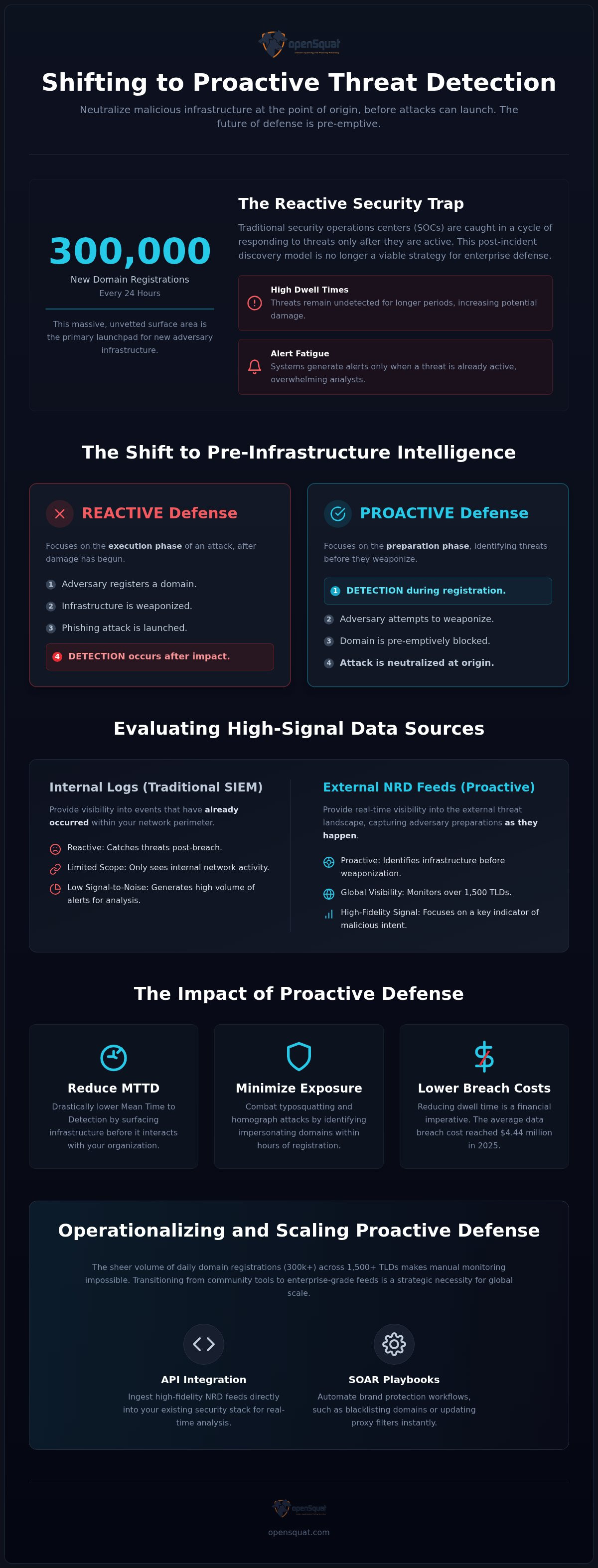
Global registries now process up to 300,000 new domain registrations every 24 hours, creating a massive, unvetted surface area for adversary infrastructure. Most security operations centers remain trapped in a reactive cycle, identifying brand impersonation only after phishing links land in employee inboxes. You understand the cost of high dwell times and the alert fatigue generated by systems that act only when a threat is already active. Relying on post-incident discovery is no longer a viable strategy for enterprise-grade defense.
This article explains how high-fidelity proactive threat detection data shifts security from reactive response to pre-infrastructure defense. By integrating newly registered domain (NRD) feeds into your security stack, you gain early warning of phishing campaigns before they launch. We will analyze 2026 trends in automated domain surveillance and show how clinical data ingestion reduces mean time to detection (MTTD). This methodical approach allows your team to neutralize malicious infrastructure at the point of origin.
Key Takeaways
- Shift your security posture from reactive alert response to pre-infrastructure surveillance by targeting the domain registration phase of the attack lifecycle.
- Understand why high-fidelity proactive threat detection data provides a superior signal-to-noise ratio compared to traditional SIEM logs during the reconnaissance phase.
- Learn the technical requirements for operationalizing NRD feeds through API integration and SOAR playbooks to automate brand protection.
- Identify the performance ceilings of community-driven surveillance tools and the strategic necessity of transitioning to enterprise-grade data feeds for global scale.
Defining Proactive Threat Detection Data in the 2026 Landscape
Proactive threat detection data represents a fundamental shift in defensive strategy. Traditional security models focus on the execution phase of an attack. Modern defense focuses on the preparation phase. In 2026, adversaries automate infrastructure deployment at scale, often registering hundreds of domains for a single campaign. Detecting a malicious domain after it sends an email represents a failure of the reactive model. Proactive surveillance monitors the registration phase itself. This is the "left-of-boom" requirement. High-fidelity data feeds allow security operations centers (SOCs) to identify assets before they are weaponized. This transition is necessary to combat the speed of automated phishing and malware distribution.
The Taxonomy of Proactive Security Data
External intelligence is now the primary driver of proactive defense. Internal logs provide visibility into events that have already occurred within the network. External data provides visibility into the environment outside the perimeter. Proactive Threat Hunting depends on this distinction to find threats that haven't yet triggered internal alerts. Predictive intelligence uses historical patterns to guess future attacks, which often results in false positives. Proactive surveillance data captures real-time events, such as domain registrations across 1,500 TLDs, as they happen. Raw data feeds offer a significant latency advantage over processed threat reports. Speed is the critical variable in 2026 security operations. Clinical data ingestion ensures that analysts work with facts rather than probabilistic guesses.
Metrics of Success: Dwell Time and Exposure Reduction
Success is measured by the reduction of the window between an adversary's registration and their first strike. By identifying a domain within hours of creation, security teams can pre-emptively block traffic or update watchlists. This directly impacts Mean Time to Detect (MTTD) by surfacing infrastructure before it interacts with the organization. The global average cost of a data breach reached $4.44 million in 2025. Reducing dwell time is a financial and operational imperative. High-signal proactive threat detection data provides the evidentiary basis for these defensive actions. It's the mechanism that turns threat intelligence into an automated workflow. Proactive detection data is the clinical requirement for modern SOCs to move from identifying victims to identifying infrastructure.
The Shift Toward Pre-Infrastructure Intelligence
Adversaries rely on the anonymity and speed of domain registration to deploy phishing infrastructure. This setup phase is the weakest link in their operation. Unlike malware payloads that can be obfuscated, a domain registration is a public event recorded in global registries. Transitioning from signature-based detection to infrastructure-based surveillance allows defenders to act on these public signals. By the time a signature is generated for a phishing kit, the campaign is likely already successful. Pre-infrastructure intelligence bypasses this delay by focusing on the assets themselves. This is where proactive threat detection data becomes the primary defensive tool for modern security teams.
Newly Registered Domains (NRDs) as a Primary Signal
NRDs serve as a high-fidelity indicator of malicious intent. Phishing campaigns often utilize domains that have been active for less than 24 hours to evade reputation-based filters and legacy blocklists. Academic research on the Early Detection of Phishing Domains demonstrates that monitoring these registrations can expose malicious infrastructure before weaponization occurs. By monitoring new domain registrations, organizations can identify look-alike patterns that mimic internal services or executive identities. This surveillance provides a critical lead time. It allows security teams to blacklist domains or update web proxy filters before the infrastructure is used in a live attack.
Combating Typosquatting and Homograph Attacks
Adversaries exploit human psychology through typosquatting and homograph attacks. These techniques use subtle character substitutions or internationalized domain names to impersonate legitimate brands. In a landscape with over 1,500 TLDs and up to 300,000 daily registrations, manual monitoring is no longer feasible. The sheer volume of data requires automated, algorithmic surveillance to maintain visibility. Leveraging newly registered gTLD data feeds ensures global coverage across all registries. This automated approach identifies impersonation attempts at the exact point of registration. It shifts the defensive focus from blocking malicious traffic to identifying the infrastructure that generates it. For teams managing high-risk brands, a dedicated brand monitoring dashboard offers the clinical efficiency needed to process these high-signal feeds at scale.
Evaluating High-Signal Data Sources: NRDs vs. Traditional Logs
Traditional SIEM and EDR logs provide visibility into events that have already occurred within your network. While these logs are essential for forensic analysis, they often miss the initial reconnaissance and setup phases of an attack. Adversaries frequently register domains days or weeks before a campaign begins. By the time these domains appear in your DNS or firewall logs, the perimeter has already been targeted. This delay represents a systemic failure in reactive security models. High-fidelity proactive threat detection data allows your team to identify these assets before they ever interact with your infrastructure. As detailed in the 2026 Cloud Threat Horizons report, attackers are increasingly leveraging short-lived, newly registered infrastructure to bypass legacy reputation filters.
Bulk Data vs. Filtered Intelligence
Selecting the right data delivery method is a matter of operational scale. High-throughput environments require a technical guide to bulk newly registered domain data ingestion to effectively process the daily volume of 300,000 new registrations. Raw feeds provide the maximum breadth of coverage, allowing internal data science teams to build custom detection models. In contrast, a managed brand monitoring dashboard is more efficient for SOC teams that need to focus specifically on impersonation and typosquatting. The decision depends on your internal processing capacity and required latency. A clinical evaluation of newly registered domain feeds is necessary to ensure your provider offers the low-latency updates required for modern defense.
The Role of Historical Context in Threat Detection
Speed is critical, but historical depth provides the context needed for accurate attribution. Mapping how an adversary's infrastructure evolves requires access to registration history and cross-referencing with known malicious IP ranges. This context allows security teams to build a comprehensive domain reputation profile. If a new domain is registered using a registrar or name server frequently associated with a specific threat actor, it's flagged for immediate review. This proactive approach ensures that automated blocking rules are based on infrastructure patterns rather than just reactive signatures. By combining real-time proactive threat detection data with historical intelligence, enterprises can maintain a robust, pre-infrastructure defense layer that anticipates threats before they launch.
Operationalising Proactive Data: Integration and Workflow Automation
Operationalizing proactive threat detection data requires a systematic shift from manual review to automated response. In 2026, the volume of new registrations makes human-led triage an operational bottleneck. Security teams must implement SOAR playbooks that trigger immediately upon the detection of high-risk domains. If a domain matches a specific brand pattern, the system should automatically update web proxies or internal DNS blocklists. This proactive stance reduces the exposure window from days to minutes. It ensures that malicious infrastructure is neutralized before the first phishing email is sent.
Architecting a NRD API for security teams ensures that high-signal data flows directly into the existing security stack. This approach handles enterprise-scale ingestion without system degradation. Utilizing real-time NRD data allows for high-frequency surveillance across more than 1,500 TLDs. To maintain high signal-to-noise ratios, advanced lexical and phonetic filtering must be applied. This clinical process eliminates false positives by distinguishing between legitimate registrations and malicious look-alikes. Precise filtering ensures that your SOC focuses only on high-probability threats.
API-First Strategies for Threat Intelligence
Integrating commercial API feeds into existing security stacks requires standardized data formats for seamless utility. This ensures compatibility between SIEM, XDR, and threat intelligence platforms. Handling high-throughput data streams necessitates an infrastructure that supports asynchronous processing. This prevents system degradation during peak registration periods. By prioritizing an API-first strategy, organizations can automate the ingestion of millions of data points daily. This creates a resilient pipeline that feeds directly into automated defensive workflows, providing the speed required for 2026 threat landscapes.
The Role of the Brand Monitoring Dashboard
A dedicated brand monitoring dashboard centralizes domain surveillance for globally distributed organizations. It visualizes emerging infrastructure trends, allowing teams to identify clusters of malicious activity. This transparency informs defensive strategy by highlighting which TLDs or registrars are currently favored by adversaries. Structured reports enable non-technical stakeholders to monitor brand risk without requiring deep technical knowledge. This unified view ensures that the entire organization remains vigilant against impersonation attempts. For teams requiring seamless integration, Commercial API Access provides the high-signal data needed to fuel these automated workflows.
Scaling Proactive Defense with Enterprise-Grade Domain Feeds
Open-source projects like the openSquat tool provide a foundational entry point for domain surveillance. However, enterprise environments eventually encounter a performance ceiling with community-driven solutions. Processing 300,000 new domains daily across more than 1,500 TLDs requires more than just script-level execution. It demands specialized infrastructure designed for high-throughput analysis. Commercial-grade intelligence ensures that data ingestion remains consistent and low-latency. This transition is essential for organizations that cannot afford gaps in their visibility or delays in their automated blocklists. Clinical data delivery replaces the unpredictability of community feeds with a reliable, enterprise-ready pipeline.
Enterprise Reliability and Data Integrity
Enterprise reliability is non-negotiable for critical security feeds. A 99.9% uptime requirement ensures that proactive threat detection data is available during peak registration windows. Data provenance and technical honesty are the pillars of this intelligence. Every data point must be verifiable and delivered in a structured format that respects the user's technical proficiency. Specifically, NRD feeds for threat hunters empower specialized teams to perform deep-dive analysis without the noise associated with low-fidelity lists. This focus on data integrity ensures that automated responses are triggered by facts, not anomalies in the feed itself.
Conclusion: The Future of Proactive Surveillance
The shift toward pre-infrastructure surveillance represents the next generation of domain-based defense. By 2026, the ability to identify assets before weaponization will be the standard for high-maturity SOCs. Reactive models are simply too slow for the current threat landscape. To future-proof your security posture, integrate high-fidelity proactive threat detection data directly into your automated workflows. This methodical approach reduces dwell time and eliminates the "after-the-fact" discovery of brand impersonation. Architects building a 2026-ready SOC should prioritize clinical data delivery over marketing hyperbole. The objective is to operate as fast as the data itself, neutralizing threats before they reach the network perimeter.
For organizations ready to scale their surveillance capabilities, openSquat provides the necessary infrastructure. Secure Commercial API Access or initiate a trial of the Brand Monitoring Dashboard to transition from reactive response to proactive defense. Our enterprise-level data feeds ensure your security stack has the high-signal intelligence required to maintain a vigilant, pre-infrastructure safeguard.
Architecting a Resilient Pre-Infrastructure Defense
Adversaries in 2026 exploit the inherent latency of reactive security systems. Relying solely on internal logs or post-incident signatures leaves your organization vulnerable during the critical weaponization phase. Transitioning to a model built on proactive threat detection data allows your SOC to neutralize malicious infrastructure at the point of registration. This shift effectively reduces mean time to detection (MTTD) and eliminates the visibility gaps inherent in traditional monitoring strategies.
Scaling these operations requires clinical precision and high-throughput delivery. Manual surveillance can't keep pace with the 300,000 domains registered daily across global registries. By integrating real-time commercial API access and utilizing a centralized brand monitoring dashboard, your team gains the high-signal intelligence needed for automated defense. This methodical approach ensures that your security stack remains alert and ready for emerging threats.
Access Enterprise-Grade NRD Feeds and Brand Monitoring to secure your perimeter with high-throughput newly registered domain data. Implementing these advanced surveillance tools positions your organization as a proactive leader in the security community. You're now equipped to stay ahead of infrastructure-based attacks.
Frequently Asked Questions
What is proactive threat detection data?
Proactive threat detection data consists of high-fidelity signals that identify malicious infrastructure before an attack begins. This includes newly registered domain (NRD) feeds, SSL certificate logs, and typosquatting indicators. Unlike reactive alerts based on network telemetry, this data focuses on the setup phase. It allows security teams to identify and block assets such as look-alike domains before they are weaponized in phishing or malware campaigns. This creates a pre-infrastructure defense layer.
How does NRD data improve phishing detection?
NRD data identifies phishing infrastructure at the point of creation. Most malicious domains are utilized within the first 24 hours of registration. By monitoring these new entries across 1,500 TLDs, security teams can detect brand impersonation attempts before a single email is sent. This proactive approach significantly reduces the dwell time of phishing campaigns and prevents users from interacting with fraudulent sites that have not yet been blacklisted by legacy reputation filters or traditional security tools.
What is the difference between proactive detection and threat hunting?
Proactive detection is a strategy focused on surfacing threats before they breach the perimeter. Threat hunting is a specific activity where analysts search through existing logs for evidence of a compromise that has already occurred. While threat hunting is often hypothesis-driven, proactive detection relies on high-signal proactive threat detection data to identify external infrastructure preparations. Both are essential, but proactive detection aims to neutralize the threat before internal logs generate an alert.
Can proactive threat detection data be automated?
Yes, automation is the primary method for operationalizing this intelligence. Organizations use commercial API access to ingest raw feeds into SOAR platforms and SIEMs. Automated workflows can then perform lexical analysis to find typosquatted domains and update DNS blocklists or firewall rules instantly. This eliminates the bottleneck of manual triage. Advanced filtering ensures that only high-probability threats trigger defensive actions, maintaining a high signal-to-noise ratio and ensuring analysts don't waste time on low-signal noise.
Why is real-time domain surveillance critical for brand protection?
Real-time surveillance is necessary because adversaries deploy and retire infrastructure with extreme speed. A phishing domain might only stay active for a few hours to evade detection. Monitoring registrations in real-time allows brand protection teams to identify homograph attacks and look-alike domains as they appear in global registries. This immediate visibility enables faster defensive updates and helps maintain customer trust so users don't fall victim to impersonation-based fraud before it impacts your user base.
How do you integrate NRD feeds into a SIEM?
Integration typically involves using a commercial API to pull domain data into your SIEM's threat intelligence module. The data is then cross-referenced against internal DNS logs and web proxy traffic. You can set up correlation rules to flag any internal connection attempts to domains registered within the last 30 days. This methodical ingestion process turns raw registration data into an actionable layer of defense within your existing security orchestration stack, providing clinical efficiency for proactive detection.
What makes a domain feed "high-fidelity"?
High-fidelity feeds are characterized by low latency, high signal-to-noise ratios, and technical precision. They provide curated data that minimizes false positives through advanced lexical and phonetic filtering. A high-fidelity feed includes comprehensive coverage of both gTLDs and ccTLDs, ensuring no visibility gaps. For enterprise environments, this data must be delivered via a reliable API with 99.9% uptime to support automated security workflows and real-time surveillance requirements. This ensures analysts work with facts rather than noise.
Is proactive security better than reactive defense?
Proactive security is a necessary evolution of, rather than a replacement for, reactive defense. Reactive systems are essential for identifying active breaches, but they cannot prevent the initial strike. Proactive security uses proactive threat detection data to block the adversary's infrastructure during the setup phase. By combining both approaches, organizations create a multi-layered defense that reduces the probability of a successful breach while maintaining the ability to respond to internal incidents if a perimeter is breached.


