
Most phishing campaigns are live and operational within twenty-four hours of a domain being registered, often before legacy security scanners even flag the entry. You're likely dealing with a high volume of false positives and a frustrating lag time between registration and detection. The technical complexity of the WHOIS-to-RDAP transition adds further friction to your existing workflows. Monitoring new domain registrations at scale requires a shift from manual keyword alerts to high-throughput data ingestion. With over 300,000 new domains registered daily, clinical efficiency in data processing isn't optional; it's a requirement for enterprise survival.
This guide explains how to leverage algorithmic surveillance to identify emerging threats before they launch. You'll discover how to establish a proactive threat hunting workflow that reduces the window of exposure for brand impersonation and phishing. We provide a technical breakdown of how to integrate domain intelligence into existing SIEM and SOAR stacks. This approach transforms raw data feeds into actionable security telemetry, allowing your team to operate with the steady confidence of a well-calibrated instrument.
Key Takeaways
- Master the technical mechanics of monitoring new domain registrations by ingesting high-throughput data from zone files and RDAP.
- Navigate the signal-to-noise challenge of over 300,000 daily registrations to detect homograph attacks that keyword alerts miss.
- Utilize technical indicators like registrar reputation and string entropy to prioritize high-risk domains for investigation.
- Establish a proactive defense by integrating NRD intelligence directly into your SIEM or SOAR workflow.
- Transition from manual surveillance to automated enterprise-grade monitoring using specialized API access and dashboards.
The Mechanics of Monitoring New Domain Registrations
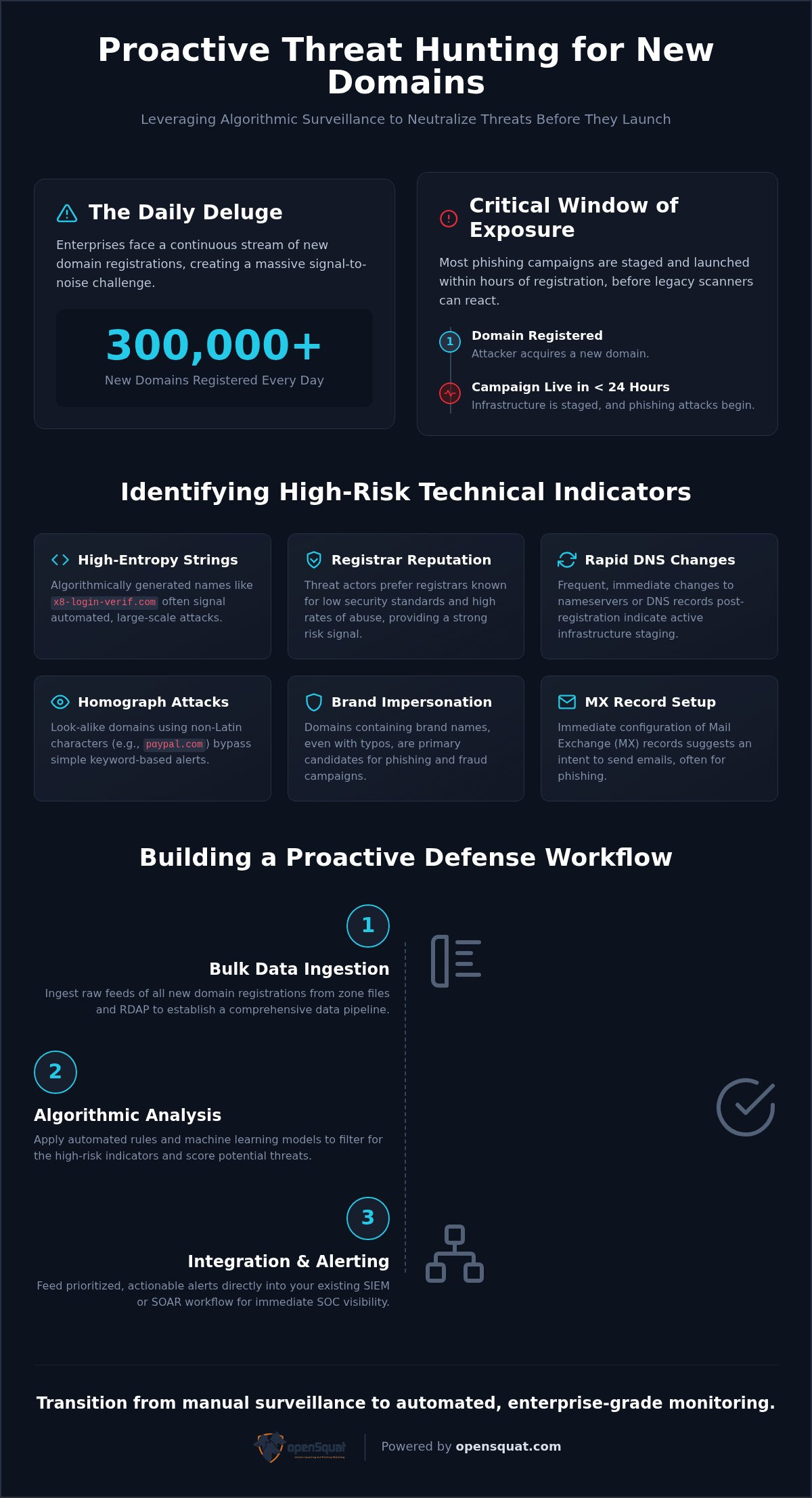
Monitoring new domain registrations is the systematic ingestion of registration events across gTLDs and ccTLDs. It's a high-frequency process designed to identify new entries in the DNS before they are weaponized. Legacy methods relied on manual WHOIS lookups; however, modern surveillance requires a more aggressive, automated approach. Clinical efficiency in threat hunting depends on visibility during the first 24 hours of a domain's lifecycle. This is the critical window where attackers stage infrastructure for phishing and malware delivery. If you aren't monitoring this period, you're missing the most dangerous phase of the campaign.
Data Sourcing: From Zone Files to RDAP
Effective monitoring of new domain registrations requires direct access to a Domain Name Registry. Security teams use zone file access to pull lists of all active domains within specific TLDs. While zone files provide the domain names, they lack the granular data needed for attribution. The shift from WHOIS to the Registration Data Access Protocol (RDAP) has changed how we view this information. RDAP provides structured, machine-readable data that's easier to integrate into automated pipelines. Because privacy regulations like GDPR have redacted much of the public record, RDAP's tiered access models are vital. Implementing bulk newly registered domain data ingestion allows your SOC to process these updates in real-time rather than waiting for daily batches.
The Lifecycle of a Malicious Domain
Most phishing campaigns follow a rapid registration-to-activation cycle. Threat actors register a domain and immediately begin staging infrastructure. This includes configuring MX records, generating SSL certificates, and hosting landing pages. This staging often occurs within hours. Monitoring must be continuous to capture these "burn-and-turn" assets. These domains are designed for short-term use and are often abandoned once they're flagged by blocklists.
Identifying these threats requires looking for specific technical indicators:
- High-entropy domain strings that suggest algorithmic generation.
- Use of registrars with known low-security standards or high abuse rates.
- Rapid, frequent changes to name servers or DNS records during the first few hours.
If your monitoring is periodic, these ephemeral threats will likely bypass your security perimeter. Persistence in surveillance is the only way to close the window of exposure.
Why Enterprise Visibility Requires Bulk Data Ingestion
Keyword-based alerts are a fundamental starting point, but they're insufficient for modern enterprise defense. Monitoring new domain registrations at scale requires processing over 300,000 entries every 24 hours. A reactive strategy that only triggers on exact string matches will fail to identify sophisticated homograph attacks or look-alike domains using non-Latin characters. Effective security operations demand a data-first approach. Data drives defense. Instead of waiting for a third-party alert, teams must ingest raw newly registered domain feeds to perform their own algorithmic analysis. This shifts the focus from manual Whois lookups to automated, high-throughput detection. It's about building a pipeline that treats registration data as a primary telemetry source.
The Limitations of Reactive Brand Protection
Reactive monitoring typically focuses on external-facing assets. It often misses infrastructure being staged for internal phishing or Command and Control (C2) servers. When an attacker registers a domain that mimics an internal service, the cost of delay is measured in compromised credentials. Minutes matter. Exposure for even a few minutes can lead to full-scale data exfiltration. Proactive surveillance flags these suspicious registrations before they're weaponized. Following Domain security best practices involves identifying these threats at the registration event, not after the first malicious email is sent. We don't have the luxury of waiting for a domain to appear on a blocklist. By the time it's listed, the damage is likely done.
Surveillance at Scale: Feeds vs. Point Queries
Point queries are useful for investigating a single lead, but they can't scale to the volume of the modern DNS. Bulk data ingestion is the only way to manage the current signal-to-noise ratio. Utilizing newly registered gTLD data feeds allows security teams to perform cross-TLD pattern matching. This identifies clusters of malicious registrations that point queries would miss. Monitoring new domain registrations through bulk feeds provides the visibility necessary to stay ahead of threat actors. Processing this high-throughput data requires robust infrastructure, including high-speed parsing engines and scalable database storage. It's a technical commitment that pays off. For experts who need clean, reliable data without the noise of marketing tools, a specialized brand monitoring dashboard provides the necessary technical precision. Enterprise security is an engineering challenge. It requires tools that prioritize functional utility over marketing hyperbole.
Identifying Threat Patterns in Registration Data
Monitoring new domain registrations is only effective if you can separate legitimate business activity from malicious staging. Raw data ingestion provides the visibility, but algorithmic analysis provides the signal. Security teams must look for specific technical indicators that correlate with high-risk activity. These include the choice of registrar, the reputation of the Top-Level Domain (TLD), and the presence of suspicious string patterns. Identifying these threats requires a multi-layered approach that combines linguistic analysis with historical reputation data. This process transforms a massive data stream into a prioritized list of targets for your security operations center.
Typosquatting and Homograph Attack Detection
Attackers frequently use typosquatting to catch users who make small errors when typing a URL. To detect these, automated systems calculate the Levenshtein distance between your brand's core domains and new registrations. This mathematical value represents the minimum number of single-character edits required to change one string into another. A low Levenshtein distance indicates a high probability of a look-alike domain. Homograph attacks are more sophisticated. They use Internationalized Domain Names (IDN) and Punycode to create domains that look identical to a target brand in a browser. A domain registered as "xn--e1afmkfd.com" might resolve to "apple.com" using Cyrillic characters. Automated tools scan for these Punycode prefixes because visual inspection is technically impossible at scale. This proactive detection ensures that look-alike infrastructure is flagged before it's used in a phishing campaign.
Algorithmic Scoring of Newly Registered Domains
Not all registrations carry the same level of risk. Algorithmic scoring allows analysts to prioritize their review based on the probability of malicious intent. This scoring model incorporates the reputation of the registrar and the historical abuse rates of specific TLDs. For example, certain generic TLDs have significantly higher rates of malicious activity than traditional .com or .org extensions. The operational status of the domain also provides a key signal. A domain that is "parked" with no active DNS records might be in a dormant staging phase, while a domain with active MX records is likely ready for an immediate mail-based attack.
Mathematical analysis of the domain string itself provides further insight. Domain entropy is a mathematical measure of randomness in a string used to flag DGA-generated domains. High entropy scores often indicate domains generated by malware for Command and Control (C2) communication. By combining these scores with brand-matching algorithms, security teams can focus their energy on the top 1% of high-risk registrations. This methodical approach reduces analyst fatigue and ensures that critical threats aren't buried in the daily noise of the global DNS.
Integrating Domain Intelligence into Security Operations
Transforming raw data into actionable intelligence requires a structured engineering approach. Integration is not a one click process; it's a technical pipeline that must handle the velocity of the global DNS. Effective monitoring new domain registrations involves a 4 step process to ensure clinical efficiency within a Security Operations Center (SOC). First, establish high throughput data acquisition. Second, apply automated filtering based on technical risk scores. Third, correlate these filtered domains against internal web proxy and DNS logs. Finally, orchestrate a response through automated blocking or analyst escalation. This methodical workflow ensures that your team isn't overwhelmed by noise but remains focused on high probability threats.
Threat hunters use these feeds to conduct proactive reconnaissance. Utilizing NRD feeds for threat hunters allows security teams to identify infrastructure before it is used in an active campaign. This is first party intelligence. It provides a baseline of what is being registered globally, allowing you to hunt for clusters of malicious activity that haven't yet reached your perimeter. High frequency real-time NRD data ingestion requires robust infrastructure capable of parsing thousands of records per second. This is an engineering commitment that yields significant defensive advantages.
Automating Discovery via Commercial APIs
Commercial APIs provide the scale necessary to bypass the rate limits of public lookups. Using an NRD API for security teams enables the automation of discovery workflows. You can trigger alerts based on custom regex patterns or specific brand terms. Data formats like JSON or CSV are most conducive to this automation. They allow for seamless ingestion into Python scripts or specialized monitoring tools. For enterprises requiring this level of precision, commercial API access provides the high throughput needed for real time surveillance.
Feed Ingestion for SIEM and SOAR Platforms
Modern defense relies on correlation. By ingesting domain feeds into your SIEM, you can automatically match new registrations against your internal web proxy logs. If a user's device attempts to connect to a domain registered in the last 24 hours, it should trigger an immediate investigation. SOAR platforms can then take this a step further. You can build playbooks that automatically block high risk NRDs at the firewall or mail gateway based on their reputation score. This reduces the window of exposure from hours to seconds. Treating domain data as a primary telemetry source transforms your security posture from reactive to proactive.
Building a Proactive Defense with openSquat
Enterprise security demands a trusted instrument that operates with clinical precision. openSquat serves as a specialized partner for threat hunters who require high-signal intelligence without the distraction of marketing fluff. Monitoring new domain registrations is no longer a manual task. It's an engineering challenge that requires reliable, high-throughput data. By providing clean, structured feeds, we enable security teams to maintain a proactive stance against brand impersonation and phishing. This vigilant approach ensures that infrastructure is identified during the staging phase, long before the first malicious payload is delivered. Functional utility and data-driven results are the foundations of effective surveillance.
From Open Source Roots to Enterprise Intelligence
openSquat’s background in open-core security ensures technical transparency. The community version of the openSquat tool provides a functional starting point for the security community, valuing peer-reviewed methodology and open principles. However, enterprise environments require the deeper data and higher throughput found in our commercial offerings. We prioritize engineering rigor over marketing hyperbole. Our premium feeds monitor over 300,000 newly registered domains daily across more than 1,000 TLDs. This volume provides the clinical coverage necessary for global threat hunting. We focus on delivering clean data that integrates seamlessly into your existing detection pipelines, ensuring that your analysts spend time on high-probability threats rather than filtering noise.
Implementing a Continuous Monitoring Workflow
An ideal surveillance stack combines bulk data ingestion, API enrichment, and centralized visibility. Adopting a "zero-trust" approach to all newly registered domains is essential for modern defense. Every new entry represents a potential threat until its technical indicators, such as registrar reputation or entropy scores, suggest otherwise. Use the brand monitoring dashboard to maintain cross-team visibility into emerging risks. This centralized view allows analysts to coordinate responses and share intelligence across the SOC without friction. The transition from manual keyword alerts to automated surveillance is a technical necessity. Integrate enterprise threat intelligence feeds into your workflow to establish a proactive defense that identifies threats before they launch. This methodical approach transforms raw DNS data into a reliable safeguard that operates quietly in the background of your security operations.
Advancing Toward Proactive Threat Surveillance
Effective enterprise defense relies on the transition from reactive alerts to high-throughput data ingestion. We've established that monitoring new domain registrations requires an engineering-first mindset to manage the signal-to-noise ratio of over 300,000 daily entries. By integrating algorithmic scoring and automated workflows into your SIEM or SOAR, your team can identify malicious infrastructure before it's weaponized. This methodical approach transforms raw DNS telemetry into a reliable safeguard. It ensures that "burn-and-turn" campaigns are neutralized during their staging phase.
Maintaining visibility across the global DNS is a technical commitment that pays off in reduced exposure and faster response times. It's a necessary step for organizations that value data-driven results over manual processes. For experts who require clinical precision and high-signal data, specialized tools provide the necessary edge. You can access enterprise-grade NRD feeds and domain intelligence to enhance your security operations. Our commercial API supports high-throughput security workflows, while our specialized brand monitoring dashboard is trusted by the global threat intelligence community. This proactive strategy ensures your organization remains alert and ready for emerging threats.
Frequently Asked Questions
What exactly is a Newly Registered Domain (NRD) feed?
An NRD feed is a structured data stream containing every domain added to the global DNS within the last 24 hours. This telemetry allows security teams to identify staging infrastructure before it is weaponized in a campaign. openSquat monitors over 300,000 daily registrations across more than 1,000 TLDs. This high-throughput intelligence provides the clinical data needed for algorithmic threat hunting and brand impersonation detection.
How often are new domain registration lists updated?
Lists are typically updated every 24 hours as registries publish new zone files. Enterprise-grade feeds aggregate data from multiple sources to provide more frequent updates throughout the day. Monitoring new domain registrations with this frequency is essential because attackers often weaponize domains within hours of purchase. Continuous ingestion ensures that the window between registration and detection remains as small as possible for your SOC.
Can monitoring new domains prevent phishing attacks before they happen?
Yes, by identifying malicious infrastructure during the staging phase. Attackers must register domains and configure DNS records before sending phishing emails. Detecting these events allows security teams to proactively block high-risk domains at the firewall or mail gateway. This shifts the defense from reactive mitigation to proactive prevention. It targets the "burn-and-turn" infrastructure used in modern phishing campaigns before the first payload is delivered.
What is the difference between WHOIS and RDAP for domain monitoring?
WHOIS is a legacy protocol that often lacks structured data and is increasingly restricted by privacy regulations. RDAP is the modern successor designed for technical precision. It provides machine-readable JSON output and supports tiered access for security professionals. RDAP's structured format is more conducive to automated pipelines and high-frequency surveillance than the inconsistent text-based responses of traditional WHOIS lookups. It is the preferred standard for modern integration.
Why should a security team monitor gTLDs and ccTLDs separately?
Registries for generic TLDs and country-code TLDs operate under different regulatory frameworks and publication schedules. For example, as of September 1, 2026, Russia requires mandatory identity verification for its domain registrations. Monitoring both ensures global coverage. Attackers often pivot to ccTLDs with less stringent oversight or different zone file access rules to hide their staging activities from standard security scanners. Global visibility requires monitoring both categories.
How do I integrate a domain threat intelligence API into my SIEM?
Integration involves using a commercial API to ingest domain feeds into your SIEM's data pipeline. You can write scripts to correlate these new registrations with internal web proxy or DNS logs. If a user's device attempts to reach a domain registered in the last 24 hours, the system triggers an alert. Structured formats like JSON allow for seamless mapping to existing security telemetry, enabling automated response workflows.
What are the technical indicators of a suspicious new domain registration?
Key indicators include high-entropy domain strings and the use of registrars with known high abuse rates. A domain that mimics a brand using Punycode or character substitutions is a high-priority threat. Additionally, the presence of active MX records on a domain registered within the last few hours suggests immediate intent for a phishing campaign. Monitoring new domain registrations allows you to score these indicators algorithmically to prioritize analyst review.
Does openSquat provide domain takedown services?
No, openSquat does not provide domain takedown or registration services. Our specialization is strictly in malicious registration identification and threat intelligence. We provide the clinical data and specialized instruments needed for experts to detect threats with high precision. Organizations requiring takedown services should partner with specialized legal or brand protection firms after identifying malicious domains through our monitoring dashboard. We focus on delivering clean, reliable data feeds.


