
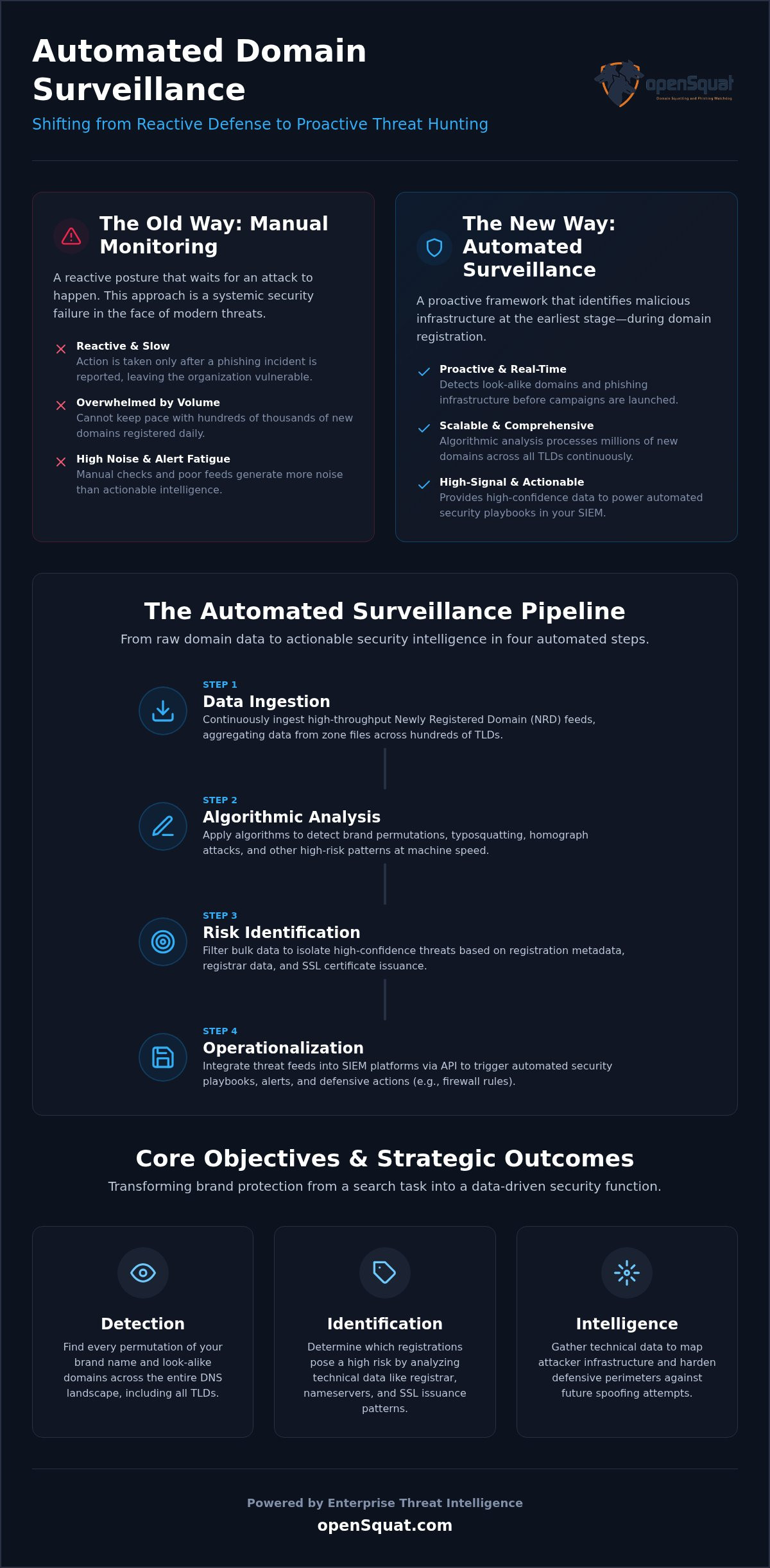
Manual brand monitoring isn't just inefficient in 2026; it's a systemic security failure. Security teams often find themselves reacting to phishing campaigns only after the first victim reports a credential theft. This reactive posture stems from a reliance on manual typo-squatting checks that cannot keep pace with the hundreds of thousands of newly registered domains (NRDs) appearing daily. To close this gap, organizations must deploy automated domain surveillance architectures that function as a continuous, high-signal data pipeline rather than a periodic search task.
You likely recognize that your current threat feeds generate more noise than actionable intelligence, leading to critical alert fatigue and missed indicators. This article explains how to transition your brand protection from manual oversight to a high-throughput, automated framework. We'll examine the mechanics of integrating enterprise-grade NRD feeds into your existing security workflows via API. You'll learn how to achieve real-time visibility into brand-related registrations and reduce your time-to-detection for malicious infrastructure before it even launches. This approach transforms brand protection from a series of disjointed searches into a clinical, data-driven security function.
Key Takeaways
- Transition from reactive response to proactive reconnaissance-phase detection by identifying malicious infrastructure during the registration phase.
- Deploy automated domain surveillance using high-throughput NRD feeds and algorithmic analysis to detect brand permutations at scale.
- Utilize enterprise-grade APIs and centralized dashboards to maintain real-time visibility across all brand-related domain registrations.
- Operationalize surveillance data by integrating threat feeds into SIEM platforms to trigger automated security playbooks and high-confidence alerts.
- Scale from community-grade open-source tools to professional threat intelligence feeds to ensure comprehensive coverage and technical precision.
Defining Automated Domain Surveillance for Modern Enterprise Security
Automated domain surveillance is the systematic, algorithmic monitoring of DNS registrations to identify brand-related risks. It operates as a continuous data ingestion pipeline rather than a static search task. While legacy domain monitoring often relies on periodic keyword matching, enterprise-grade surveillance utilizes high-volume data feeds to detect malicious patterns at scale. This capability is a critical component of a modern cyber threat intelligence (CTI) framework. It shifts the defensive posture from reactive takedowns to proactive reconnaissance-phase detection. By identifying threats during the registration phase, security teams can neutralize phishing infrastructure before a single email is sent.
This approach differentiates itself through technical precision. It doesn't just look for exact matches; it analyzes the underlying registration data to find anomalies. Integrating these feeds into a broader security workflow allows for a modular response to emerging threats. It provides the raw intelligence needed to inform firewall rules and email gateway filters. This proactive stance ensures that the organization isn't just reacting to incidents but is actively shaping its defensive perimeter based on real-time DNS telemetry.
The Evolution from Manual Brand Monitoring to Automated Surveillance
Manual searches on WHOIS databases are no longer viable for global brands. The volume of newly registered domains (NRDs) has scaled beyond human capacity. Modern attackers use automated phishing kits that weaponize a domain within minutes of registration. This speed makes traditional monitoring obsolete. In 2026, security teams rely on automated domain surveillance to preempt homograph attacks. These attacks use visually similar characters to deceive users. Surveillance systems identify these registrations instantly across thousands of TLDs. This transition replaces slow, error-prone manual oversight with clinical, high-speed data processing. It addresses the fundamental problem of cybersquatting by providing visibility into the attacker's setup phase.
Core Objectives: Detection, Identification, and Intelligence
The primary objective of automated surveillance is identifying look-alike domains before they enter active phishing campaigns. This requires monitoring the entire DNS landscape for typosquatting patterns. The system doesn't just flag keywords; it analyzes registration metadata to identify broader attacker infrastructure. This intelligence allows teams to map out the adversary's resources. Effective surveillance follows a logical flow:
- Detection: Finding every permutation of a brand name across all available TLDs.
- Identification: Determining which registrations pose a high risk based on registrar data and SSL certificate issuance.
- Intelligence: Gathering technical data to harden defensive perimeters against future spoofing attempts.
By focusing on these objectives, organizations gain a strategic advantage over adversaries. Attackers depend on the obscurity of their infrastructure to succeed. Surveillance removes that obscurity. It provides the transparency needed to maintain a vigilant and ready security posture.
How Automated Surveillance Systems Detect Brand Impersonation
Effective automated domain surveillance relies on the continuous ingestion of DNS telemetry. This process begins with the acquisition of raw data from top-level domain (TLD) registries. While some platforms rely on traffic logs, this reactive method ignores threats until they're already active. A proactive surveillance architecture identifies malicious infrastructure during the setup phase by analyzing newly registered domain feeds. This allows security teams to detect look-alike domains before they appear in user traffic or email headers.
The Role of Newly Registered Domain (NRD) Feeds
NRD feeds provide the primary raw material for brand protection. These feeds aggregate data from zone files across hundreds of TLDs. The technical challenge lies in processing millions of registrations daily without introducing latency. Security teams must filter bulk data to isolate high-risk candidates based on specific brand keywords. A 24-hour delay in this process can be catastrophic. Attackers often weaponize domains within hours of registration to launch short-lived phishing campaigns. High-throughput data ingestion ensures that your team sees these registrations as they happen, providing a clinical view of the evolving threat landscape.
Algorithmic Detection of Look-Alike Domains
Once the data is ingested, an algorithmic layer scans for permutations. This layer uses Levenshtein distance to calculate the edit distance between a registered domain and a protected brand name. It also monitors for bit-squatting, where a single bit flip in a DNS request leads a user to a malicious IP. Surveillance tools identify homoglyph and homograph attacks by recognizing visually similar characters from different alphabets. Detection logic also extends to subdomains and nested paths. Modern tools discover brand keywords buried within complex URL structures, preventing attackers from hiding behind legitimate-looking third-party hosting providers.
The system scores threat levels by analyzing metadata, such as the registrar used or the reputation of the name servers. If a registration matches a brand pattern and uses a registrar frequently associated with malicious activity, the alert priority increases. While surveillance identifies these risks, organizations may eventually need to reference the Uniform Domain Name Dispute Resolution Policy for formal remediation. For security engineers building these automated workflows, utilizing commercial API access provides the structured data needed for high-confidence scoring and rapid response.
Key Features of Enterprise-Grade Domain Surveillance Tools
Enterprise-grade security tools must process vast amounts of DNS telemetry without sacrificing speed or precision. For organizations scaling their brand protection, automated domain surveillance is the only viable method for maintaining visibility across a fragmented global namespace. These tools provide the technical foundation for identifying malicious infrastructure before it's used in active campaigns. A robust surveillance architecture moves beyond simple pattern matching; it creates a high-signal environment where security analysts can focus on validated threats rather than raw data noise.
Commercial API Access vs. Open-Source Limitations
While community-driven tools provide a valuable entry point, they often lack the throughput required for production environments. Public APIs frequently impose strict rate limits that break automated surveillance workflows during peak registration periods. Mission-critical security data requires the high-availability and guaranteed uptime found in commercial feeds. These feeds deliver data in structured JSON or CSV formats, which are essential for automated ingestion into existing security stacks. This technical reliability ensures that security teams don't miss critical indicators due to system throttling or intermittent connectivity issues. Relying on an enterprise-grade API ensures that data ingestion remains consistent even as the volume of newly registered domains fluctuates.
The Brand Monitoring Dashboard: Centralizing Intelligence
A centralized brand monitoring dashboard transforms raw data into actionable intelligence. It allows analysts to visualize registration trends over time, making it easier to spot coordinated campaign spikes that might be missed in a raw text feed. This interface facilitates collaborative threat hunting across different security tiers by providing a single source of truth. By implementing noise reduction algorithms and intelligent deduplication, these dashboards significantly reduce analyst fatigue. The focus shifts from sorting through thousands of entries to investigating high-confidence matches that meet specific risk thresholds.
Customizable alerting is another pillar of enterprise surveillance. Security teams can define specific brand keywords and risk parameters to ensure they only receive notifications for relevant registrations. This precision is necessary when monitoring thousands of TLDs simultaneously, including newer gTLDs and specific ccTLDs. Comprehensive coverage ensures that organizations can identify registrations that violate the Anticybersquatting Consumer Protection Act across any jurisdiction. This global visibility provides the technical evidence needed to initiate internal security playbooks or external enforcement actions without delay. By centralizing these features, organizations maintain a vigilant and proactive defense against the evolving landscape of brand impersonation.
Operationalizing Surveillance Data within your SOC
Raw telemetry requires a structured workflow to become defensive intelligence. Integrating high-throughput feeds into existing Security Information and Event Management (SIEM) platforms allows for automated correlation with internal logs. This process identifies automated domain surveillance alerts that match active traffic patterns or historical connection attempts. By establishing a direct feedback loop, security teams can programmatically update firewall blocking rules and email gateway filters. This modular approach ensures the SOC isn't just observing threats but is actively neutralizing them at the perimeter.
Integrating with SIEM and SOAR Workflows
Mapping surveillance alerts to the MITRE ATT&CK framework provides the necessary context for incident response. Specifically, detections during the domain registration phase align with the Resource Development stage of the adversary lifecycle. Automating the initial triage of these alerts saves significant analyst time. Security Orchestration, Automation, and Response (SOAR) platforms can use webhooks to trigger immediate defensive actions. For example, a high-confidence match can automatically initiate a DNS sinkhole or alert the identity management team to monitor for credential harvesting attempts. This clinical efficiency reduces the mean time to respond (MTTR) by removing manual bottlenecks from the detection pipeline.
Advanced Threat Hunting with Surveillance Data
Surveillance data serves as a starting point for deeper investigations. Analysts can pivot from a single malicious domain to discover entire attacker clusters by analyzing shared infrastructure patterns. Cross-referencing surveillance data with historical domain reputation feeds reveals recurring adversary tactics and infrastructure reuse. This intelligence is vital for identifying brand impersonation online before campaigns reach full scale. SOC teams should also build custom watchlists for high-value executives and specific product names to ensure specialized monitoring for targeted spear-phishing attempts. The deployment of automated domain surveillance within the SOC architecture turns passive observation into a proactive hunting capability.
Operationalizing this data transforms the SOC into a vigilant and ready security function. It provides the technical honesty needed to assess the true scope of the external threat landscape. To begin integrating these high-signal feeds into your security stack, access our commercial threat intelligence feeds for direct API integration.
OpenSquat: Enterprise Threat Intelligence and Domain Feeds
openSquat functions as the specialized engine for enterprise automated domain surveillance. It provides the technical foundation for organizations that require more than just periodic scanning. While many security professionals are familiar with the openSquat open-source tool, the requirements of global brands in 2026 demand a more robust architecture. The transition to professional data feeds allows teams to move from community-grade scripts to enterprise-grade threat intelligence. This shift ensures that the data ingested is clinically precise, removing the marketing hyperbole often found in broader security platforms.
The core of the service is functional utility. We don't offer the bloat of managed SOC services or generic takedown packages. Instead, we focus on providing the high-signal data that powers your existing security stack. This specialized approach ensures that the intelligence is both actionable and technically honest. By focusing solely on domain-based telemetry, we maintain a level of depth that generalist providers cannot match. It's a tool designed for experts who value data integrity and system reliability over superficial features.
Enterprise-Grade Data Feeds for Proactive Defense
Our Enterprise Threat Intelligence Feeds provide real-time access to newly registered domain data with comprehensive global coverage. This isn't a sampled dataset; it's a high-fidelity stream that captures registrations across gTLDs and ccTLDs as they occur. The primary advantage of a specialized provider is the reduction of noise. Our algorithmic layer filters millions of daily registrations to isolate high-risk candidates, significantly minimizing false positives. This precision allows your SOC to maintain a vigilant posture without being overwhelmed by low-confidence alerts. It provides the raw material needed for proactive defense, identifying threats during the reconnaissance phase before they reach your network.
Seamless Integration and Scalable Architecture
The architecture is built for integration. Through high-throughput Commercial API Access, openSquat supports the most demanding security environments. The API delivers structured data that fits naturally into SIEM and SOAR workflows. This reliability is the result of a platform designed by experts for experts. We understand that mission-critical security data requires consistent uptime and predictable performance. Our infrastructure scales with the volume of global DNS registrations, ensuring your visibility remains uninterrupted regardless of attacker activity levels. To enhance your organization's defensive capabilities, you can Scale your surveillance with openSquat Commercial API and integrate high-signal NRD feeds directly into your workflow.
Securing the DNS Perimeter for 2026 and Beyond
The landscape of brand impersonation requires a shift from manual oversight to algorithmic precision. Organizations can't rely on reactive takedowns once a phishing campaign is live. Implementing automated domain surveillance allows security teams to identify malicious infrastructure during the registration phase. This proactive stance is supported by high-throughput NRD feeds and seamless API integration into existing SOC workflows. By focusing on clinical data quality and removing the noise of managed services, you'll achieve real-time visibility into emerging threats across all TLDs.
Global security teams use these specialized feeds for proactive threat hunting, relying on a high-throughput commercial API with 99.9% reliability. This specialized focus on newly registered domain intelligence ensures your defensive perimeter remains vigilant and ready. Automate your brand protection with openSquat Enterprise Feeds. Strengthening your digital footprint starts with the right telemetry.
Frequently Asked Questions
What is automated domain surveillance and how does it differ from manual monitoring?
Automated domain surveillance is the continuous, algorithmic ingestion of DNS registration data to identify brand risks. Manual monitoring relies on periodic, human-led searches of WHOIS databases, which cannot scale to the hundreds of thousands of new registrations appearing daily. Automation allows security teams to process global data in real time. This technical shift ensures that look-alike domains are identified within minutes rather than days or weeks after an attack has launched.
How can automated surveillance help prevent phishing attacks?
Surveillance identifies malicious infrastructure during the reconnaissance phase, often hours or days before a phishing campaign begins. By detecting brand permutations at the point of registration, security teams can proactively update firewall rules and email filters. This prevents the delivery of phishing emails to end users. It transforms brand protection from a reactive recovery process into a proactive defense that neutralizes the attacker's setup before weaponization occurs.
What are newly registered domain (NRD) feeds and why are they critical?
Newly registered domain (NRD) feeds are aggregated streams of DNS data sourced directly from TLD registries and zone files. They provide the raw telemetry needed for effective automated domain surveillance. These feeds are critical because they capture the earliest indicators of adversary infrastructure development. Without high-fidelity NRD data, security teams remain blind to new domains until they appear in malicious traffic logs, which is often too late for prevention.
Can automated domain surveillance detect homograph attacks?
Yes, modern surveillance tools utilize specialized algorithms to detect homograph and homoglyph attacks. These algorithms identify visually similar characters from different alphabets, such as Cyrillic or Greek characters that mimic Latin letters. The system calculates the edit distance between a registered domain and a protected brand name. This ensures that even subtle permutations designed to deceive the human eye are flagged for immediate review by security analysts.
How do I integrate domain threat intelligence into my existing SOC?
Integration is achieved through commercial API access that delivers structured data in JSON or CSV formats. This allows for seamless ingestion into SIEM and SOAR platforms for automated correlation with internal logs. Security teams can establish webhooks to trigger specific defensive playbooks when high-confidence matches occur. This modular approach ensures that domain intelligence becomes a functional part of the broader security architecture rather than a siloed reporting tool.
Does openSquat provide domain takedown services as part of its surveillance?
openSquat does not provide domain takedown services. Our specialized focus is on delivering enterprise-grade threat intelligence and newly registered domain feeds. We position ourselves as the data provider that powers the SOC, focusing on technical honesty and clinical data precision. While we identify malicious registrations and provide the evidence needed for remediation, we don't offer the managed services or legal advocacy required for formal domain takedowns.
What is the difference between open-source tools and enterprise domain feeds?
Open-source tools like the community version of openSquat are excellent for periodic testing but often lack the throughput needed for enterprise environments. Professional domain feeds offer high-availability API access with guaranteed uptime and no rate limits. Enterprise solutions provide structured, high-signal data that minimizes false positives through advanced algorithmic filtering. This reliability is essential for mission-critical workflows where missing a single malicious registration can result in a significant security breach.
How often is the domain surveillance data updated?
Domain surveillance data is updated continuously as new information is processed from global TLD registries. High-throughput feeds ensure that registrations are visible to security teams in near real-time. This frequency is necessary because attackers often weaponize infrastructure within hours of registration. Maintaining a constant stream of DNS telemetry allows for the rapid identification of threats, ensuring your defensive perimeter remains vigilant against the latest impersonation attempts.


