
In the first half of 2026 alone, 1,803 data compromises were reported, many leveraging high-trust exploitation of newly registered infrastructure. When attackers can weaponize a domain within hours of registration, waiting for legacy blacklists is a failed strategy. You're likely tired of generic threat feeds that generate high false-positive rates and create more noise than security. Integrating a specialized domain threat intelligence API allows your team to move from reactive patching to proactive infrastructure surveillance.
This guide serves as a technical reference for security architects looking to build automated defense workflows. We'll demonstrate how to ingest high-signal data into your existing SIEM and SOAR platforms for immediate impact. You'll learn the mechanics of setting up an early-warning system for typosquatted domains and how to automate reconnaissance of emerging attacker infrastructure. By the end of this article, you'll have a clear roadmap for integrating newly registered domain (NRD) feeds into a clinical, high-throughput defense stack.
Key Takeaways
- Shift from reactive blacklisting to proactive surveillance by ingesting real-time registration data at the source.
- Evaluate technical benchmarks for a domain threat intelligence API to ensure high-throughput access to newly registered domain (NRD) feeds.
- Identify and neutralize phishing infrastructure during the setup phase by enriching SIEM and SOAR alerts with high-fidelity reputation data.
- Establish rigorous evaluation criteria for data freshness and signal-to-noise ratios to minimize false positives in automated defense workflows.
- Streamline the transition from open-source tools to commercial-grade API integration for enterprise-scale brand monitoring and infrastructure reconnaissance.
The Strategic Role of a Domain Threat Intelligence API in 2026
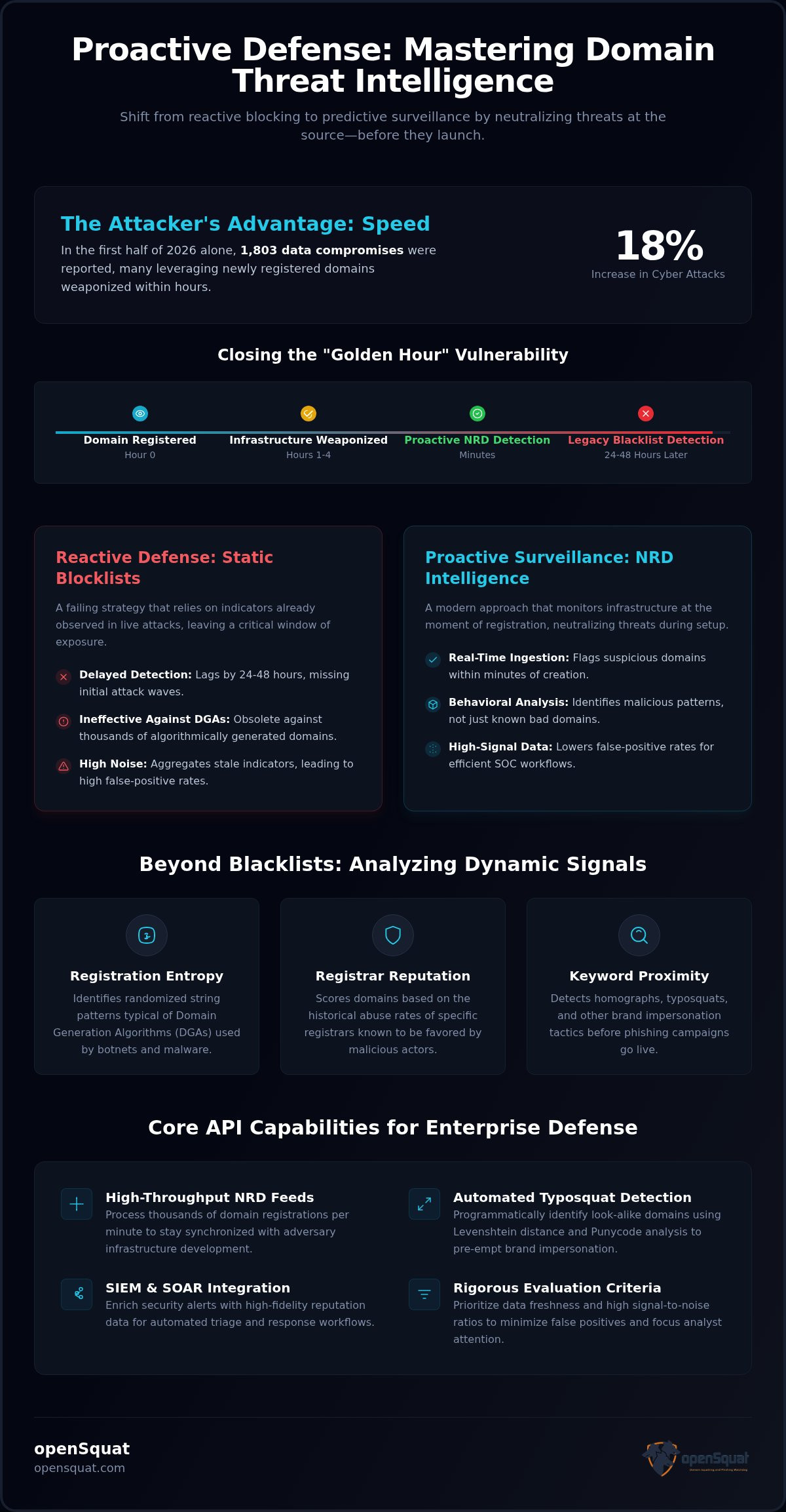
A domain threat intelligence API functions as a programmatic gateway for the systematic ingestion of real-time registration data and reputation metadata. It replaces the inefficiency of manual lookups with a high-throughput stream designed for automated analysis. In 2026, security architectures must account for an 18% increase in cyber-attacks compared to previous years. This surge is driven by automated infrastructure deployment that outpaces human-led defense. The clinical difference between generic threat feeds and specialized NRD intelligence is the signal-to-noise ratio. While generic feeds aggregate stale indicators, a specialized API focuses on the exact moment infrastructure is registered.
Bridging the Gap Between Registration and Weaponization
The "Golden Hour" is the narrow temporal window between a domain's registration and its weaponization in a live campaign. Traditional security vendors often lag by 24 to 48 hours before a malicious domain is identified and added to shared lists. This delay is a primary vulnerability that attackers exploit for maximum impact. Using a domain threat intelligence API allows your defense stack to identify these registrations before DNS activation occurs. By monitoring newly registered domain (NRD) feeds, security architects can flag suspicious patterns during the attacker's setup phase. This proactive surveillance is a core component of sophisticated Cyber Threat Intelligence (CTI) programs that prioritize early detection over reactive blocking.
Beyond Static Blocklists: The Evolution of DNS Intelligence
Static blocklists are fundamentally reactive. They rely on indicators that have already been observed in the wild; it's a losing strategy against modern tactics. Attackers now utilize domain generation algorithms (DGAs) to produce thousands of unique subdomains, rendering traditional lists obsolete. Proactive defense requires the integration of behavioral signals, such as:
- Registration Entropy: Identifying randomized string patterns typical of DGAs.
- Registrar Reputation: Scoring domains based on the historical abuse rates of specific registrars.
- Keyword Proximity: Detecting homographs or typosquatted variations of protected brand assets.
A specialized API provides these dynamic signals, enabling algorithmic scoring rather than binary blacklisting. This methodical approach ensures that your SOC can prioritize alerts based on high-signal data, effectively neutralizing threats before they reach the internal network.
Technical Capabilities of Enterprise-Grade Domain APIs
An enterprise-grade domain threat intelligence API provides the structured telemetry required for automated decision-making across the security stack. It delivers more than a simple list of names; it provides a deep look into the provenance and configuration of internet infrastructure. High-throughput ingestion is the prerequisite for modern defense. In 2026, with the global domain market exceeding 386 million registered entities, the volume of new data requires a clinical approach to filtering and analysis. This programmatic access allows security teams to move beyond manual WHOIS lookups toward a model of continuous infrastructure surveillance.
High-Throughput NRD Data Ingestion
Newly registered domain (NRD) feeds are the foundational signal for 2026 domain threat hunting. Processing thousands of registrations per minute ensures that your security stack remains synchronized with the adversary's infrastructure development. Enterprise APIs allow users to apply granular filters by TLD, registrar, or specific regex patterns before the data ever reaches the SIEM. This reduces the ingestion load and focuses analyst attention on high-risk zones. Many professionals pursuing cyber threat intelligence training emphasize that data freshness is the primary differentiator in effective surveillance. By minimizing the latency between a domain's registration and its appearance in your monitoring queue, you close the window of opportunity for attackers.
Automated Look-alike and Typosquat Detection
Adversaries frequently use subtle character substitutions to bypass human visual inspection. An effective API automates the detection of these assets using Levenshtein distance and bit-squatting algorithms programmatically. It identifies homograph attacks by analyzing Punycode representations, flagging domains that appear identical to protected brands but use non-Latin characters. This programmatic approach allows for pre-emptive detection of brand impersonation infrastructure before a single phishing email is sent. It's a methodical process of identifying infrastructure that mirrors your own, allowing for defensive staging before an attack is launched.
Metadata Enrichment and Query Flexibility
Rich metadata ingestion is critical for contextualizing a threat. The API should return comprehensive WHOIS records, DNS configurations, and SSL certificate details in a standardized JSON format. This structure ensures that parsing by SOAR platforms or custom Python scripts is seamless. Whether you're performing bulk historical lookups or consuming a real-time stream of new registrations, the output remains consistent and machine-readable. Organizations looking for this level of precision can explore commercial API access to enhance their existing monitoring capabilities. This flexibility supports both the enrichment of existing alerts and the proactive discovery of new threats through automated reconnaissance.
Core Use Cases for SOC and CTI Integration
Operationalizing a domain threat intelligence API transforms raw registration data into actionable security outcomes. In 2026, where ransomware incidents have increased by 47% year-over-year, the speed of response is the primary metric of success. Security Operations Centers (SOC) and Cyber Threat Intelligence (CTI) teams utilize this data to move beyond perimeter defense toward environmental hardening. Programmatic integration ensures that telemetry is delivered directly into the tools analysts already use, removing the friction of manual data collection.
SOAR Workflow Automation and Enrichment
Integrating domain intelligence into Security Orchestration, Automation, and Response (SOAR) platforms enables immediate triage without human intervention. When the API identifies a new registration matching a protected brand keyword, it triggers an automated playbook. This process typically involves several clinical stages:
- Ticket Enrichment: Automatically appending WHOIS data, registrar reputation, and SSL status to open cases.
- Risk Scoring: Applying programmatic weights to domains based on Levenshtein distance from core assets.
- Automated Pre-filtering: Routing high-risk domains to senior analysts while discarding low-signal noise.
This methodical approach reduces analyst fatigue by ensuring that the SOC only interacts with high-fidelity indicators. By the time an analyst opens a ticket, the domain threat intelligence API has already provided the necessary context to determine the threat's legitimacy. It's a shift from investigating every alert to managing validated risks.
Pre-emptive Phishing Campaign Discovery
Attackers often employ "sleeper" domains, which are registered months before an active campaign to build age-based reputation. API-driven surveillance identifies phishing infrastructure before the first email is sent. By monitoring for specific triggers, such as the issuance of an SSL certificate on a suspicious look-alike domain, CTI teams can anticipate the transition from a dormant to an active state. This early-warning system allows for defensive measures to be staged before the adversary initiates contact with employees or customers.
Infrastructure Mapping and Incident Response
During incident response, the ability to map connected infrastructure is vital. If a malicious domain is identified, the API allows analysts to pivot across shared attributes like registrant email hashes or name server configurations. This reconnaissance reveals the broader scope of an attacker's campaign, identifying secondary assets that haven't been weaponized yet. It's a clinical method for dismantling a threat actor's operational capacity rather than just blocking a single endpoint. Monitoring impersonation across global TLDs ensures that brand protection remains comprehensive, covering regional extensions that are often overlooked by manual surveillance.
Evaluation Criteria for Domain Threat Intelligence APIs
Selecting a domain threat intelligence API requires a rigorous assessment of technical benchmarks that directly impact security outcomes. It isn't enough to simply ingest data; the information must be actionable, timely, and machine-readable. In 2026, with the domain market reaching 386.9 million registered entities, the sheer volume of telemetry can overwhelm a SOC if the signal isn't refined. High-fidelity intelligence depends on the provider's ability to filter out background noise while maintaining a low false-positive rate. Security architects should prioritize APIs that offer clinical precision over those that merely aggregate bulk records without contextual scoring.
Benchmarking Data Freshness and Accuracy
In the context of domain surveillance, real-time must mean minutes, not hours. If a malicious registration occurs at 09:00 and your feed doesn't update until 13:00, the adversary has a four-hour window to execute their campaign. You should evaluate the latency between a domain's appearance in the global zone files and its availability via the API. Accuracy is equally critical. Test the API against known typosquatting patterns to see how effectively it identifies homographs and bit-squatting attempts. For a deeper dive into these metrics, read our evaluation of newly registered domain feeds to understand how data quality varies across the industry.
Integration Flexibility and Developer Experience
A well-designed API should feel like a natural extension of your existing stack. Evaluate the RESTful design and the robustness of the authentication mechanisms, such as API keys or OAuth2. Documentation quality is a primary indicator of a tool's maturity; clear endpoints, comprehensive SDKs, and functional code samples are mandatory for rapid deployment. Your engineering team shouldn't have to spend weeks writing custom parsers. Standardized JSON outputs ensure that data flows seamlessly into SOAR playbooks and SIEM dashboards without friction. Scalability is another non-negotiable factor. The service must handle enterprise-level request volumes during a major incident without throttling or performance degradation.
Cost-to-Signal Ratio and ROI
Evaluating the ROI of a commercial feed involves comparing it against the hidden costs of open-source alternatives. While community tools are valuable for research, they often lack the high-throughput capabilities and data enrichment required for automated enterprise defense. A specialized commercial API reduces analyst fatigue by pre-filtering records, allowing your team to focus on validated threats. This efficiency translates to faster triage and a smaller window of exposure. To ensure your organization has the necessary throughput for global monitoring, you can explore commercial API access tailored for high-volume enterprise environments. This methodical approach ensures that your investment provides the maximum defensive signal for every dollar spent.
Implementing openSquat Commercial API for Enterprise Security
Transitioning from the openSquat open-source tool to commercial API access represents a move from research-grade experimentation to production-grade surveillance. While the open-source version provides a robust foundation for identifying typosquatting, enterprise environments require the high-throughput capabilities only available through commercial channels. Integrating the domain threat intelligence API allows for the ingestion of high-signal data at a scale that community versions can't sustain. This shift ensures that your security stack isn't throttled during periods of high registration activity, maintaining the clinical efficiency required for proactive defense.
Seamless Integration into Modern Security Stacks
Deployment begins with configuring API keys and environment variables within your ingestion pipeline. Security engineers must map openSquat data fields to internal SIEM schemas to ensure that telemetry is parsed correctly. This mapping allows for consistent alerting across the enterprise, whether you're monitoring for homographs or bit-squatting attempts. It's a methodical process that ensures data integrity from ingestion to analysis. You can also learn how to utilize our brand monitoring dashboard for centralized surveillance, providing a visual layer to your programmatic data feeds.
Scaling Beyond Open-Source Limitations
Scaling requires moving from periodic polling to continuous, high-signal data feeds that provide immediate visibility into newly registered domains. The commercial tier unlocks advanced detection logic and the ability to process global data volumes without latency. The openSquat API is the logical upgrade for organizations outgrowing community-level domain monitoring. This transition allows for the customization of feeds to match specific enterprise threat models, focusing on the TLDs and keywords most relevant to your brand's footprint. It's about moving from a general tool to a specialized instrument tailored to your specific infrastructure.
Technical Support and Customization
Accessing expert technical support is a critical component of the commercial offering. For complex integration scenarios involving custom SOAR playbooks or proprietary analytics platforms, our team provides the engineering rigor needed to ensure a stable deployment. We don't just provide raw data; we help you refine the logic that drives your automated defense. This methodical approach to implementation guarantees that your domain threat intelligence API functions as a reliable instrument within your broader security architecture, providing the transparency and results your SOC requires.
Strengthening Enterprise Resilience through Programmatic Surveillance
The transition from reactive blacklisting to proactive infrastructure monitoring is no longer optional for modern security teams. By integrating a domain threat intelligence API, organizations gain the ability to identify and neutralize malicious registrations during the critical setup phase. This clinical approach to data ingestion ensures that your SOC operates with high-signal telemetry, effectively closing the window of opportunity for brand impersonation and phishing campaigns.
Implementing a methodical surveillance strategy requires a tool that balances technical precision with operational scale. openSquat has been trusted by the security community since 2020 to deliver the transparency and engineering rigor required for complex defense workflows. Whether you're automating SOAR playbooks or utilizing a specialized brand monitoring dashboard, the goal remains the same: identifying threats before they weaponize.
Take the next step in securing your digital perimeter. Integrate openSquat's Commercial API for Enterprise-Grade Domain Intelligence and gain access to high-signal newly registered domain feeds designed for high-throughput defense. Establishing a proactive posture today ensures your organization remains alert and ready for the challenges of the evolving threat landscape.
Frequently Asked Questions
What is a domain threat intelligence API?
A domain threat intelligence API is a programmatic interface providing real-time access to domain registration telemetry and reputation metadata. It allows security systems to ingest high-signal data for automated analysis and threat detection. By utilizing this API, organizations move beyond manual WHOIS lookups toward continuous infrastructure surveillance. The output is machine-readable, ensuring that your security stack processes thousands of indicators without human intervention.
How does an NRD API help prevent phishing attacks?
The API identifies malicious infrastructure during the "Golden Hour" between registration and weaponization. By monitoring newly registered domain (NRD) feeds, security teams detect suspicious registrations before the first phishing email is sent. This proactive approach identifies sleeper domains and infrastructure mirroring your brand, allowing for defensive staging. It effectively closes the window of opportunity that attackers rely on when using fresh, unlisted domains.
Can this API integrate with my existing SIEM/SOAR platform?
Yes, the domain threat intelligence API is designed for seamless integration into modern security stacks. It utilizes RESTful design principles and provides standardized JSON responses easily parsed by platforms like Splunk, Sentinel, or various SOAR tools. This integration allows for the automation of phishing reconnaissance and the enrichment of security alerts with deep contextual metadata. Analysts can configure API keys and environment variables for secure, high-throughput ingestion.
What is the difference between open-source tools and a commercial domain API?
Open-source tools like the openSquat community version are designed for research and periodic polling. In contrast, a commercial API provides the high-throughput access and enterprise-level data volumes required for production environments. Commercial access includes advanced detection logic, higher rate limits, and expert technical support for complex integration scenarios. It's the logical upgrade for organizations that have outgrown the limitations of community-level domain monitoring.
How often is the newly registered domain data updated?
Data is updated in near real-time to ensure maximum defensive signal. The API monitors global zone files and registration streams, making new domains available for analysis within minutes of their creation. This speed is critical for identifying infrastructure before it's weaponized. In 2026, where the time from registration to exploitation has shrunk significantly, maintaining this level of data freshness is essential for a proactive security posture.
Does the API support bulk lookups for historical domain data?
Yes, commercial API access supports both real-time streaming and bulk historical lookups. This flexibility allows security teams to map connected attacker infrastructure by pivoting across shared attributes like registrant email hashes or name server configurations. Historical data is vital for incident response and understanding the broader scope of a threat actor's campaign. Organizations query large datasets to identify secondary assets that haven't yet been activated in an attack.
What data formats are supported for API responses?
The API provides responses in standardized JSON and CSV formats. These machine-readable structures ensure that data flows seamlessly into existing workflows without the need for custom parsers. JSON is the preferred format for SOAR automation and custom Python scripts; CSV is often used for bulk reporting and historical analysis. Both formats include rich metadata such as WHOIS records, DNS configurations, and SSL certificate details for comprehensive enrichment.
How does the API handle typosquatting and look-alike domain detection?
The API utilizes algorithmic detection methods, including Levenshtein distance and bit-squatting analysis, to identify character substitutions. It also processes Punycode to detect homograph attacks where non-Latin characters impersonate legitimate brands. This programmatic approach identifies look-alike domains with clinical precision, flagging them for review based on their proximity to protected assets. It allows for the automated discovery of brand impersonation infrastructure across global TLDs.


